Executive Summary
Amazon Web Services (AWS) has published a security bulletin detailing CVE-2026-71215, an isolation and memory retention vulnerability within the AWS Lambda execution environment. The flaw, assigned a CVSS v3.1 base score of 8.8 (High/Critical), allowed processes operating inside custom runtime containers (provided.al2 and provided.al2023) to inspect unzeroed memory pages and recover ephemeral Security Token Service (STS) credentials assigned to previous function invocations.
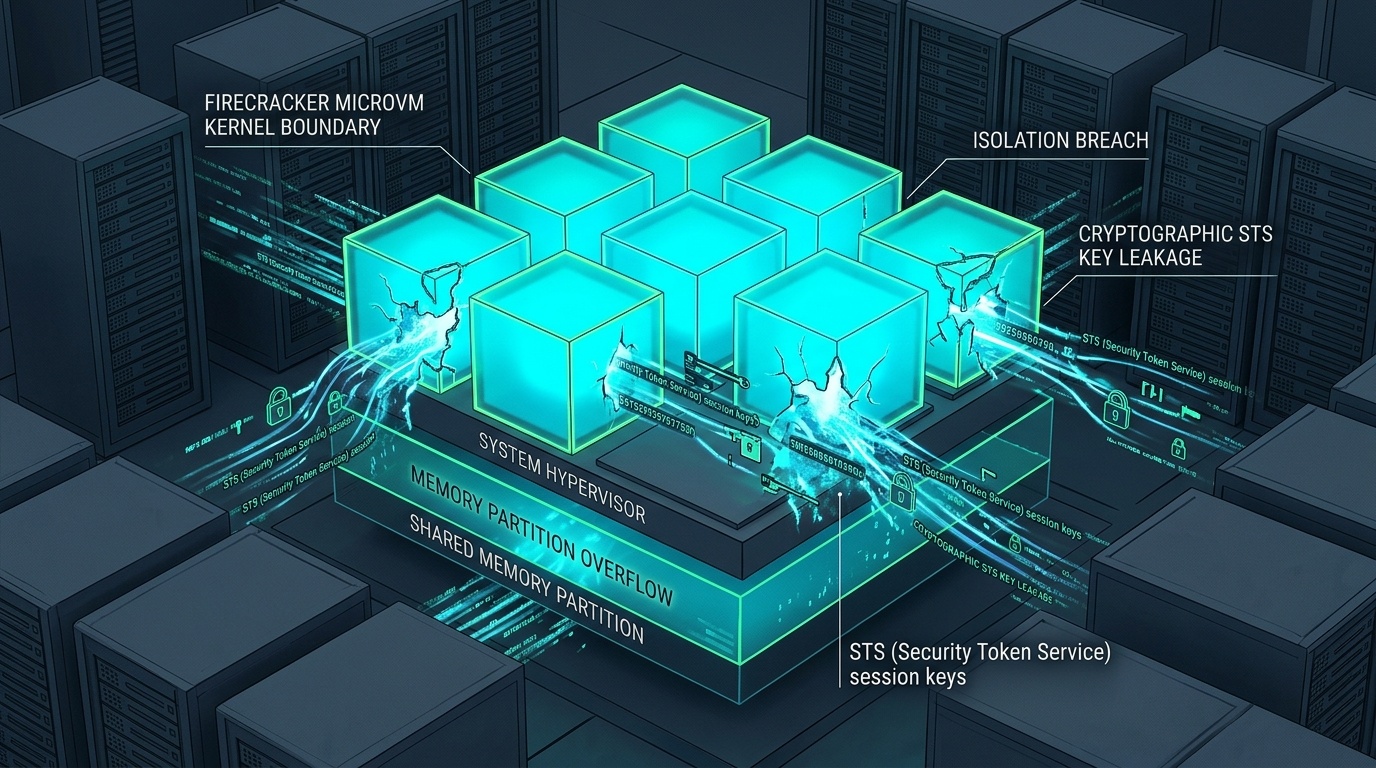
AWS Lambda utilizes the open-source Firecracker microVM hypervisor to provide hardware-virtualized isolation between tenants. While cross-tenant isolation remained fully intact, CVE-2026-71215 exposed a subtle memory reclamation gap within single-tenant warm containers where multiple invocations of the same function share execution contexts across sequential requests.
Vulnerability Mechanics: Warm MicroVM Memory Reclamation Gap
To reduce cold-start latency, the Lambda execution harness preserves initialized Firecracker microVMs across consecutive invocations. Prior to executing a new invocation, the runtime is responsible for clearing environment variables, re-provisioning ephemeral credentials from the local metadata endpoint (AWS_CONTAINER_CREDENTIALS_INITIAL_URI), and wiping process memory.
Security researchers discovered that custom runtimes leveraging specific Linux memory allocation daemons (e.g., custom jemalloc or TCMalloc wrappers) failed to trigger zero-fill on heap memory reclaimed via madvise(MADV_DONTNEED). Under heavy concurrency, pages previously containing decrypted STS session tokens remained accessible to low-privilege application code executing within subsequent requests:
// Conceptual representation of the unzeroed memory recovery vector
void *inspect_residual_pages(size_t chunk_size) {
    // Allocating large memory block without PROT_ZERO initialization
    char *buffer = (char *)malloc(chunk_size);

    // Pattern scanning unzeroed memory for AWS STS session token headers
    for (size_t i = 0; i < chunk_size - 32; i++) {
        if (memcmp(buffer + i, "ASIA", 4) == 0) { // AWS Ephemeral STS Key Prefix
            extract_sts_credentials(buffer + i);
        }
    }
    return buffer;
}
Threat Modeling & Impact Analysis
The primary attack scenario for CVE-2026-71215 occurs in multi-user applications hosted on a single Lambda function—such as a SaaS API gateway processing requests for different customer tenants under a single Lambda execution role:
- Tenant A Requests Resource: The function receives a request from Tenant A, assumes an IAM role via STS, processes the query, and terminates.
- Warm Container Reuse: The Lambda container remains warm and accepts a subsequent incoming request from Tenant B (a potentially malicious actor).
- Credential Extraction: Tenant B exploits an arbitrary memory leak or out-of-bounds read in the custom application code to recover Tenant A’s temporary STS session token.
- Privilege Escalation: With Tenant A’s STS credentials, Tenant B accesses private S3 buckets or DynamoDB records belonging to Tenant A.
Remediation & Cloud Architecture Playbook
AWS deployed hypervisor-level deterministic zeroing patches across all AWS Lambda fleets globally. No manual microVM patching or container restarts were required on customer infrastructure. However, serverless architects must adhere to established architectural isolation guidelines:
- Segregate Tenant Functions: Avoid routing requests from mutually untrusted tenants through a single shared Lambda function and execution role. Deploy dedicated functions per tenant where strict isolation is required.
- Enforce IAM Least Privilege: Restrict Lambda execution roles strictly to necessary resources, avoiding wildcard
*actions on data stores. - Session Tagging in STS: When calling
sts:AssumeRole, pass session tags (e.g.,TenantID) and enforce attribute-based access control (ABAC) in downstream IAM policies to prevent cross-tenant credential re-use. - Adopt Ephemeral Storage Encryption: Enable KMS customer managed keys (CMK) for Lambda
/tmpephemeral storage directories.