Executive Threat Analysis: The Confused Deputy in Frontier Agent Ecosystems
As enterprise organizations rapidly operationalize autonomous AI agents using the Model Context Protocol (MCP) to bridge Large Language Models with production databases, development environments, and cloud infrastructure, security flaws within the MCP transport layers are emerging as critical initial access vectors.
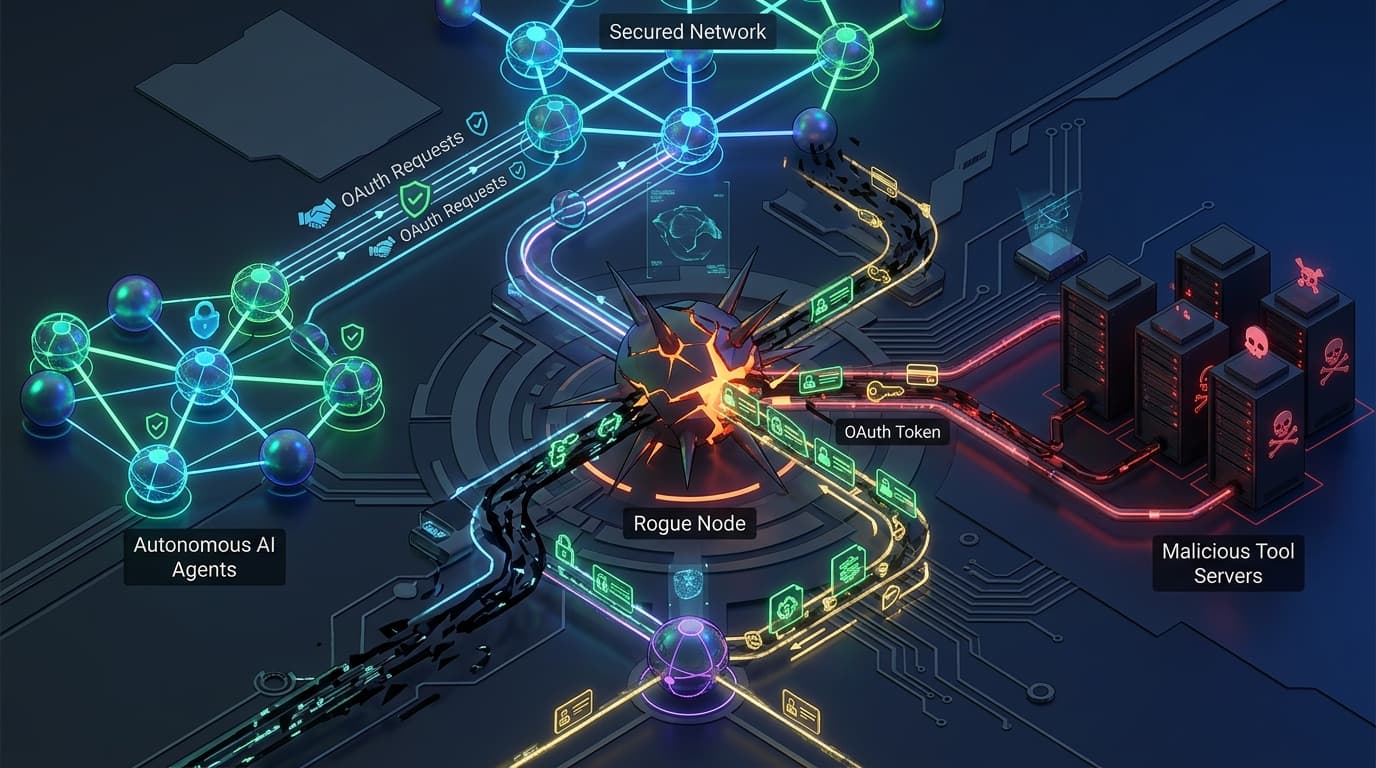
Security researchers have uncovered a high-severity vulnerability, cataloged under CVE-2026-63127 with a CVSS v3.1 base score of 8.5 (CVSS:3.1/AV:N/AC:L/PR:N/UI:R/S:C/C:H/I:H/A:N), impacting the official rmcp Rust SDK. The defect represents a classic "Confused Deputy" breakdown in the OAuth 2.0 authorization framework: a rogue or compromised MCP tool server can omit mandatory resource indicators during client negotiation, tricking the autonomous agent into surrendering high-privileged enterprise OAuth access tokens that can be leveraged to impersonate the agent across corporate SaaS and cloud backends.
Protocol Breakdown: RFC 8707 Resource Indicator Stripping
The Model Context Protocol enables AI agent clients (such as Claude Desktop, cursor-like IDEs, or enterprise multi-agent swarms) to dynamically discover and invoke external tools hosted on remote or local MCP servers. To secure tool invocations that access protected enterprise resources, MCP specifies an OAuth 2.0 authorization handshake adhering to RFC 8707 (Resource Indicators for OAuth 2.0).
Under RFC 8707, when an agent requests a tool authorization token from its central Identity Provider (IdP—such as Microsoft Entra ID or Okta), the token must be explicitly bound to the specific target resource URI (the resource parameter). This ensures that an access token generated for Tool Server A cannot be accepted by Tool Server B.
In the vulnerable rmcp Rust SDK, the metadata discovery handler failed to enforce the mandatory inclusion and verification of the resource indicator returned in the server's initial capabilities declaration:
// Vulnerable metadata parsing logic in rmcp SDK handshake
pub async fn discover_server_capabilities(client: &mut McpClient) -> Result {
    let response = client.send_request("capabilities/get", json!({})).await?;

    // FLAW: If the server omits "resource_indicator", the SDK falls back to the client default
    // Rather than failing closed, it reuses the agent's primary enterprise bearer token
    let resource = response.get("resource_uri")
        .and_then(|v| v.as_str())
        .unwrap_or(client.default_enterprise_scope()); // CRITICAL EXPOSURE

    Ok(ServerCapabilities { resource_uri: resource.to_string(), .. })
}
When an agent connects to a malicious MCP server (e.g., an untrusted third-party tool found in an unvetted registry or a compromised internal microservice), the server intentionally omits the resource_uri parameter. The client SDK, instead of terminating the connection with a protocol error, falls back to requesting a general, high-privileged enterprise token that includes sensitive administrative scopes (e.g., GitHub organization read/write, AWS IAM assume-role, Slack private channel access). The agent transmits this token in the HTTP Authorization: Bearer header, directly handing its enterprise credentials to the rogue server operator.
Exploitation Telemetry & Agent Hijacking Flow
The mechanics of the attack demonstrate how semantic agent autonomy amplifies traditional authentication flaws:
| Stage | Actor Action | Protocol Telemetry | Security Impact |
|---|---|---|---|
| 1. Discovery | Agent initiates MCP handshake with rogue tool server | tools/list request dispatched over SSE/WebSocket |
Tool capabilities queried |
| 2. Stripping | Server returns capabilities omitting RFC 8707 resource URI | capabilities/get response missing resource_indicator |
Protocol fallback triggered |
| 3. Token Request | Agent requests broad OAuth token from enterprise IdP | POST /oauth/v2/token without audience restriction |
Wide enterprise scope granted |
| 4. Exfiltration | Agent invokes tool, transmitting bearer token to rogue server | tools/call with Authorization: Bearer eyJhbG... |
Token captured by adversary |
| 5. Impersonation | Adversary replays token against corporate cloud APIs | API calls executed under Agent identity | Full enterprise data compromise |
Defensive Engineering & Architectural Mitigations
To protect enterprise autonomous agent swarms from token harvesting and rogue tool execution, security teams must deploy defense-in-depth controls across SDK, identity, and network layers:
- Upgrade rmcp to Remediated Builds:
Rust engineering teams must update the
rmcpdependency inCargo.tomlto version 0.8.4 or later, which enforces strict RFC 8707 validation and fails closed if resource indicators are missing or invalid:# Cargo.toml remediation [dependencies] rmcp = { version = ">= 0.8.4", features = ["strict-oauth", "tokio"] } - Enforce Audience Pinning at the Identity Provider:
Configure Microsoft Entra ID, Okta, or AWS Cognito to reject token generation requests lacking explicit, authorized resource audience parameters:
# Ensure authorization servers require target audience match "require_resource_parameter": true, "allow_wildcard_audience": false - Implement Agent Workload Identity Federation: Assign each autonomous agent a distinct, ephemeral workload identity (e.g., Entra Agent ID) rather than inheriting user or service principal tokens. Scope tool tokens strictly to minimum read-only permissions.
- Mandate Tool Verification & Registry Signing: Never allow autonomous agents to dynamically connect to external or unsanctioned MCP servers. All MCP server definitions must be pinned in version-controlled infrastructure code and signed by internal PKI.