Executive Summary: Centralized SD-WAN Fabric Collapse
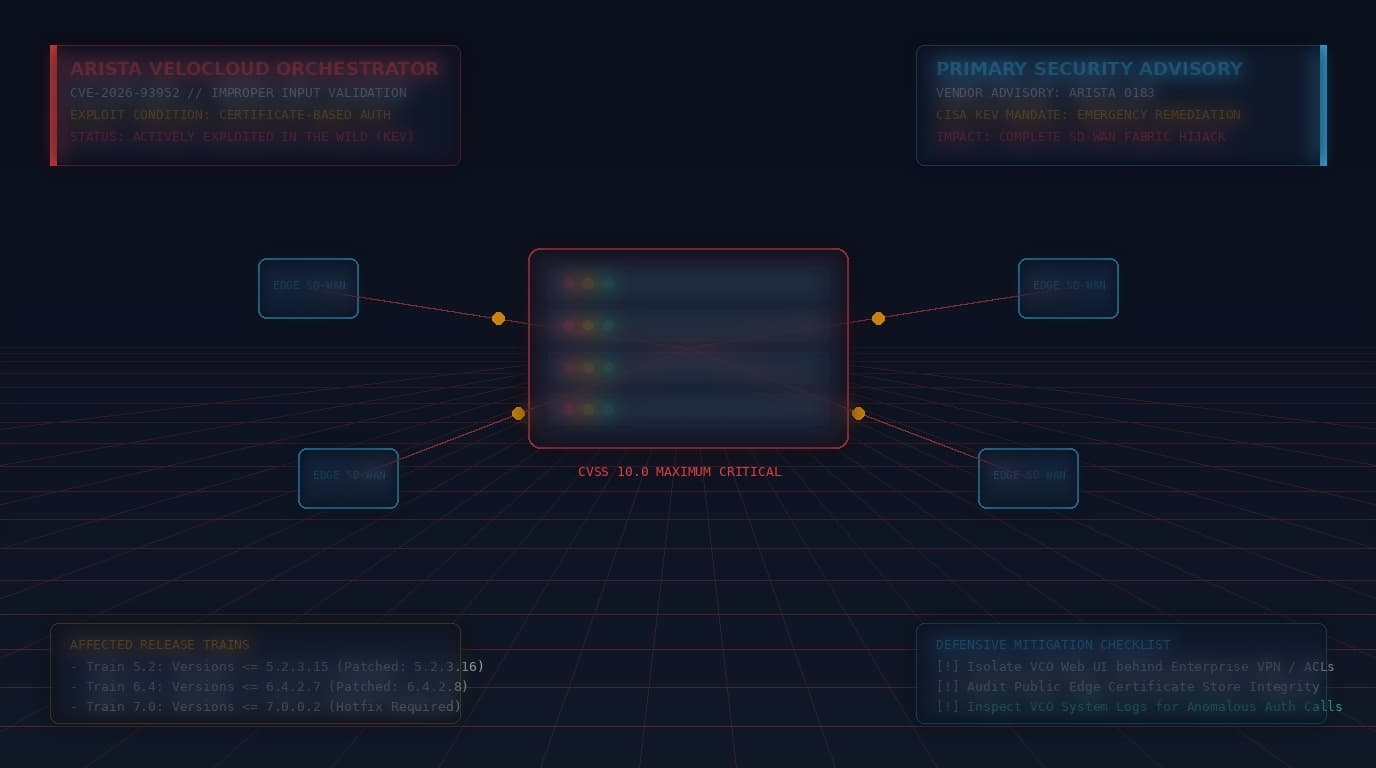
In an emergency security bulletin (Advisory 0183), Arista Networks has confirmed that sophisticated adversaries are actively exploiting a maximum-severity zero-day vulnerability tracked as CVE-2026-93952. Assigned the highest possible CVSS v3.1 base score of 10.0 Critical, the flaw affects on-premises deployments of the Arista VeloCloud Orchestrator (VCO)—the central management and policy controller that orchestrates software-defined wide area network (SD-WAN) fabrics across global enterprise enterprises, financial networks, and critical government infrastructure.
The vulnerability represents an improper input validation breakdown (CWE-20) within the orchestrator's device onboarding and heartbeat verification service. Specifically, when an on-premise VCO is configured to evaluate certificate-based authentication between branch Edge routers and the central cluster, flaws in public certificate normalization permit an unauthenticated remote adversary to forge legitimate Edge identity claims.
Because the VeloCloud Orchestrator possesses full administrative authority over all connected VeloCloud Edge appliances, successful compromise yields total control over the enterprise wide area network. Threat actors can alter BGP and OSPF routing paths, inject malicious DNS resolvers, intercept unencrypted inter-branch traffic, and push weaponized configuration scripts directly into branch office local area networks (LANs).
Technical Dissection: Certificate Parsing & Input Validation Flaw
VeloCloud SD-WAN utilizes mutual TLS (mTLS) or certificate-based verification to establish secure control plane channels between remote hardware/virtual Edges and the central Orchestrator. When an Edge reports telemetry or requests updated routing policies, it connects over HTTPS to the VCO web service (listening on ports 80/443).
Vulnerable Handshake Flow
During the certificate evaluation routine, the backend VCO authentication service parses incoming X.509 client certificates and serial parameters submitted via the Edge registration API:
POST /portal/rest/edge/authenticateCertificate HTTP/1.1
Host: vco.enterprise.local
Content-Type: application/json
User-Agent: VeloCloud-Edge-Daemon/6.4.2

{
  "edgeLogicalId": "d38a7c21-4f11-4829-9e8a-810a9c2b4e01",
  "certificatePayload": "-----BEGIN CERTIFICATE-----\nMIIFazCCA1OgAwIBAgIU...[Public Edge Certificate]...\n-----END CERTIFICATE-----",
  "authChallengeResponse": {
    "validationToken": "${INJECTED_OVERRIDE_PAYLOAD}"
  }
}
The architectural defect exists in how the VCO application processes the certificatePayload and accompanying authorization tokens. The parser validates that the certificate is cryptographically valid and signed by a trusted CA, but omits a mandatory cryptographic proof-of-possession check (e.g., verifying that the client holds the corresponding private key matching the public certificate).
Because public Edge certificates are routinely exchanged across branch provisioning emails, transmitted in plaintext TLS negotiation handshakes, or stored in readable configuration files, an attacker who acquires any public Edge certificate can present it to the VCO. The orchestrator's flawed input validation logic validates the certificate subject, bypasses authentication, and initializes an elevated administrative session with the VCO host operating system.
Active Threat Telemetry & Campaign Profile
The Cybersecurity and Infrastructure Security Agency (CISA) has formally added CVE-2026-93952 to the Known Exploited Vulnerabilities catalog. Threat intelligence telemetry indicates state-aligned espionage groups and advanced access brokers are conducting targeted network scans against internet-exposed VCO management interfaces, weaponizing the authentication bypass to deploy persistent implants and harvest inter-datacenter credentials.
Vulnerability Scope & Affected Versions Matrix
Arista confirms that while multi-tenant SaaS Hosted and Dedicated cloud environments have been secured centrally, on-premises customer-managed appliances require immediate administrative patching:
| Software Release Train | Vulnerable Version Range | Remediated Release | Remediation Priority |
|---|---|---|---|
| Release Train 5.2.x | Versions ≤ 5.2.3.15 | 5.2.3.16 | Critical / Immediate |
| Release Train 6.1.x | Versions ≤ 6.1.3.7 | Apply Hotfix Release | Critical / Immediate |
| Release Train 6.4.x | Versions ≤ 6.4.2.7 | 6.4.2.8 | Critical / Immediate |
| Release Train 7.0.x | Versions ≤ 7.0.0.2 | Apply Hotfix Release | Critical / Immediate |
Defensive Playbook & Mitigation Protocol
Network engineering and security operations teams operating on-premise VeloCloud Orchestrator clusters must execute the following remediation checklist immediately:
1. Immediate Firmware Upgrade
Obtain the verified patch build corresponding to your deployment train directly from the official Arista Support Portal (e.g., upgrade to 5.2.3.16 or 6.4.2.8) and verify the SHA-256 binary hash prior to installation.
2. Emergency Perimeter Network Isolation
The VeloCloud Orchestrator management web interface must never be exposed directly to the public internet. If internet access cannot be decommissioned immediately, enforce strict firewall access control lists (ACLs) permitting traffic only from verified static IP addresses of authorized branch Edges:
# Linux iptables firewall rules on VeloCloud Orchestrator host
# Restrict port 443/tcp access to authorized corporate branch subnets only

iptables -P INPUT DROP
iptables -A INPUT -i lo -j ACCEPT
iptables -A INPUT -m conntrack --ctstate ESTABLISHED,RELATED -j ACCEPT

# Allow Edge router VPN endpoints
iptables -A INPUT -p tcp --dport 443 -s 198.51.100.0/24 -j ACCEPT
iptables -A INPUT -p tcp --dport 443 -s 203.0.113.0/24 -j ACCEPT

# Allow Internal Administrative Bastion
iptables -A INPUT -p tcp --dport 443 -s 10.100.5.50 -j ACCEPT
3. Threat Hunting & Forensic Log Audit
Examine VCO application access logs located in /var/log/velocloud/ for anomalous authentication requests originating from unexpected IP addresses or rapid consecutive certificate evaluation failures:
# Search for suspicious authenticateCertificate calls
grep -E 'authenticateCertificate' /var/log/velocloud/portal.log | grep -v 'result=SUCCESS'

# Audit for unauthorized administrative accounts created via API
grep -E 'CREATE_USER|UPDATE_USER_ROLE' /var/log/velocloud/audit.log

# Verify running processes and listening sockets
netstat -tulpn | grep -E '443|80|8443'
ps aux | grep -vE 'velocloud|mysql|nginx|sshd'