Executive Summary & Cloud Threat Overview
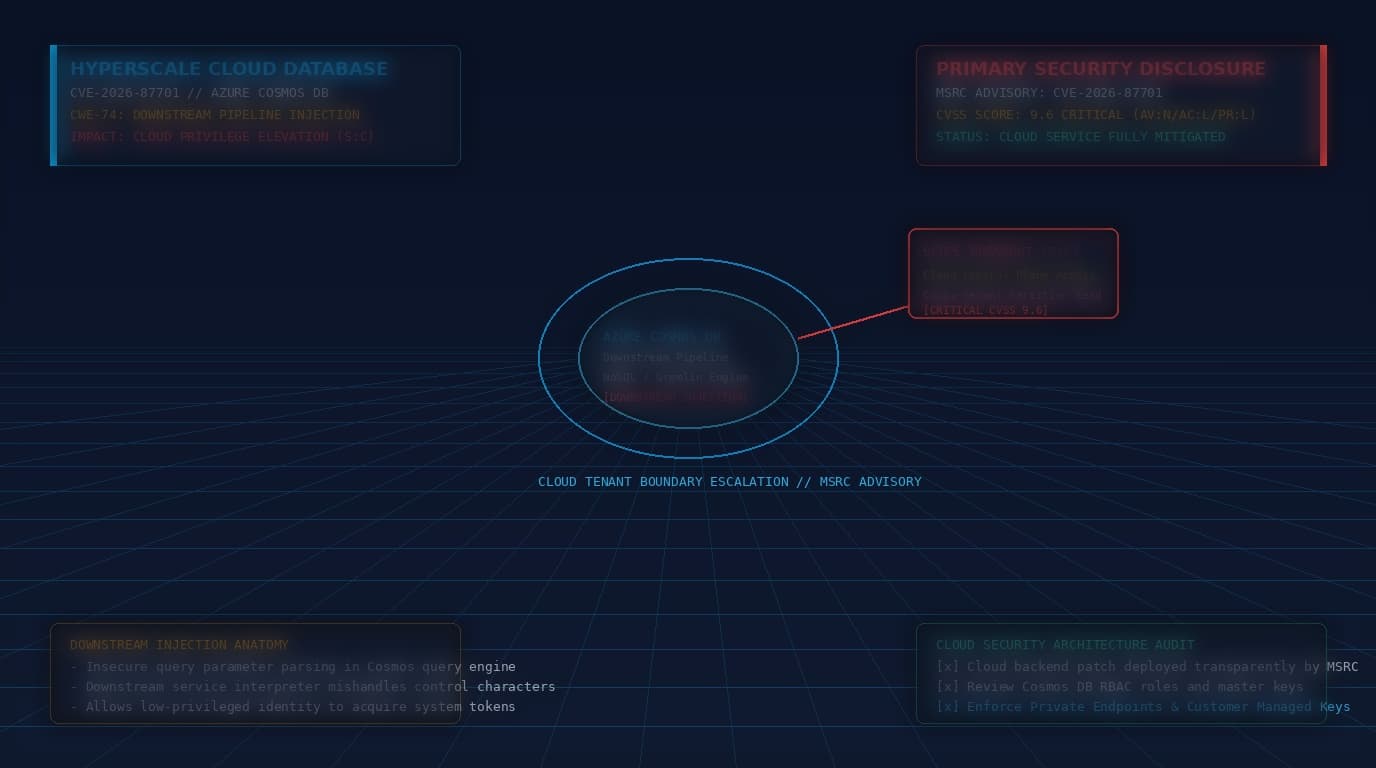
The Microsoft Security Response Center (MSRC) has published a security bulletin documenting a critical privilege escalation vulnerability in Azure Cosmos DB, Microsoft's globally distributed, multi-model NoSQL cloud database platform. Tracked as CVE-2026-87701, the vulnerability carries a near-maximum Common Vulnerability Scoring System (CVSS v3.1) base score of 9.6 (Critical) with the vector string:
CVSS:3.1/AV:N/AC:L/PR:L/UI:N/S:C/C:H/I:H/A:N
The vulnerability is classified as CWE-74: Improper Neutralization of Special Elements in Output Used by a Downstream Component (Injection). Most critically, the CVSS metric specifies Scope Changed (S:C), indicating that an attacker with legitimate low-privileged credentials to a Cosmos DB database account could bypass isolation boundaries and compromise resources beyond the initial authorization scope, including underlying control-plane management services.
Because Azure Cosmos DB operates as a fully managed Platform-as-a-Service (PaaS), Microsoft engineered and rolled out comprehensive backend mitigations across all global Azure datacenter regions prior to public disclosure. No customer patching or downtime was required, but the advisory provides vital transparency into cloud database isolation architectures.
Technical Root Cause: Downstream Query Pipeline Injection (CWE-74)
Azure Cosmos DB supports multiple data access APIs—including the native NoSQL (Core SQL) API, MongoDB API, Apache Cassandra API, Apache Gremlin (Graph), and Azure Table API. To service heterogeneous client requests uniformly across underlying physical storage partitions, Cosmos DB routes queries through an internal translation and aggregation pipeline.
The query engine parses client-submitted syntax, generates an intermediate query graph, and forwards optimized execution instructions to downstream partition management daemons running on Azure infrastructure nodes.
[Client Request: /dbs/{db}/colls/{coll}/docs]
        |
        | 1. Authenticated query with valid Low-Privilege Data Contributor role
        v
[Cosmos DB Front-End Gateway / API Parser]
        |
        | 2. Translates query into internal downstream protocol
        | 3. Insecure concatenation / missing character neutralization (CWE-74)
        v
[Internal Downstream Partition Management Component]
        |
        | 4. Interprets injected control commands
        | 5. Internal service token issued to request context
        v
[Azure Cloud Control Plane Boundary (Scope: Changed)]
        |
        +--> Attacker obtains elevated cluster-level privileges
The vulnerability originated in the internal serialization logic that transforms client-specified query parameters and system metadata into downstream RPC commands. When processing specific escape sequences and delimiter characters within complex projection filters or user-defined function (UDF) arguments, the parser failed to properly sanitize the serialized command stream.
As a result, a downstream interpreter treated attacker-controlled text as legitimate system control instructions. This allowed an attacker with low-level data read/write permissions on a single collection to inject management commands that manipulated the security context of the internal servicing process.
Scope Changed (S:C): Why Cross-Boundary Flaws Matter in Cloud Databases
In cloud security, the difference between standard privilege escalation (S:U) and scope-changed escalation (S:C) represents the fundamental boundary between single-tenant compromise and cloud multi-tenancy risk:
| CVSS Metric Dimension | Standard Escalation (Scope Unchanged) | CVE-2026-87701 (Scope Changed S:C) |
|---|---|---|
| Authorization Scope | Confined to the single database or resource collection | Breaches database sandbox into underlying host infrastructure |
| Privilege Target | Elevates from database read to database administrator | Acquires cloud infrastructure service identity tokens |
| Blast Radius | Impacts only data owned by the customer account | Potential lateral access across co-located tenant partitions |
| Customer Remediation | Customer must patch software or rotate database credentials | CSP must modify foundational cloud architecture and query compilers |
Microsoft confirmed that internal threat monitoring detected no active exploitation in the wild, and customer data integrity was preserved throughout the remediation rollout.
Enterprise Cloud Security Playbook: Hardening Azure Cosmos DB
Although Microsoft resolved the underlying engine flaw at the cloud provider layer, enterprise security architects must enforce defense-in-depth configurations across all Azure Cosmos DB instances:
1. Eliminate Shared Master Keys in Favor of Azure AD / Entra ID RBAC
Traditional Cosmos DB master keys provide unmitigated administrative access to all databases and collections within an account. Modern enterprise deployments must disable master key authentication entirely:
# Disable local primary/secondary master key authentication via Azure CLI
az cosmosdb update   --name "cosmos-enterprise-prod"   --resource-group "rg-enterprise-data"   --disable-key-based-metadata-write-access true

# Enforce Azure RBAC (Entra ID) data plane role assignments
az cosmosdb sql role assignment create   --account-name "cosmos-enterprise-prod"   --resource-group "rg-enterprise-data"   --role-definition-id "00000000-0000-0000-0000-000000000002"   --principal-id "d3b07384-d113-4f24-bc65-8b3d5b24479e"   --scope "/dbs/ProductionDB/colls/CustomerOrders"
2. Restrict Network Access to Private Endpoints Only
Ensure database instances do not expose public IP endpoints to the Internet. Utilize Azure Private Link to anchor Cosmos DB directly into virtual network (VNet) subnets:
# Disable public network access on Cosmos DB account
az cosmosdb update   --name "cosmos-enterprise-prod"   --resource-group "rg-enterprise-data"   --public-network-access "Disabled"
3. Implement Customer-Managed Keys (CMK) with Azure Key Vault
Protect data at rest using Customer-Managed Keys (CMK) backed by Azure Key Vault Hardware Security Modules (HSM). This ensures that even in hypothetical platform-level injection scenarios, encrypted data blocks cannot be decrypted without external Key Vault access policies.