Executive Summary & Frontier AI Cloud Risk
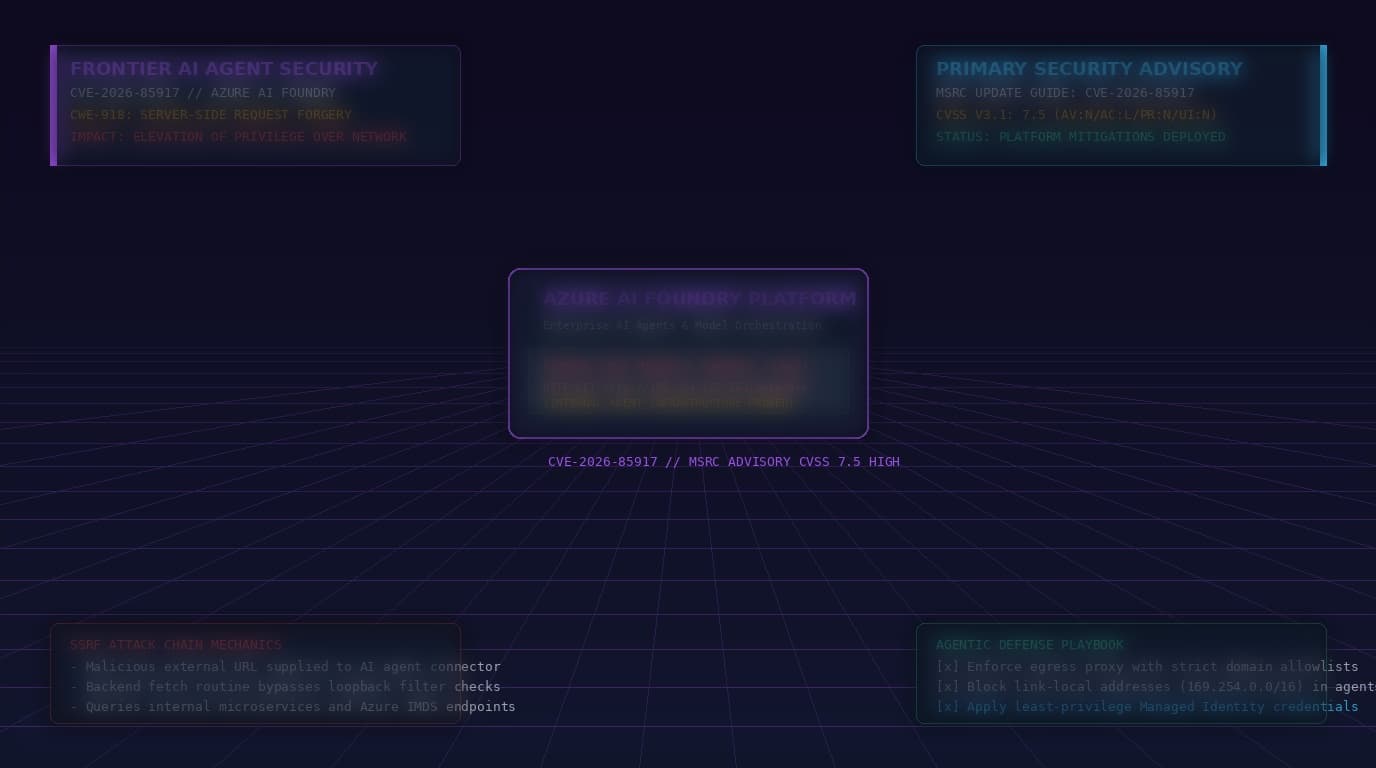
The Microsoft Security Response Center (MSRC) has disclosed a high-severity vulnerability in Azure AI Foundry, Microsoft's flagship enterprise platform for building, customizing, and governing autonomous AI agents and large language model (LLM) applications. Cataloged as CVE-2026-85917 with a CVSS v3.1 base score of 7.5 (High) (CVSS:3.1/AV:N/AC:L/PR:N/UI:N/S:U/C:H/I:N/A:N), the vulnerability is classified under CWE-918: Server-Side Request Forgery (SSRF).
The flaw allowed an unauthenticated remote adversary to coerce backend Azure AI Foundry worker processes into initiating outbound network requests to internal, non-public infrastructure endpoints. By abusing this SSRF relay, an attacker could probe internal microservice architectures, query cloud management planes, and elevate privileges over the network.
Because Azure AI Foundry operates as a fully managed hyperscale cloud service, Microsoft deployed global backend mitigations across all production datacenter regions prior to public CVE publication. The advisory provides critical architectural lessons for enterprise security teams deploying autonomous agents with dynamic tool-calling and web-retrieval capabilities.
Technical Root Cause: SSRF in AI Agent Data Grounding Connectors
Azure AI Foundry enables enterprise developers to connect foundation models (such as GPT-4o, Claude 3.5 Sonnet, and custom fine-tuned models) to corporate data stores using Retrieval-Augmented Generation (RAG) and autonomous agentic tool connectors. Agents can be configured to fetch documents from external URLs, OpenAPI webhooks, or custom REST APIs to ground model answers in real-time context.
The vulnerability resided in the backend document ingestion and URL validation component utilized during agent connector configuration and testing:
// Conceptual representation of vulnerable URL retrieval handler:
public async Task<HttpResponseMessage> FetchAgentDatasourceAsync(string targetUrl)
{
    // FLAW: Insufficient DNS resolution validation and link-local address filtering
    Uri parsedUri = new Uri(targetUrl);

    // Check only verified protocol scheme without blocking internal IP ranges
    if (parsedUri.Scheme != "http" && parsedUri.Scheme != "https")
    {
        throw new ArgumentException("Invalid URI protocol");
    }

    // Direct HTTP request dispatched from internal Azure AI Foundry worker node
    using HttpClient client = new HttpClient();
    return await client.GetAsync(parsedUri);
}
When an unauthenticated adversary submitted an agent configuration request specifying a target URL pointed toward internal IP addresses (such as http://127.0.0.1/, internal RFC 1918 subnets, or the link-local metadata address http://169.254.169.254/), the backend service failed to restrict the request.
Consequently, the internal AI worker node dispatched the HTTP GET request from inside the Azure virtual network boundary, relaying internal service responses back to the attacker.
Exploitation Scenarios: Azure IMDS and Agentic Infrastructure Probing
In cloud environments, an unauthenticated SSRF represents a high-probability bridge to privilege escalation:
[Attacker / Remote Unauthenticated User]
        |
        | 1. Submit forged URL via AI Foundry agent connector endpoint:
        |    http://169.254.169.254/metadata/identity/oauth2/token?api-version=2018-02-01&resource=https://management.azure.com/
        v
[Azure AI Foundry Ingestion Microservice]
        |
        | 2. Server-side fetch executed from inside Azure datacenter subnet
        v
[Azure Instance Metadata Service (IMDS: 169.254.169.254)]
        |
        | 3. Returns Managed Identity OAuth access token
        v
[Attacker Acquires Azure Resource Manager (ARM) Token]
        |
        +--> Elevates privileges across cloud control plane
Even where IMDS requires custom headers (such as Metadata: true), SSRF vulnerabilities can often be chained with HTTP header injection or used to map internal Kubernetes pod networks, etcd clusters, and private agent execution sandboxes.
Enterprise Architectural Lessons for Agentic AI Security
The disclosure of CVE-2026-85917 highlights a fundamental challenge in enterprise agentic AI architectures: autonomous agents must be treated as untrusted callers. Security engineering teams building internal AI platforms must enforce strict defensive controls:
1. Isolate Agent Fetch Workers in Dedicated Sandboxes
Never permit agent retrieval processes to execute within the same network namespace or virtual network as cloud management microservices. Deploy URL fetching workers into isolated, ephemeral containers with zero access to internal RFC 1918 subnets.
2. Strictly Block Link-Local Metadata (IMDS) at Network Boundary
Configure iptables, eBPF, or cloud network security groups (NSGs) to block all outbound traffic from AI agent workloads to 169.254.169.254/32:
# Example iptables rule on AI container hosts to block IMDS theft:
iptables -A OUTPUT -d 169.254.169.254 -j DROP

# For Azure Kubernetes Service (AKS), enable Azure Linux IMDS Restriction:
az aks update   --resource-group "rg-ai-enterprise"   --name "aks-ai-foundry-cluster"   --enable-node-restriction
3. Enforce Strict DNS Resolution & Egress Proxy Whitelisting
Implement forward egress proxies (such as Squid or Envoy) that resolve DNS prior to dispatching HTTP requests. If the resolved IP address falls within private IP blocks (10.0.0.0/8, 172.16.0.0/12, 192.168.0.0/16, 127.0.0.0/8, or 169.254.0.0/16), the proxy must terminate the request immediately, preventing DNS rebinding attacks.