Executive Lead: Critical RCE in Frontier AI Model Serving Core
The maintainers of the popular open-source vLLM inference and serving engine—in coordination with cloud AI security researchers—have released an urgent security update resolving a maximum-severity remote code execution vulnerability. Cataloged as CVE-2026-22778, the flaw carries a critical CVSS v3.1 base score of 9.8 (CVSS:3.1/AV:N/AC:L/PR:N/UI:N/S:U/C:H/I:H/A:H).
vLLM is widely recognized as the de facto high-performance engine for deploying open-weight large language models (LLMs) and vision-language models (VLMs)—such as Llama 3.2 Vision, Qwen2-VL, and Mistral Pixtral—across cloud hyperscalers, private GPU clusters, and enterprise AI platforms. The vulnerability enables unauthenticated remote attackers to submit specially crafted video inputs to vLLM multimodal inference endpoints, corrupt memory structures on host GPU servers, and achieve unrestricted arbitrary code execution with root privileges inside the host container or bare-metal environment.
Attack Mechanics: Chaining ASLR Information Leaks with Heap Overflows
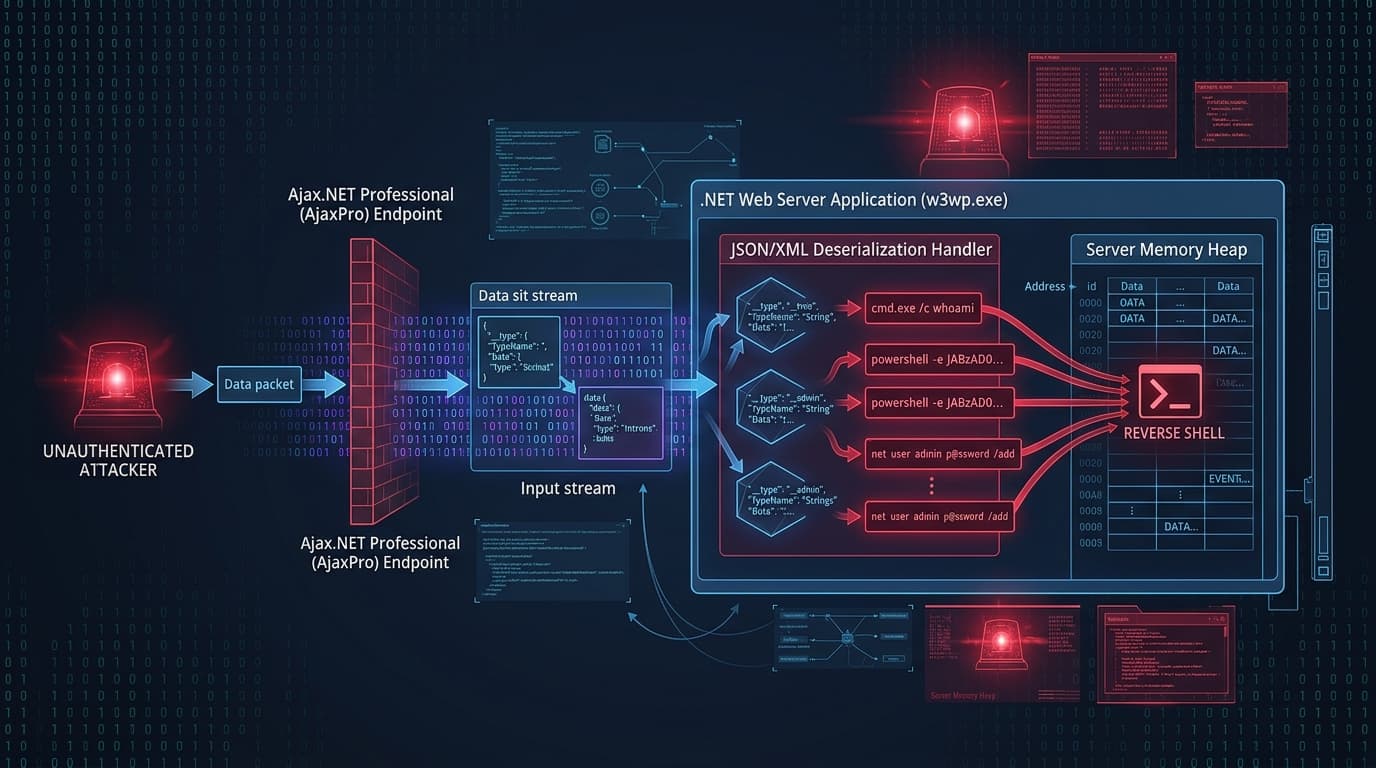
The exploitation of CVE-2026-22778 represents a sophisticated, two-stage vulnerability chain in vLLM's multimedia input ingestion pipeline:
- Multimodal Ingestion Pipeline: When a client submits an inference request containing a video URL or encoded base64 frames to the
/v1/chat/completionsendpoint, vLLM invokes auxiliary video parsing handlers (utilizing underlying PyAV, OpenCV, and FFmpeg libraries) to sample frames and transform them into tensor embeddings. - Stage 1: ASLR Leakage via Malformed Metadata: In affected versions (v0.8.3 through v0.14.0), passing an image or video with an invalid color profile or corrupted EXIF header triggers an out-of-bounds read in the image preprocessor. The parser leaks memory pointers from the Python process heap back into debug error responses, allowing the attacker to completely bypass Address Space Layout Randomization (ASLR).
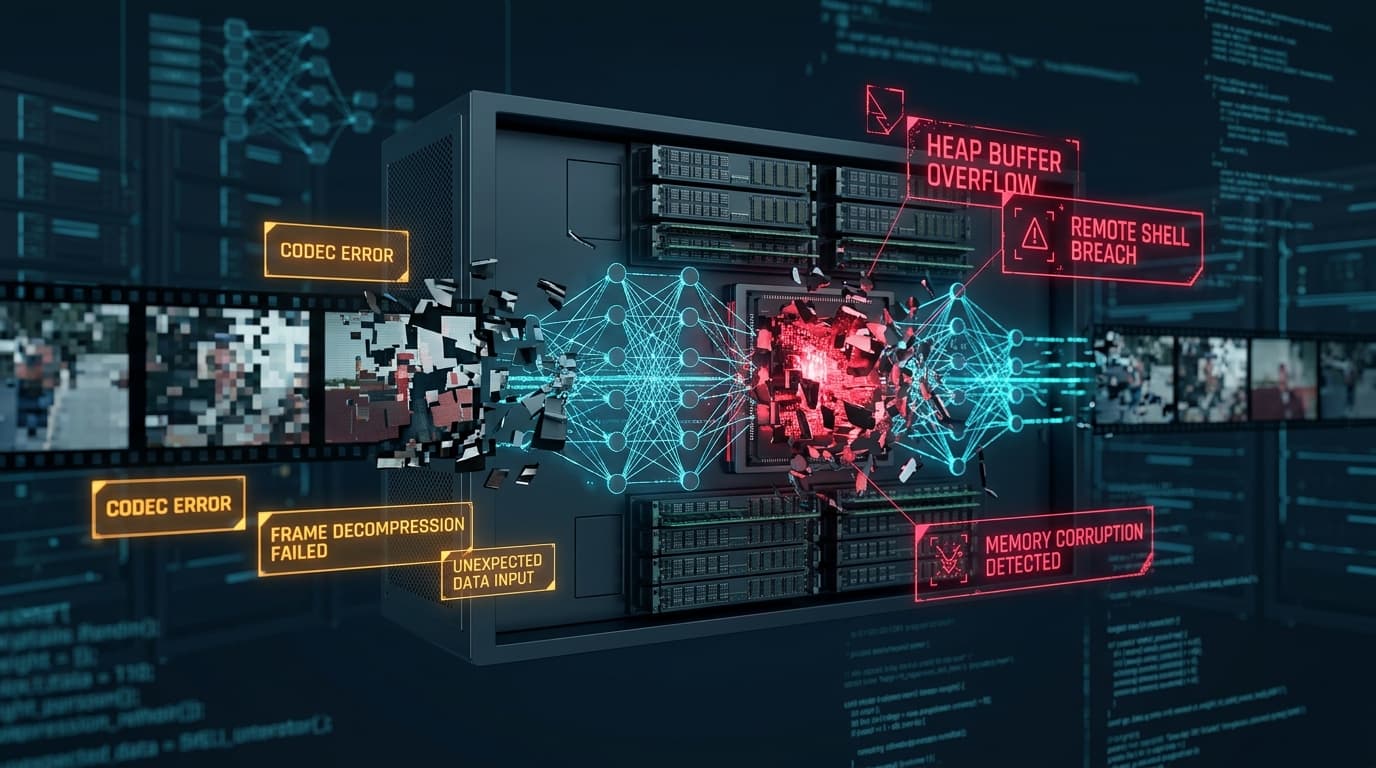
- Stage 2: Heap Buffer Overflow in Video Decoding: Armed with heap layout intelligence, the attacker delivers a video stream containing crafted, out-of-spec frame dimensions. During video frame decompression in memory, the allocation logic miscalculates buffer stride size, causing decoded pixel data to overflow the allocated heap buffer and overwrite critical Python function pointers and return addresses, yielding direct shell execution.
# Conceptual depiction of the vLLM multimodal RCE exploit vector
[Unauthenticated Remote Attacker]
       │
       ▼ (Sends HTTP POST /v1/chat/completions with crafted video payload)
[vLLM Multimodal API Gateway]
       │
       ▼ (Invokes video parsing pipeline)
[Image Preprocessor] --> (Corrupted metadata triggers heap pointer leak / ASLR bypass)
       │
       ▼ (Passes crafted frame dimensions to video decoder)
[Frame Decompression Buffer] --> (Heap Buffer Overflow overwrites memory pointers)
       │
       ▼
[Arbitrary Remote Code Execution on High-Value GPU Server]
Enterprise Threat Vector: Cloud GPU Infrastructure Takeover
Modern GPU inference servers represent the single highest-value compute assets within enterprise infrastructure:
- GPU Cluster Pivoting: Exploitation yields control over high-end NVIDIA H100, A100, or Blackwell GPU nodes. Attackers can hijack compute resources for unauthorized cryptocurrency mining, proprietary model weight extraction, or lateral movement across Kubernetes cluster networks.
- Training Data & Prompt Exfiltration: By capturing the vLLM memory space, an adversary can intercept all prompt inputs, system instructions, and completion tokens passing through the inference server in real time, exposing confidential enterprise communications and intellectual property.
- Model Weight Poisoning: An elevated attacker can tamper with loaded neural network model weights in volatile GPU memory (VRAM), subtly introducing backdoors or bias into model outputs without altering the static model weights stored on disk.
Version Comparison & Impact Matrix
| Product Name | Affected Versions | Remediation Status | CVSS v3.1 Score |
|---|---|---|---|
| vLLM Inference Engine | v0.8.3 up to v0.14.0 | Vulnerable — Upgrade immediately | CVSS:3.1/AV:N/AC:L/PR:N/UI:N/S:U/C:H/I:H/A:H (9.8) |
| vLLM Release Candidate / Fixed | v0.14.1 and newer | Patched (Buffer bounds enforced) | Remediated |
| vLLM Text-Only Deployments | Models with vision/video disabled | Mitigated if multimodal inputs disabled | Multimodal parsing uninvoked |
Defensive Playbook & Actionable Remediation Plan
Machine learning operations (MLOps) engineers and cloud security teams must execute the following remediation protocol immediately:
1. Upgrade vLLM Packages and Container Images
Update vLLM installations to version v0.14.1 or higher:
# Upgrade Python package
pip install --upgrade "vllm>=0.14.1"

# Or update Docker base image in Dockerfile
FROM vllm/vllm-openai:v0.14.1

# Deploy updated image across Kubernetes GPU node pools
kubectl set image deployment/vllm-vision vllm=vllm/vllm-openai:v0.14.1
2. Disable Multimodal URL Fetching via Configuration
If immediate patching is not possible, disable external URL resolution and restrict video processing parameters in the vLLM serving configuration:
# Launch vLLM with restricted multimodal limits
python -m vllm.entrypoints.openai.api_server     --model Qwen/Qwen2-VL-7B-Instruct     --limit-mm-per-prompt 'video=0'     --enable-auto-tool-choice false
3. Enforce Micro-VM / gVisor Sandboxing for AI Workloads
- Deploy vLLM inference pods inside user-space kernel sandboxes (such as gVisor (runsc) or Kata Containers) to prevent container escape in the event of memory corruption within video codec libraries.
- Ensure egress network filtering prevents inference pods from fetching arbitrary external URLs or establishing reverse shell connections to external IP addresses.