The Cybersecurity and Infrastructure Security Agency (CISA) has issued a binding operational directive instructing federal agencies and critical infrastructure operators to remediate CVE-2021-23758. The vulnerability affects Ajax.NET Professional (AjaxPro), an early asynchronous JavaScript and XML communication framework for Microsoft .NET Framework applications that remains embedded in legacy financial portals, enterprise HR systems, and government web applications.
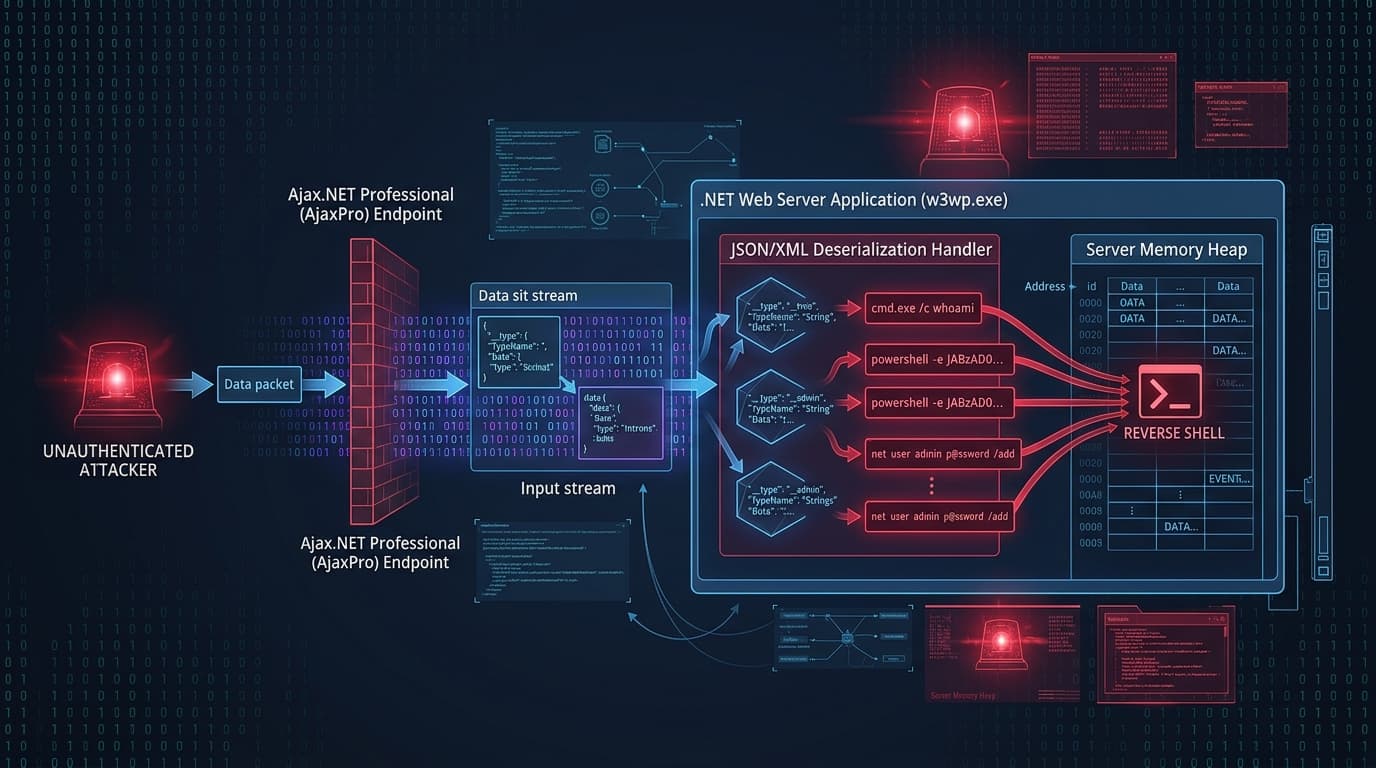
Holding a near-maximum CVSS v3.1 base score of 9.8 (CVSS:3.1/AV:N/AC:L/PR:N/UI:N/S:U/C:H/I:H/A:H), the vulnerability allows unauthenticated remote threat actors to transmit crafted HTTP POST payloads to AjaxPro handlers (such as ajaxpro/*.ashx) and execute arbitrary operating system commands under the context of the IIS application pool identity (such as IIS APPPOOL\DefaultAppPool or NT AUTHORITY\NETWORK SERVICE).
Root Cause Analysis: Insecure Type Deserialization in AjaxPro Type Handlers
The flaw is categorized under CWE-502: Deserialization of Untrusted Data. In Ajax.NET Professional, client-side JavaScript calls server-side .NET methods by serializing parameters into JSON objects:
- Unrestricted Type Declaration: The AjaxPro JSON deserializer permits requests to specify arbitrary .NET object types via type metadata fields (such as
__type). - Dangerous Class Instantiation: When the deserializer reconstructs incoming parameters into .NET objects, it fails to enforce a type allowlist. An attacker can instruct the serializer to instantiate gadget chains—such as classes in
System.Windows.Data.ObjectDataProviderorSystem.Configuration.Install.AssemblyInstaller. - Arbitrary Process Spawning: When the instantiated gadget executes during property assignment or object finalization, it invokes underlying Windows API functions (e.g.,
Process.Start), spawning interactive command shells or executing encoded PowerShell payloads.
Legacy framework vulnerabilities are particularly dangerous because organizations frequently consider these backend systems stable and overlook them during routine patch cycles. When threat actors automate exploitation across exposed .ashx endpoints, web servers are converted into initial access pivot points within minutes.
Affected Framework Releases & Remediation Status
| Component / Library | Affected Versions | Remediated Release | CISA Remediation Mandate |
|---|---|---|---|
| Ajax.NET Professional (AjaxPro.2.dll) | Versions 21.10.30.1 and prior | 21.11.2.1 or later (GitHub) | Emergency Directive Action Required |
| AjaxPro Legacy (.NET 1.1 / 2.0) | All legacy unsupported releases | Discontinue & Migrate | Discontinue Unsupported Software |
| ASP.NET Web Forms Embedded Portals | All unpatched applications | Implement WAF Filter Rules | Immediate Patch Mandate |
Detection, Audit & Defensive Playbook
Windows server administrators and application security engineers must perform the following audit steps across all IIS web hosting environments:
# Search all IIS web applications for embedded AjaxPro binaries
Get-ChildItem -Path "C:inetpubwwwroot" -Filter "AjaxPro*.dll" -Recurse

# Audit IIS web.config files for AjaxPro HTTP handler registrations
Select-String -Path "C:inetpubwwwroot*web.config" -Pattern "AjaxPro"

# Audit IIS W3C access logs for requests targeting ajaxpro handler endpoints
Select-String -Path "C:inetpublogsLogFilesW3SVC**.log" -Pattern "ajaxpro"
Recommended Enterprise Mitigation Checklist
- Update to Remediated Release or Modern Framework: Update Ajax.NET Professional to the latest community release that restricts type resolution, or transition legacy web services to ASP.NET Core Web API with modern, type-safe serializers (e.g.,
System.Text.Json). - Deploy WAF Signature Filtering: Configure web application firewalls (WAFs) to inspect HTTP POST bodies directed to
*.ashxendpoints and block requests containing__typedeclarations referencing dangerous namespaces such asSystem.Windows.DataorSystem.Diagnostics. - Isolate IIS Application Pools: Ensure all IIS application pools execute under unique managed service accounts (gMSA) with minimum file system permissions, and disable write access to application root folders.