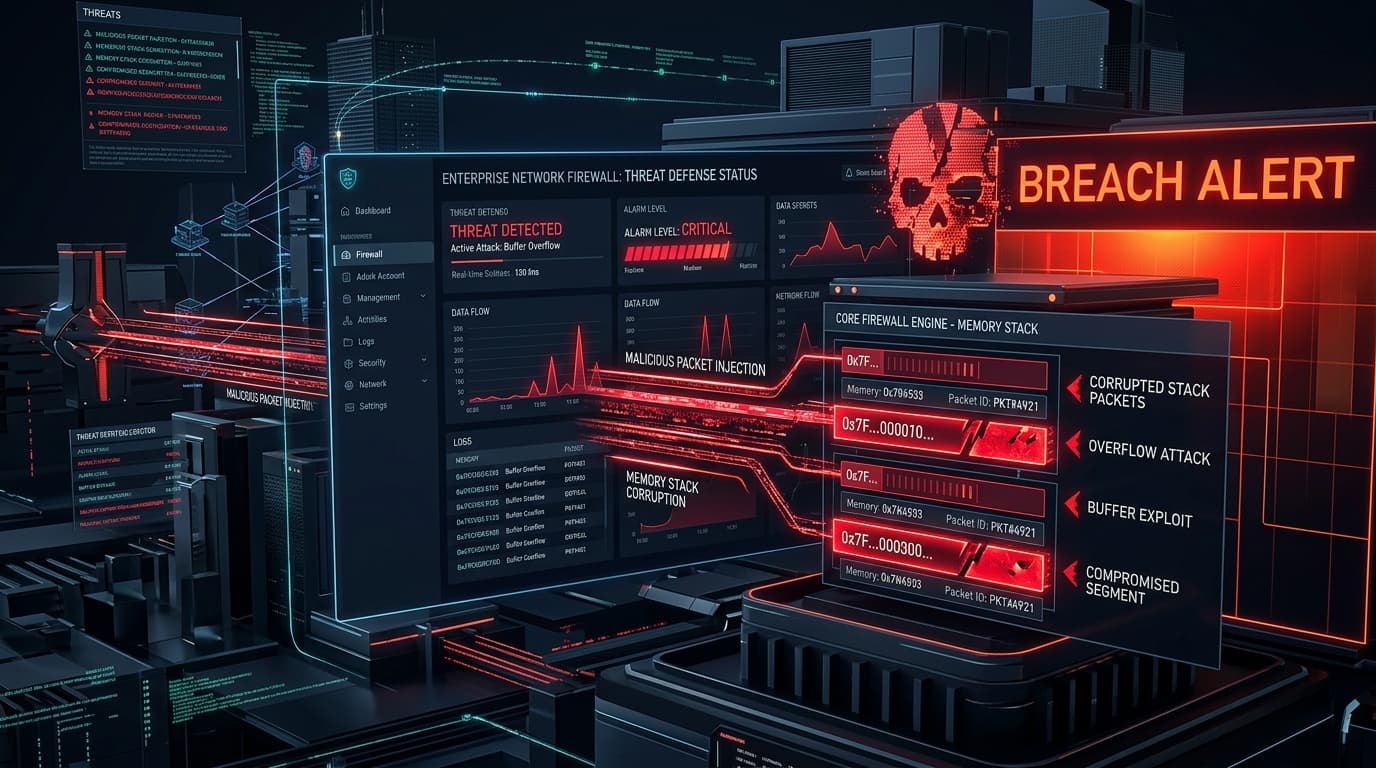
Executive Lead: Critical Pre-Authentication Buffer Overflow in Firewall Management Core
Check Point Software Technologies, in coordinated disclosure with the Indian Computer Emergency Response Team (CERT-In under advisory CIVN-2026-0465), has released urgent out-of-band software updates resolving a maximum-severity remote code execution flaw in its enterprise security management appliances. Tracked under standard identifier CVE-2026-91843, the vulnerability carries a critical CVSS v3.1 base score of 9.8 (CVSS:3.1/AV:N/AC:L/PR:N/UI:N/S:U/C:H/I:H/A:H).
The defect represents a catastrophic breakdown in the authentication perimeter of enterprise security fabrics: an unauthenticated remote adversary operating across the corporate WAN or exposed administrative ports can execute arbitrary operating system commands with full root privileges on Check Point Security Management Servers, Multi-Domain Management nodes, and centralized Log Servers. Because security management servers maintain centralized policy definitions, cryptographic keys, VPN root trust stores, and administrative credentials for thousands of distributed firewall enforcement points, compromise of this single asset grants adversaries absolute lateral control over the entire enterprise perimeter.
Vulnerability Forensics: Memory Stack Overflow in CPM Authentication Middleware
The root cause of CVE-2026-91843 lies in the C-based daemon handling pre-authentication connection requests for administrative GUI clients (SmartConsole) and API interfaces within the Check Point Management (CPM) process. Specifically, during the initial TLS handshake and user authentication negotiation on TCP port 18190 and port 19009, the daemon parses incoming client identity strings using fixed-size stack buffers:
/* Vulnerable memory allocation logic in CPM daemon authentication receiver */
#define MAX_ADMIN_USER_LEN 256

int handle_smartconsole_auth_request(int client_sock) {
    char username_buffer[MAX_ADMIN_USER_LEN];
    uint32_t payload_length = read_uint32(client_sock);

    /* FATAL FLAW: Missing length bounds check prior to memory copy */
    /* An adversary submitting payload_length > 256 overwrites the stack frame pointer and return address */
    if (payload_length > 0) {
        read_bytes(client_sock, username_buffer, payload_length);
    }

    return verify_administrator_credentials(username_buffer);
}
When an attacker transmits a maliciously crafted packet containing an oversized username string exceeding the allocated 256-byte stack frame, the incoming stream overflows the buffer boundaries. By carefully packing the payload with shellcode and overwriting the saved instruction pointer (EIP/RIP), the attacker hijacks the execution flow before any authentication or credential validation logic is executed.
Because the management daemon operates under high operating system privileges (root) on the underlying Gaia OS kernel, the injected shellcode executes immediately within the root security context without requiring local privilege escalation or container escape primitives.
Threat Actor & Lateral Movement Telemetry
Threat intelligence monitoring indicates that advanced persistent threat (APT) clusters and sophisticated initial access brokers (IABs) routinely prioritize perimeter security appliances for corporate espionage and ransomware deployment. Upon achieving root code execution via CVE-2026-91843, an adversary initiates the following post-exploitation playbook:
- Database Exfiltration: Extracting the internal Check Point policy database (
$FWDIR/conf/rulebases_5_0.fws) and administrative password hashes stored in Gaia shadow directories. - Global Rulebase Tampering: Injecting silent "Allow Any Any" pass-through firewall rules that synchronize automatically across all managed gateway clusters during scheduled policy pushes.
- VPN Certificate Harvesting: Stealing internal CA private keys used for IPsec site-to-site tunnels and Remote Access VPN client validation.
- Backdoor Persistence: Planting cron jobs and modifying SSH authorized keys in
/root/.ssh/authorized_keysto maintain persistent out-of-band access independent of the management daemon.
Comprehensive Version Remediation Matrix
The vulnerability impacts all major supported and legacy branches of Check Point Security Management and Log Servers:
| Software Branch | Vulnerable Build / Take | Remediation Package | Status & Urgency |
|---|---|---|---|
| R82.20 | Base Release prior to LivePatch | Apply R82.20 LivePatch via sk1000155 | Immediate Hotfix |
| R82.10 | Jumbo Hotfix Take 44 and earlier | Jumbo Hotfix Take 45+ or LivePatch | Critical Hotfix |
| R82 | Jumbo Hotfix Take 126 and earlier | Jumbo Hotfix Take 127+ or LivePatch | Critical Hotfix |
| R81.20 | Jumbo Hotfix Take 166 and earlier | Jumbo Hotfix Take 167+ or LivePatch | Critical Hotfix |
| R81.10 | Jumbo Hotfix Take 190 and earlier | End of Support — Upgrade Required | Urgent Migration |
| R80.x / R81 | All Takes | End of Support — Vulnerable | Immediate Decommission |
Defensive Playbook & Actionable Remediation Checklist
Security engineering and SOC teams must immediately execute the following operational containment checklist:
- Verify Automated LivePatch Deployment:
Check Point's automated LivePatch mechanism (documented under
sk175504) delivers runtime binary fixes without requiring full gateway reboots. Administrators can verify patch installation via the Gaia CLI:# Check active LivePatch status on Check Point Management Server clish -c "show livepatch" cpinfo -y all | grep -i "cve-2026-91843" - Restrict SmartConsole & CPM GUI Clients:
Ensure that management access is strictly bounded to internal out-of-band bastion jumpboxes. Never expose management ports (TCP 18190, 19009, 443) to the public internet:
# Verify trusted client IP configurations in SmartConsole # Navigate to: Security Management Server Object -> Trusted Clients # Verify setting is configured to dedicated management subnet (e.g., 10.200.50.0/24) NOT "Any" - Audit Forensic Telemetry for Exploitation Artifacts:
SOC analysts should search central syslog and SmartLog indices for the distinct buffer overflow crash telemetry string:
Any instance of this log indicates an active probe or weaponization attempt utilizing oversized username strings.# SmartLog and Gaia OS audit query event_type:CPM_AUTH "Administrator failed to log in: Username too long" - Network Ingress Filtering: Enforce microsegmentation policies dropping all traffic targeting Check Point management interfaces originating outside designated administrative VLANs.