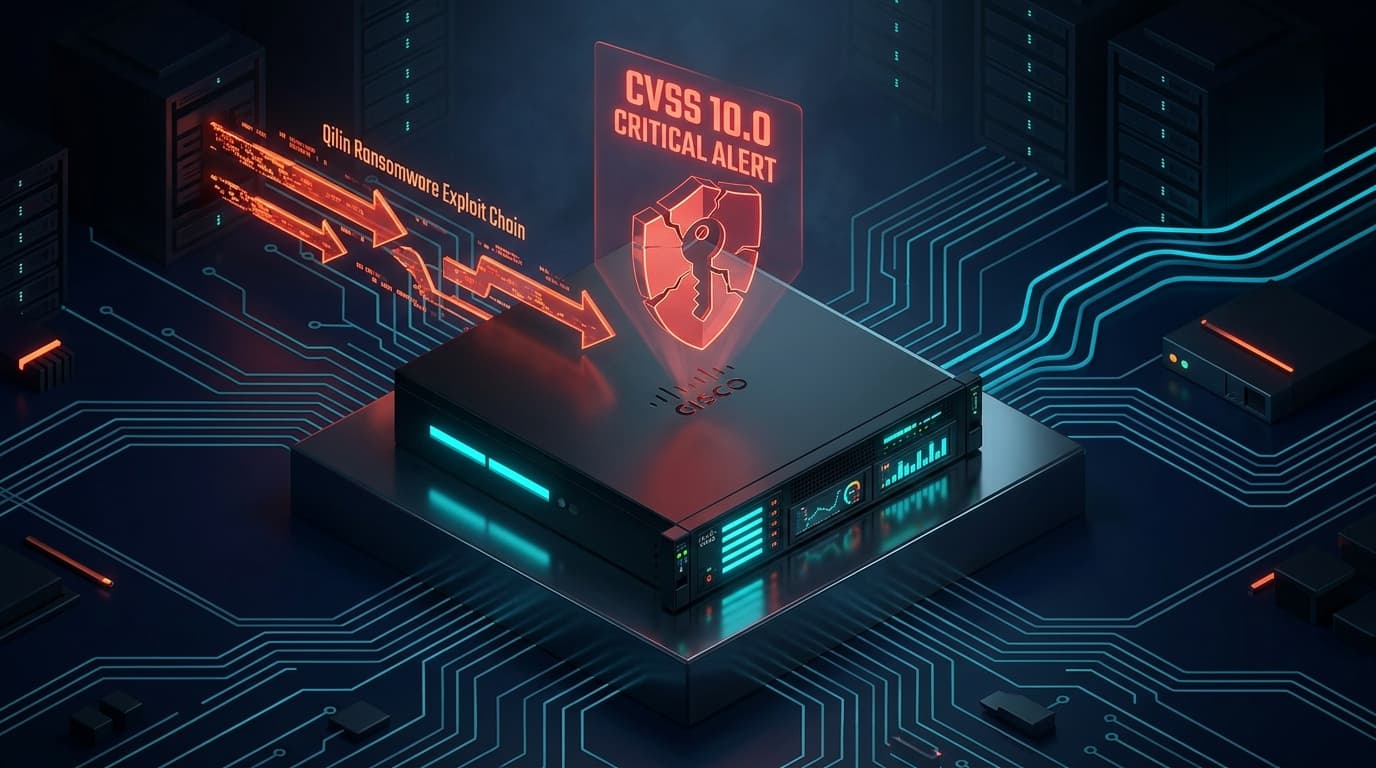
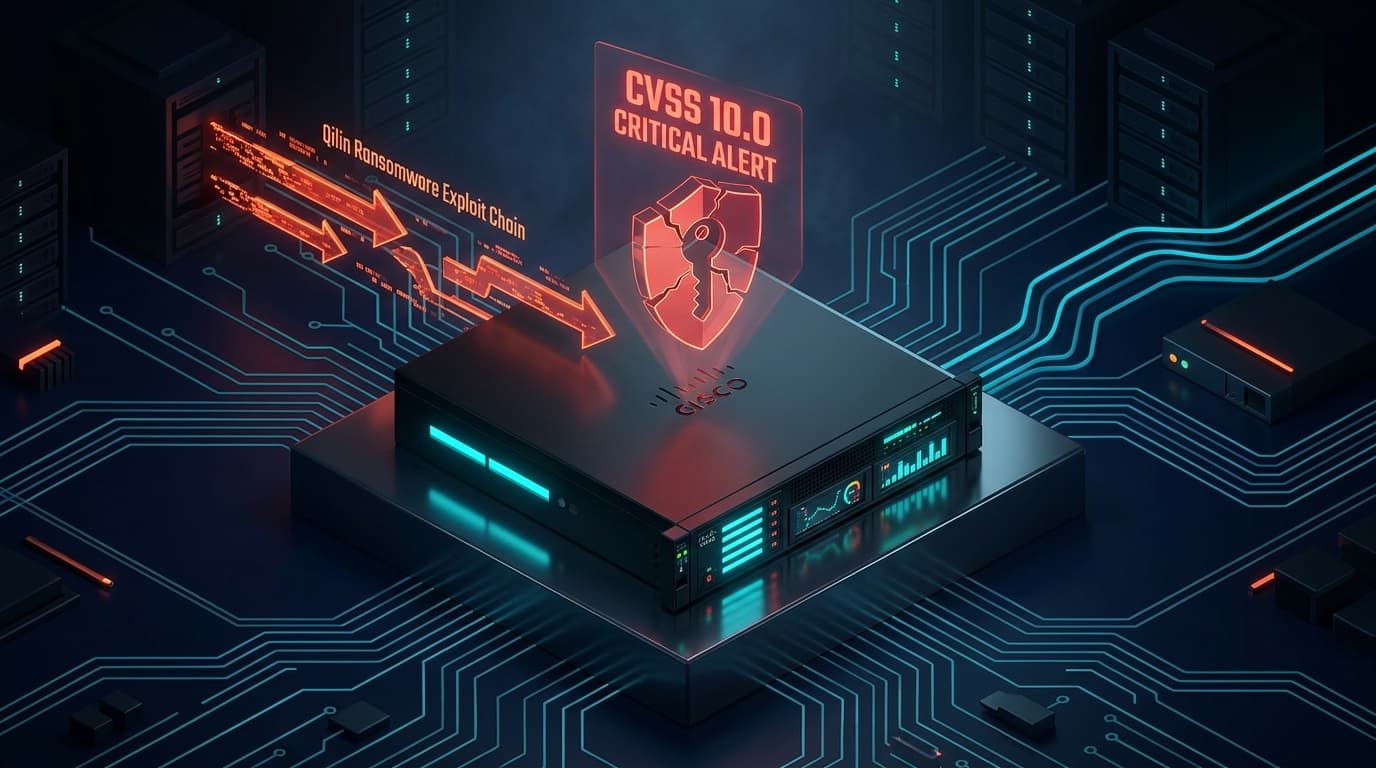
Executive Threat Advisory: Maximum-Severity Perimeter Firewall Weaponization
Enterprise networking and cybersecurity leader Cisco Systems has issued an emergency software hardening release addressing a series of critical vulnerabilities across its flagship perimeter defense line: Cisco Secure Firewall Adaptive Security Appliance (ASA) Software, Cisco Secure Firewall Threat Defense (FTD) Software, and Cisco Secure Firewall Management Center (FMC) Software.
The most severe vulnerability in the advisory (Advisory ID: cisco-sa-hardening-asaftdfmc-uvpPROhN), cataloged as CVE-2026-20329, carries an alarming CVSS v3.1 base score of 9.9 (CVSS:3.1/AV:N/AC:L/PR:N/UI:N/S:C/C:H/I:H/A:H). Crucially, Cisco PSIRT and threat intelligence partners confirmed that threat actors are actively exploiting vulnerabilities within this hardening release in targeted campaigns against corporate and government infrastructure.
Vulnerability Mechanics & Root Cause: CWE-703 Exception Breakdown
The core flaw resides within the hardware-accelerated packet inspection pipeline shared by Cisco ASA and FTD operating systems. Classed under CWE-703 (Improper Handling of Exceptional Conditions), the defect stems from how the firewall's stateful inspection engine handles malformed, highly fragmented protocol packets traversing VPN or ingress interfaces.
Under normal traffic inspection:
- The firewall receives incoming transport frames and reconstructs protocol headers within low-level kernel ring buffers.
- When a packet with non-standard option headers or deliberate protocol specification violations is processed, an internal validation handler throws an exceptional condition.
- Due to an unhandled pointer dereference during exception handling, the kernel memory state enters an inconsistent mode where critical memory regions are freed but remain referenced (use-after-free condition).
- By sending carefully timed secondary packets, an unauthenticated remote attacker can hijack the instruction pointer (
RIP), achieving arbitrary remote code execution (RCE) with highest system privileges directly on the firewall appliance.
Threat Actor Telemetry & Post-Exploitation Activity
Global incident response teams tracking in-the-wild exploitation have identified clear intrusion signatures associated with perimeter compromise:
- Persistence via Modified Bootstraps: Attackers alter internal Linux startup scripts (such as
/mnt/disk0/.private) to install stealthy user-space rootkits that survive device reboots. - In-Memory Traffic Interception: Threat actors deploy memory-resident packet capture hooks to siphon cleartext corporate VPN credentials, TLS session keys, and active user authentication cookies before traffic enters internal routing fabrics.
- Tunneling & Lateral Access: Compromised edge firewalls are leveraged as reverse SOCKS5 proxies, routing malicious Command and Control (C2) traffic directly into internal Active Directory domains while evading perimeter egress filtering.
Immediate Mitigation & Firmware Upgrade Directives
Cisco has explicitly stated that no software workarounds exist for CVE-2026-20329. Immediate firmware remediation is strictly required across all enterprise environments:
| Affected Software Line | Vulnerable Release Train | First Fixed Remediation Release |
|---|---|---|
| Cisco Secure Firewall ASA | 9.16, 9.18, 9.20, 9.22 | Upgrade to 9.18.4.22, 9.20.2.14, or 9.22.1.8 |
| Cisco Secure Firewall FTD | 7.0, 7.2, 7.4, 7.6 | Upgrade to 7.2.9, 7.4.2.1, or 7.6.1 |
| Cisco Firewall Management Center | 7.0, 7.2, 7.4, 7.6 | Upgrade FMC to match or exceed managed FTD versions |
Verification Commands for Network Engineers
Network administrators can verify their current running firmware and interface stability via the ASA CLI:
# Check active ASA software version
ciscoasa# show version | include Software Version
Cisco Adaptive Security Appliance Software Version 9.20(2)14

# Check crash dump logs for CWE-703 exception signatures
ciscoasa# show crashinfo
ciscoasa# show logging | include %ASA-1-106021