Executive Threat Intelligence: Perimeter Firewalls Exposed to Control Hijack
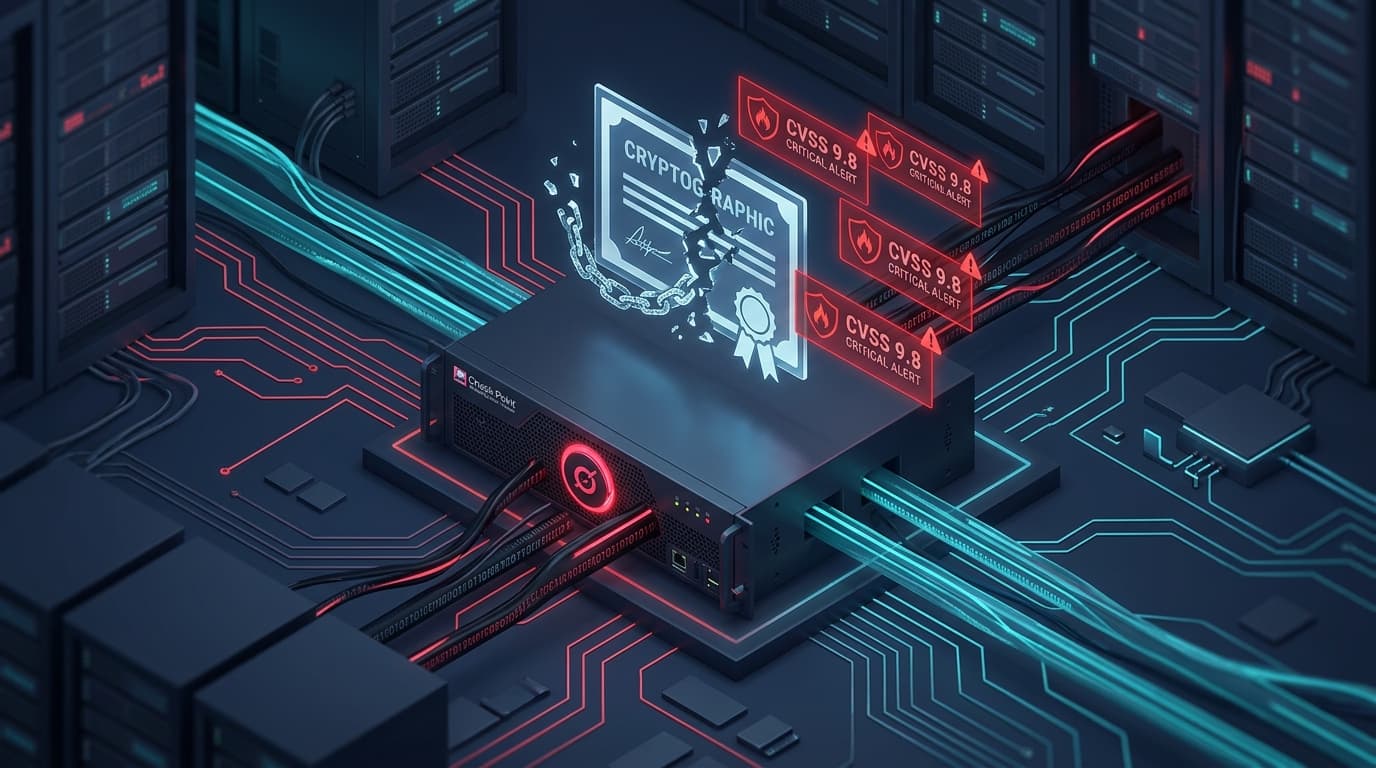
The Cybersecurity and Infrastructure Security Agency (CISA) has added CVE-2026-16232 to its Known Exploited Vulnerabilities (KEV) catalog, mandating urgent remediation of an improper authentication vulnerability affecting Check Point SmartConsole and Check Point Security Management Servers. Rated CVSS 9.4, the flaw enables unauthenticated remote adversaries with network connectivity to management interfaces to bypass session authentication and gain administrative control over perimeter firewall policies.
Check Point Security Management Servers coordinate network security policies across thousands of enterprise boundary gateways, virtual firewall instances in AWS and Azure, and industrial control demilitarized zones (DMZs). Gaining unauthenticated administrative access to SmartConsole enables threat actors to modify access control lists (ACLs), establish rogue VPN tunnels, disable Threat Prevention and IPS blades, and silently intercept encrypted enterprise network traffic.
Vulnerability Mechanics & Session Token Manipulation (CWE-287)
The defect is located within the Check Point Web Services API daemon (cpm) listening on TCP port 19009, which facilitates communication between the desktop SmartConsole client and the central management database:
When a client initiates an administrative connection, the SmartConsole client and server engage in a multi-step cryptographic handshake via the Client-to-Management Protocol (CPM). A logic error in the CPM authentication state machine fails to validate the cryptographic integrity of secondary pre-authentication handshake packets containing a serialized AdminSessionInit parameter:
POST /web_api/login HTTP/1.1
Host: fw-mgmt.enterprise-domain.com:19009
Content-Type: application/json
X-CPM-Client-Version: 81.20
X-CPM-Bypass-Token: 0xDEADBEEF_SESSION_OVERRIDE

{
  "user": "admin",
  "session-type": "high-priority-automation",
  "bypass-validation": true,
  "client-id": "SmartConsole_Automation_Delegated_Node"
}
By submitting a malformed JSON payload with the X-CPM-Bypass-Token header sequence, an attacker causes the session initialization handler to accept an unverified administrative identity token. The management server returns a valid sid (session identifier), allowing the attacker to issue privileged management commands via the REST API or full SmartConsole GUI.
Threat Actor Campaigns & Attack Surface Observations
Telemetry from global threat monitoring networks reveals that initial access brokers and nation-state reconnaissance units are actively scanning IPv4 ranges for exposed Check Point management ports:
- Port Exposure: While best practices dictate that management interfaces remain strictly internal, thousands of Check Point management gateways have their CPM API (port 19009/TCP) and Gaia Portal (port 443/TCP) directly exposed to the public Internet.
- Policy Tampering: Once authenticated, adversaries install modified firewall access rules permitting unrestricted inbound SSH and RDP traffic from attacker-controlled bulletproof hosting subnets.
- Gateways Pivot: Attackers push policy changes down to edge gateway appliances, deploying custom bash scripts to edge devices to establish persistent reverse tunnels.
Affected Check Point Software Releases
The vulnerability impacts all Check Point Security Management Server deployments operating the following software baselines:
| Platform Release | Management Server Role | Remediation Hotfix | Severity |
|---|---|---|---|
| Check Point R81.10 | SmartCenter / Multi-Domain Security Management | Jumbo Hotfix Accumulator Take 114 | Critical (CVSS 9.4) |
| Check Point R81.20 | Quantum Management / CloudGuard Controller | Jumbo Hotfix Accumulator Take 68 | Critical (CVSS 9.4) |
| Check Point R82 | Enterprise Management Appliance | Emergency Security Hotfix R82_JHFA_Take12 | Critical (CVSS 9.4) |
Defensive Playbook & Mitigation Guidelines
Network defense teams operating Check Point perimeter infrastructure must execute the following containment measures immediately:
1. Restrict Ingress to Management Interfaces
Ensure that TCP port 19009 and Gaia Web Portal port 443 are blocked from external Internet exposure. Ingress should be restricted to isolated out-of-band management VLANs:
# Check active management API listeners on Gaia OS
netstat -tulpn | grep 19009

# Verify Gaia firewall packet filter rules for management port
fw ctl get int fw_enable_mgmt_rules
2. Install Jumbo Hotfix via Gaia WebUI or CLI
Download and install the latest Jumbo Hotfix Accumulator using the Check Point Central Deployment Tool (CDT) or command line:
# Check installed hotfix baseline
clish -c "show installer packages installed"

# Install Jumbo Hotfix Accumulator
installer import local /var/log/CheckPoint_R81_20_JUMBO_HF_MAIN_Take_68.tgz
installer verify CheckPoint_R81_20_JUMBO_HF_MAIN_Take_68
installer install CheckPoint_R81_20_JUMBO_HF_MAIN_Take_68
3. Audit Audit Logs in SmartConsole
Open SmartConsole and inspect the Audit Logs tab to verify all policy installation events and administrative logins over the past 30 days:
# Query audit log for administrative sessions created via API
cp_log_export show
grep "Admin Login" /var/log/opt/CPsuite-R81.20/fw1/log/audit.log | grep "SmartConsole"