Executive Lead: Substation Remote Parameterization Paralysis
Siemens ProductCERT—in coordination with the Cybersecurity and Infrastructure Security Agency (CISA) ICS-CERT team—has issued security advisory SSA-246443 disclosing a high-severity denial-of-service vulnerability in its SICAM 8 family of industrial automation and remote terminal units (RTUs). Cataloged under universal identifier CVE-2026-27663, the defect carries a CVSS v4.0 base score of 7.1 (CVSS:4.0/AV:N/AC:L/AT:N/PR:N/UI:N/VC:N/VI:N/VA:H/SC:N/SI:N/SA:N) and a CVSS v3.1 score of 6.5.
The SICAM 8 platform (comprising the SICAM A8000, SICAM EGS, and SICAM S8000 series) forms the backbone of modern electrical substation automation, smart grid distribution networks, and renewable energy collection systems. Deployed across transmission and distribution substations, these RTUs translate supervisory SCADA commands into electrical switchgear operations, monitor telemetry via IEC 60870-5-104 and IEC 61850 protocols, and orchestrate grid stability. The vulnerability allows an unauthenticated network adversary to transmit high-volume crafted packet streams that exhaust device memory and processing cycles, completely incapacitating remote parameterization and freezing remote control over substation assets until a technician physically reboots the device.
Attack Mechanics: Remote Operation Mode Memory & CPU Starvation
The vulnerability occurs within the remote parameterization service managed by the CPCI85 (Central Processing/Communication) and RTUM85 (RTU Base) firmware modules:
- Stateful Parameterization Handshakes: SICAM 8 devices provide a remote parameterization interface allowing utility engineers to push configuration updates, adjust electrical protection settings, and alter communication routes remotely via engineering workstations over TCP/IP.
- Unbounded Request Queueing: In firmware versions prior to V26.10, the remote operation listener allocates dedicated memory buffers for incoming parameterization sessions without enforcing strict connection throttling, request queue caps, or session timeout limits.
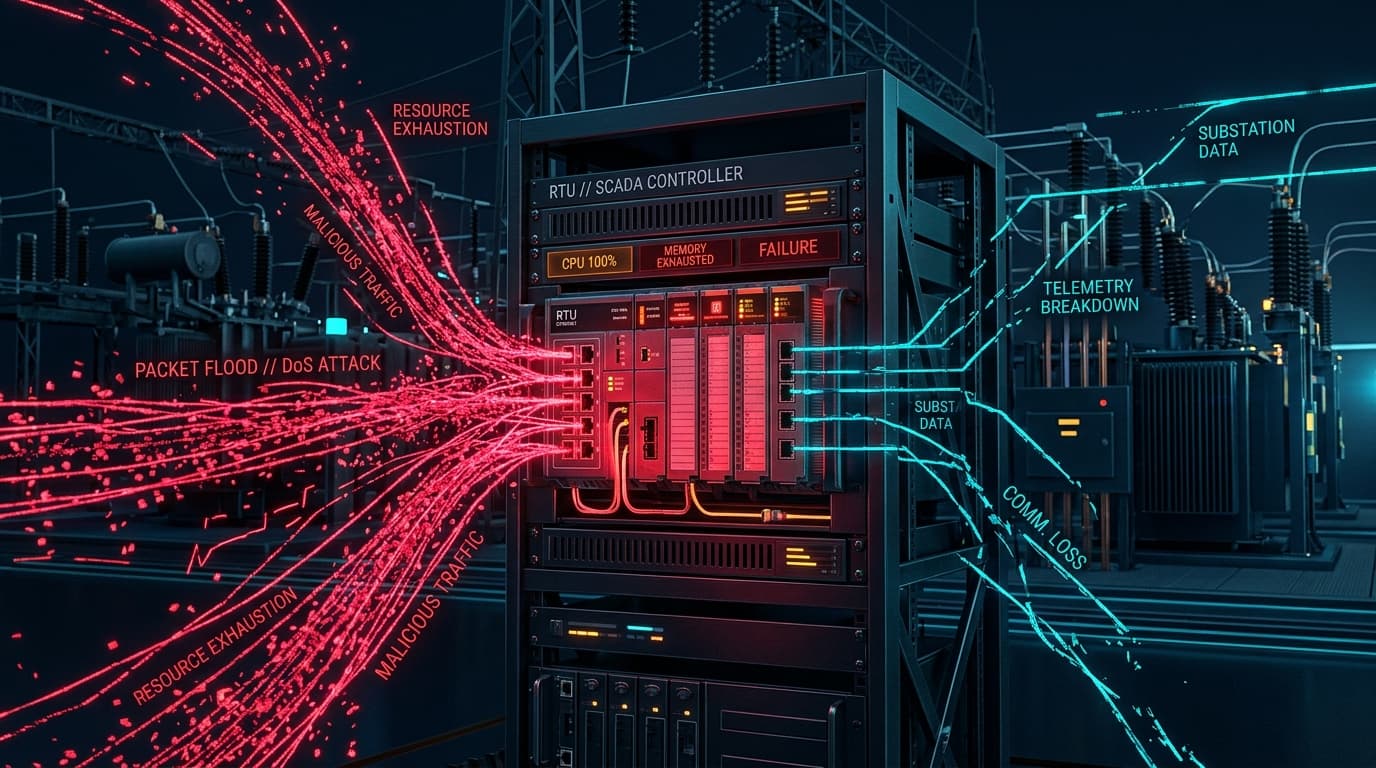
- Service Starvation & Lockup: An adversary who floods the target port with rapid, malformed parameterization requests quickly exhausts the RTU's internal non-paged memory pool and maxes out the real-time processing cores. The remote parameterization daemon enters a non-responsive deadlock state. Crucially, once exhausted, the service cannot recover automatically even after the packet flood terminates, remaining permanently disabled until an operator executes a manual service reset via local serial connection or performs a physical power-cycle of the RTU chassis.
# Packet flow of the SICAM 8 resource exhaustion DoS vector
[Adversary on Substation WAN / OT Network]
        │
        ▼ (Floods crafted parameterization requests over TCP)
[Siemens SICAM 8 RTU (CP-8031 / CP-8050)]
        │
        ▼ (CPCI85 / RTUM85 allocates unthrottled memory buffers)
[System Resource Starvation: Memory Pool Exhausted, CPU at 100%]
        │
        ▼
[Parameterization Service Deadlock: Remote Configuration Frozen]
[Permanent Outage Until Physical Substation Power Cycle]
Critical Infrastructure Threat Profile: Grid Blindness & Operational Paralysis
Within the context of electric utility operations, a permanent denial of service on substation RTUs introduces substantial operational vulnerabilities:
- Grid Blindness During Fault Conditions: While the primary protection relays may continue executing hardcoded logic locally, supervisory control centers (Control Centers / EMS) lose the ability to dynamically reconfigure feeder lines or isolate faulted segments during grid fluctuations or storm emergencies.
- Coordinated Attack Amplification: Threat actors targeting bulk electric systems frequently combine cyber disruptions with physical incidents. By freezing remote parameterization on substation RTUs, attackers prevent grid operators from re-routing electrical power around compromised substations.
- Truck-Roll Operational Burden: Because the deadlock requires manual intervention to clear, restoring remote control across dozens of rural or offshore substations requires dispatching physical field crews, causing hours or days of delayed grid maintenance.
Version Comparison & Firmware Remediation Matrix
| Firmware Module | Associated Hardware Series | Vulnerable Builds | Patched Version |
|---|---|---|---|
| CPCI85 Central Processing/Comm | SICAM A8000 (CP-8031, CP-8050), SICAM EGS | All versions < V26.10 | Upgrade to V26.10 or newer |
| RTUM85 RTU Base Firmware | SICAM A8000 (CP-8010, CP-8012), SICAM S8000 | All versions < V26.10 | Upgrade to V26.10 or newer |
Defensive Playbook & Actionable Remediation Checklist
Power grid engineers and operational technology defense teams should implement the following hardening measures:
1. Upgrade Firmware to Version V26.10 or Newer
Download the official Siemens firmware update packages from the Siemens Industry Online Support (SIOS) portal and schedule coordinated firmware flashing during planned maintenance windows:
# Verify current SICAM CPCI85 / RTUM85 firmware via SICAM Device Manager
sicam-tool --target 10.20.30.15 --get-firmware-version

# Deploy update image V26.10
sicam-tool --target 10.20.30.15 --flash-firmware CPCI85_V26.10.bin
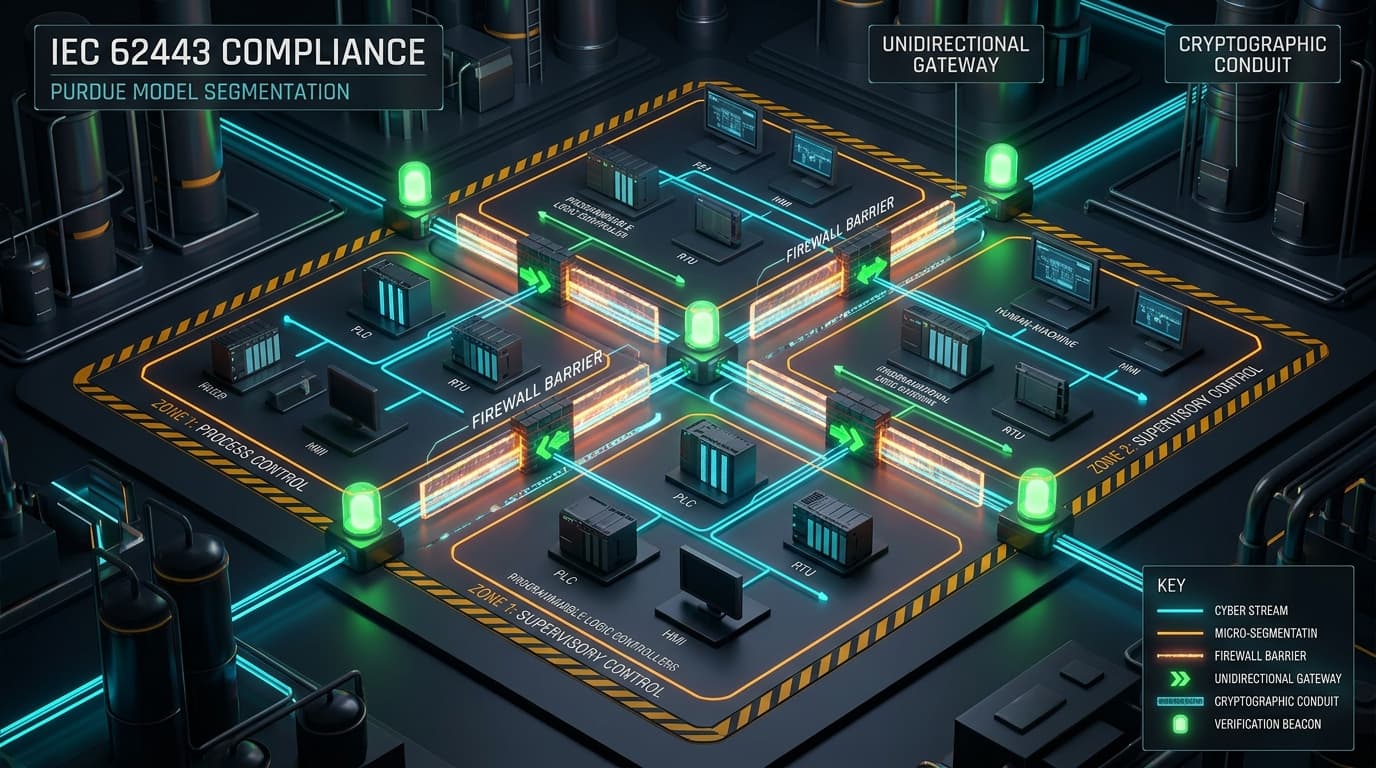
2. Enforce Substation Zone Segmentation (IEC 62443-3-2)
- Isolate Substation LANs: Ensure SICAM 8 devices reside in dedicated Purdue Level 1/2 substation automation zones protected by industrial boundary firewalls.
- Deploy Hardware Rate Limiting: Configure substation network switches (e.g., Siemens RUGGEDCOM or Cisco IE series) with ingress rate limiting on RTU management ports to drop anomalous packet bursts.
- Restrict Remote Management Traffic: Implement strict Access Control Lists (ACLs) permitting remote parameterization traffic exclusively from designated engineering workstations on the Substation DMZ.