Executive Summary: Cyber-Physical Kinematics in Smart Manufacturing
Siemens ProductCERT, in coordination with the Cybersecurity and Infrastructure Security Agency (CISA), has issued a high-severity Industrial Control Systems (ICS) security advisory (SSA-562721 / ICSA-26-265-02) addressing critical vulnerabilities in Siemens SIMOVE Fleetmanager and the SIPLANT factory automation suite.
SIMOVE Fleetmanager is an industrial supervisory software platform deployed in smart factories, aerospace manufacturing facilities, and automotive assembly plants worldwide. It coordinates automated guided vehicles (AGVs) and autonomous mobile robots (AMRs) transporting heavy engine blocks, chassis frames, and dangerous chemical components across factory floors. Tracked as CVE-2026-48921 with a CVSS v3.1 base score of 9.8 Critical, the defect allows an unauthenticated adversary on the industrial network to manipulate AGV route dispatchers, override velocity envelopes, and forge navigation commands.
Vulnerability Mechanics & Root Cause: CWE-287 in AGV Telemetry Dispatcher
The vulnerability resides in the core communication service of SIMOVE Fleetmanager responsible for transmitting path segments, battery charging schedules, and intersection turn reservations down to individual mobile robots over industrial Wi-Fi (5 GHz / 802.11ax):
- Missing Mutual Authentication on Dispatch Port: The fleet management service listens on TCP port 49152 for AGV client heartbeats. The protocol lacked cryptographic mutual authentication, assuming that any client possessing physical layer network connectivity belonged to an authorized AGV onboard controller.
- Cleartext Command Injection: Path allocation packets are formatted as unencrypted binary structs containing coordinate vectors (
X, Y, Theta) and maximum allowed linear velocities. An attacker transmitting forged navigation commands can overwrite active waypoint queues. - Denial of Physical Process: When an AGV receives conflicting trajectory instructions from both the legitimate fleet server and an attacker-injected packet, the onboard Safety Programmable Logic Controller (Safety PLC) triggers an emergency category 0 stop (immediate power removal to drive motors), halting assembly line throughput indefinitely.
Kinetic Safety Impact & Industrial Automation Architecture
In modern manufacturing plants adhering to the Purdue Model, SIMOVE Fleetmanager resides at Level 2 (Supervisory Control), communicating with Level 1 SIMATIC S7-1500 controllers mounted inside mobile vehicles:
| Attack Vector | Attacker Action | Kinetic & Process Impact |
|---|---|---|
| Intersection Deadlock | Injecting false reservation locks on transit intersections | Total traffic gridlock across automated warehouse logistics lines |
| Safety Buffer Override | Manipulating LiDAR safety field zone parameters | Vehicles fail to decelerate near human worker pedestrian crossings |
| Battery Depletion Attack | Redirecting AGVs away from automated inductive charging pads | Robots become stranded across assembly lines, requiring manual crane extraction |
Remediation Playbook for Plant Operations & OT Engineers
- Upgrade SIMOVE Fleetmanager to Patched Release: Download and apply SIMOVE Fleetmanager V3.2 HF1 or newer from the Siemens Industry Online Support (SIOS) portal. The update implements TLS 1.3 mutual authentication for all inter-AGV dispatch communications.
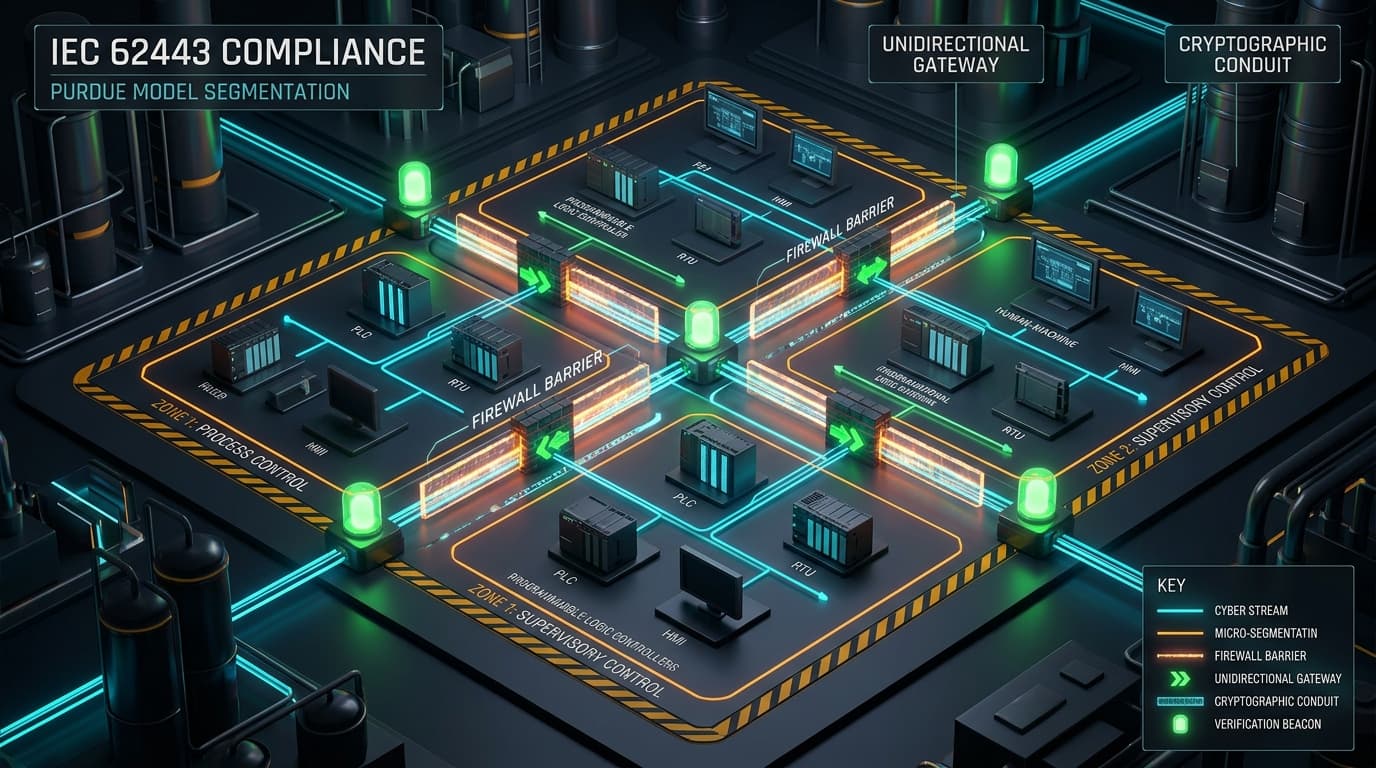
- Isolate AGV Wireless Networks (IEC 62443 Zones):
Isolate the automated vehicle Wi-Fi SSID from general plant IT networks. Mandate 802.1X EAP-TLS authentication with client certificates burned into the AGV's hardware Trusted Platform Module (TPM):
# Industrial Firewall Rule: Restrict SIMOVE Dispatch port exclusively to AGV subnet iptables -A FORWARD -p tcp --dport 49152 -s 10.150.10.0/24 -d 10.150.2.10 -j ACCEPT iptables -A FORWARD -p tcp --dport 49152 -j DROP - Deploy Industrial Anomaly Detection: Ingest wireless access point NetFlow telemetry into an OT intrusion detection system (such as Nozomi Networks or Claroty) configured to baseline AGV trajectory message rates.