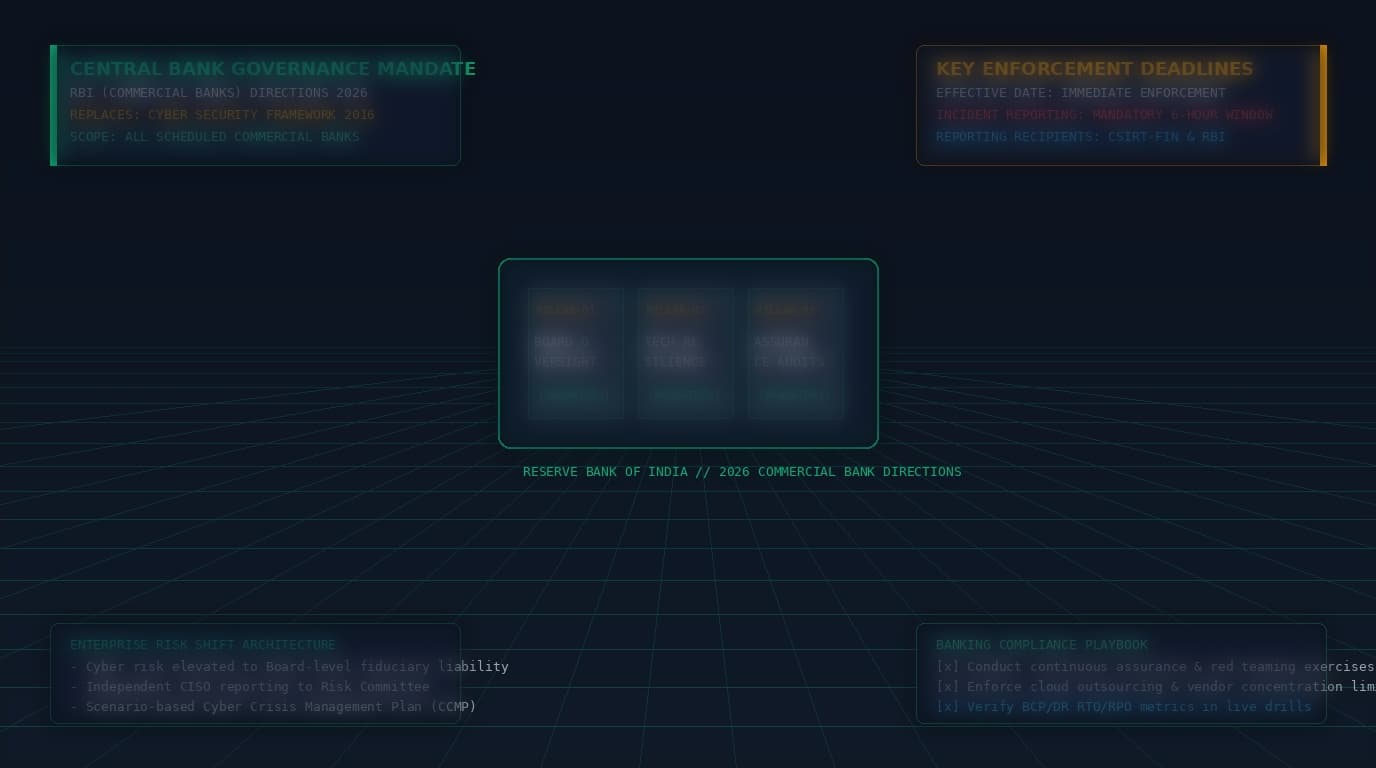
Executive Summary: India Digital Governance Enters Strict Enforcement
The regulatory landscape governing digital privacy and enterprise data security in India has crossed a decisive threshold. Following parliamentary enactment of the Digital Personal Data Protection Act, 2023 (DPDP Act), the Ministry of Electronics and Information Technology (MeitY) has officially operationalized the comprehensive DPDP Rules 2026.
The rollout establishes the operational mechanisms, summons powers, and digital inquiry workflows of the Data Protection Board of India (DPBI). For domestic banks, fintech conglomerates, SaaS providers, e-commerce platforms, and multinational enterprises operating within India, the rules activate enforceable obligations under Section 10 for entities designated as Significant Data Fiduciaries (SDFs).
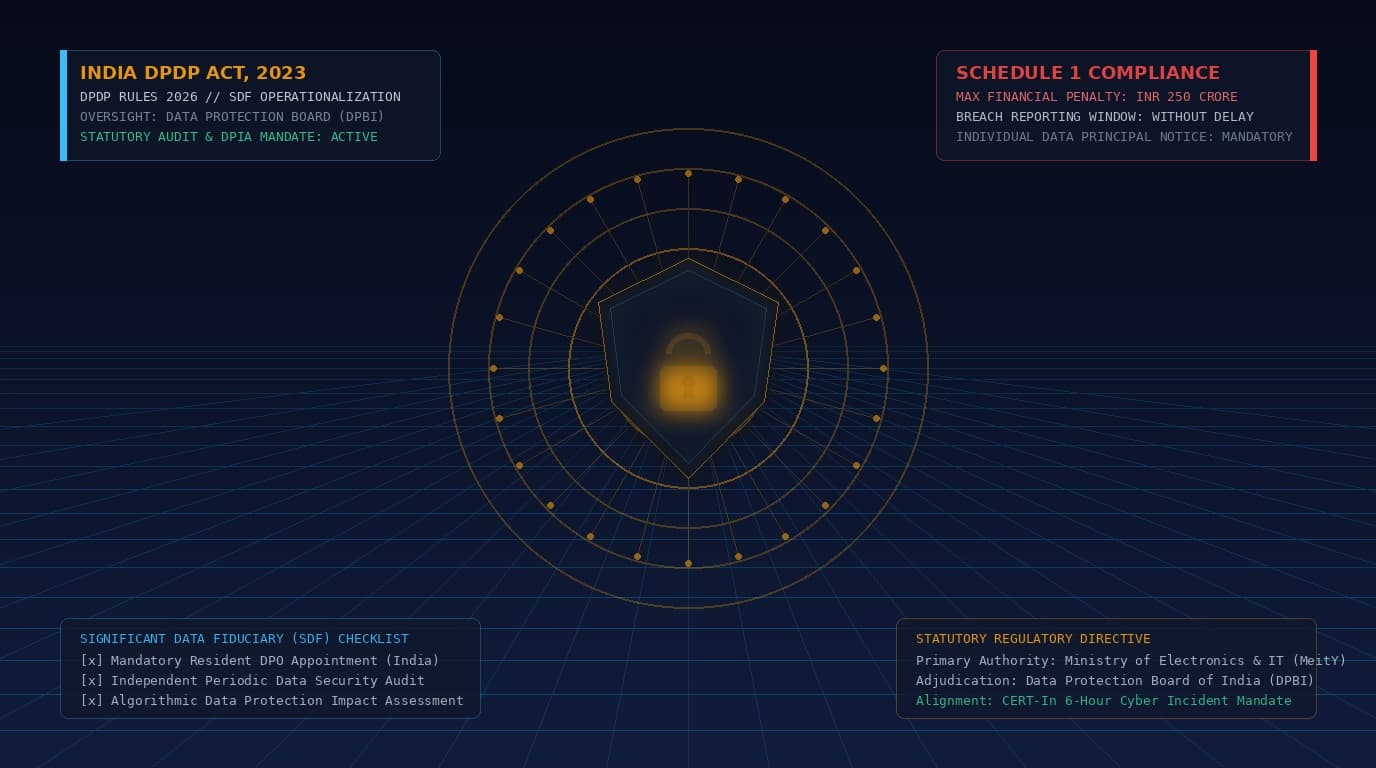
Most critically, the DPDP Rules define the statutory adjudication framework governing the Act's punitive Schedule 1 penalties. Failure to take reasonable security safeguards to prevent personal data breaches incurs statutory fines up to ₹250 Crore (~$30 Million USD) per incident, accompanied by mandatory dual-notification obligations that leave zero room for opaque or delayed breach disclosures.
Core Architecture of DPDP Rules 2026
The operational rules structure data fiduciary compliance around four institutional pillars designed to protect the constitutional right to privacy established under the landmark Puttaswamy ruling:
1. Significant Data Fiduciary (SDF) Governance Mandates
Entities classified as SDFs—determined by the volume, sensitivity of data processed, risk of harm to Data Principals, and potential impact on sovereignty and national security—must institutionalize three statutory roles:
- Resident Data Protection Officer (DPO): Appointment of an individual based physically in India who represents the fiduciary and reports directly to the Board of Directors.
- Independent Data Auditor: Engagement of an accredited external auditing firm to conduct periodic evaluations of data processing algorithms, storage encryption, and consent record-keeping.
- Algorithmic Impact Assessments (DPIA): Mandatory formal risk assessments before deploying machine learning models, biometric profiling engines, or autonomous automated decision-making systems processing citizen telemetry.
2. Dual Personal Data Breach Notification Workflow
Under Section 8(6) of the Act and the DPDP Rules 2026, when a personal data breach occurs, the Data Fiduciary must submit immediate intimations without undue delay across two parallel tracks:
- Intimation to the DPBI: Digital reporting through the DPBI regulatory portal specifying the nature, volume of impacted records, exploited vulnerability, containment status, and remediation timeline.
- Intimation to Data Principals: Clear, unencrypted notifications transmitted directly to impacted individuals via SMS, registered email, or in-app push alerts, providing actionable guidance on mitigating fraud or identity theft.
This obligation operates synchronously with CERT-In's mandatory 6-hour cybersecurity incident reporting directive, establishing one of the most stringent incident disclosure regimes in the Indo-Pacific region.
Statutory Penalty Schedule (Schedule 1)
| Compliance Failure / Violation | Governing Section | Maximum Statutory Penalty |
|---|---|---|
| Failure to institute reasonable security safeguards to prevent personal data breach | Section 8(5) | Up to ₹250 Crore (~$30,000,000) |
| Failure to notify the Board and affected Data Principals of a personal data breach | Section 8(6) | Up to ₹200 Crore (~$24,000,000) |
| Non-fulfillment of statutory obligations in relation to processing children's data | Section 9 | Up to ₹200 Crore (~$24,000,000) |
| Non-fulfillment of additional obligations prescribed for Significant Data Fiduciaries | Section 10 | Up to ₹150 Crore (~$18,000,000) |
| Breach of any other general provision of the Act or Rules | Section 33(1) | Up to ₹50 Crore (~$6,000,000) |
Enterprise Implementation Playbook: Preparing for DPBI Audits
Chief Information Security Officers (CISOs), Chief Privacy Officers (CPOs), and General Counsels must execute a systematic roadmap to align enterprise architectures with DPDP Rules 2026:
1. Data Mapping & Purpose Limitation Inventory
Maintain automated data cataloging mapping every personal data ingestion pipeline to a legally valid Consent Artefact or Specified Purpose:
# Data Discovery & Schema Tagging Schema for DPDP Compliance
{
  "dataset_identifier": "customer_kyc_vault",
  "data_principals": "retail_banking_customers",
  "attributes_collected": ["pan_number", "aadhaar_vault_ref", "phone", "email"],
  "consent_version": "v2026.04_biometric_optin",
  "storage_jurisdiction": "mumbai_ap_south_1",
  "encryption_at_rest": "AES_256_GCM",
  "retention_period_days": 1825,
  "sdf_dpia_certified": true
}
2. Consent Management Architecture (Consent Managers)
Integrate with interoperable, MeitY-registered Consent Managers that empower Indian citizens to view, manage, and revoke granular consent in all 22 Eighth Schedule official languages. Ensure technical mechanisms automatically trigger data erasure or anonymization upon consent withdrawal.
3. Cryptographic Storage & Zero-Trust Boundary Controls
- Aadhaar Vault Masking: Strictly prohibit the storage of raw 12-digit Aadhaar numbers in databases. Enforce UIDAI-compliant secure reference keys and HSM encryption.
- Granular Column-Level Encryption: Enforce envelope encryption for personally identifiable information (PII) using customer-managed encryption keys (CMEK) with strict audit logging.
- Third-Party Vendor Risk Auditing: Mandate contractual clauses aligning data processors with DPBI inquiry summons and periodic technical verification.