Regulatory Transformation: Overhauling Indian Banking Cyber Governance
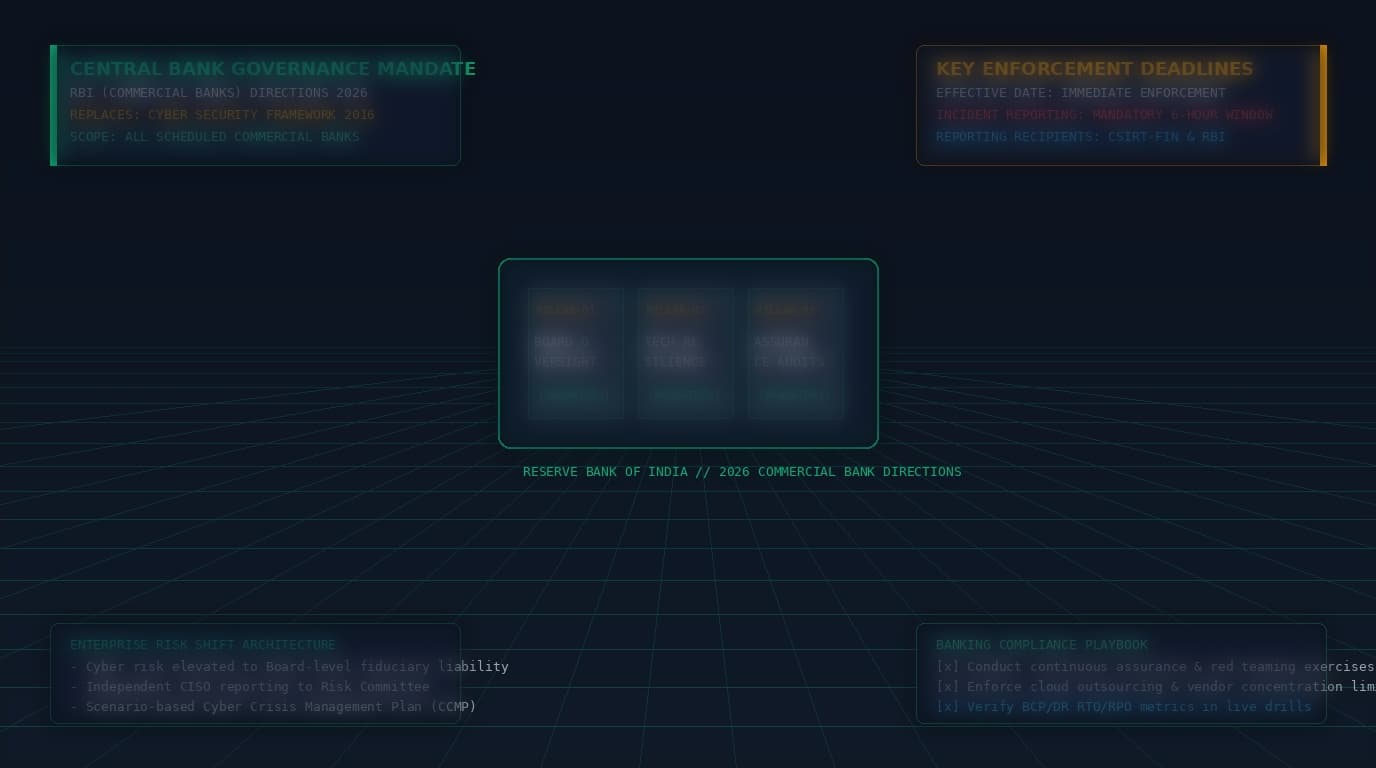
The Reserve Bank of India (RBI) has enacted a landmark regulatory overhaul of cybersecurity governance for India's banking sector with the promulgation of the Reserve Bank of India (Commercial Banks – Cybersecurity, Technology: Risk, Resilience and Assurance Framework) Directions, 2026. Effective immediately across all Scheduled Commercial Banks (SCBs), Small Finance Banks (SFBs), and foreign bank branches operating in India, the new Directions formally supersede the decade-old Cyber Security Framework in Banks (CSFB 2016) and harmonize with the Master Direction on Information Technology Governance, Risk, Controls and Assurance Practices.
The regulatory update signals a profound structural shift in central bank oversight: cybersecurity is no longer treated as an isolated information technology operational function. Instead, the Directions establish cyber resilience as a core pillar of fiduciary Board-level enterprise risk management, placing cyber risk on equal footing with credit risk, market risk, and capital adequacy requirements.
Core Architectural Pillars of the 2026 Framework
The 2026 Directions establish a tripartite regulatory architecture structured around Governance, Resilience, and Assurance:
| Framework Pillar | Regulatory Mandates & Core Directives | Enforcement Mechanism & Fiduciary Responsibility |
|---|---|---|
| 1. Board Governance & Leadership | Board Risk Management Committee oversight; independent CISO reporting line; dedicated Cyber Security Strategy Committee | Explicit Board of Directors liability; quarterly cyber risk appetite reviews |
| 2. Operational Technology Resilience | Mandatory scenario-based Cyber Crisis Management Plan (CCMP); stringent RPO/RTO metrics; zero-trust network microsegmentation | Annual live multi-site disaster recovery (DR) drills with unannounced failover tests |
| 3. Continuous Assurance & Evidence | Continuous automated vulnerability management; threat-led red teaming (TLPT); supply chain and sub-contractor audits | Documented control evidence submitted to RBI Department of Supervision (DoS) |
The 6-Hour Incident Reporting Mandate & CSIRT-Fin Coordination
A cornerstone of the 2026 Directions is the strict codification of emergency incident disclosure timelines. In alignment with CERT-In regulatory directives, banks must report any cybersecurity incident meeting threshold criteria to the RBI and CSIRT-Fin (Cyber Security Incident Response Team for the Financial Sector) within six (6) hours of detection.
Incident classification triggers requiring mandatory notification include:
- Unauthorized intrusion into Core Banking Systems (CBS), payment gateways, or settlement switches (RTGS, NEFT, UPI, IMPS).
- Ransomware or destructive wiper malware infections across any production, staging, or disaster recovery environment.
- Data exfiltration or unauthorized exposure of customer personally identifiable information (PII) or financial account balances.
- Denial of Service (DoS/DDoS) attacks disrupting Internet banking or mobile banking platforms for greater than 15 consecutive minutes.
- Breaches originating from third-party technology service providers or cloud hosting partners impacting banking services.
[Cybersecurity Anomaly Detected by SOC / EDR]
         |
         | <-- [Detection Timestamp T_0]
         v
[T_0 + 2 Hours: Incident Triage & Preliminary Severity Assessment]
         |
         | Verification of impacted systems (CBS, UPI Switch, Swift Gateway)
         v
[T_0 + 6 Hours: MANDATORY EMERGENCY DISCLOSURE]
         |
         |--> Submit Form CS-1 to RBI Department of Supervision
         |--> Submit Secure Incident Dispatch to CSIRT-Fin / CERT-In
         v
[T_0 + 24 Hours: Technical Intermediate Forensic Report]
         |
         | Root cause indicators (IOCs), vector of initial access, blast radius
         v
[T_0 + 14 Days: Final Root Cause Analysis (RCA) & Board-Approved Remediation]
Third-Party Cloud Outsourcing & Supply Chain Concentration Limits
Recognizing that extensive reliance on hyperscale cloud service providers (AWS, Microsoft Azure, Google Cloud) and fintech software vendors introduces systemic contagion risk across India's financial grid, the 2026 Directions introduce stringent supply chain mandates:
- Concentration Risk Assessment: Banks must monitor and cap cumulative exposure to individual cloud service providers to prevent systemic single-point-of-failure vulnerabilities across critical banking workloads.
- Continuous Vendor Audits: Regulated entities must retain contractual audit rights—including direct access for RBI supervisory inspectors—to examine the source code, security controls, and datacenter facilities of third-party SaaS and PaaS providers.
- Sub-Contractor Visibility: Outsourcing contracts must prohibit vendors from delegating critical banking services to fourth-party sub-contractors without prior written approval from the bank's IT Strategy Committee.
Digital Payment Security & Zero-Trust Mandates
In response to escalating digital fraud schemes (such as money mule networks and unauthorized SIM-swap transfers), the framework prescribes end-to-end cryptographic safeguards:
- End-to-End Payment Tokenization: All card-on-file and mobile transaction flows must utilize dynamic tokenization, preventing storage of raw PAN and CVV data.
- Behavioral Biometrics & Adaptive MFA: High-value transactions must enforce risk-based multi-factor authentication incorporating device fingerprinting, geolocation velocity checks, and behavioral keystroke telemetry.
- Zero-Trust Microsegmentation: Core banking database networks must be isolated from internet-facing web portals and third-party API gateways using microsegmentation policies and mutual TLS (mTLS) authentication.
Bank CISO & Executive Action Plan for 2026 Compliance
Chief Information Security Officers (CISOs) and banking compliance committees must execute the following strategic roadmap to ensure full regulatory alignment:
1. Align Board Risk Reporting & Cyber Appetite Metrics
Establish formal Key Risk Indicators (KRIs) and Key Performance Indicators (KPIs) presented quarterly to the Board Risk Management Committee:
# Core metrics mandated for Board dashboard:
- Mean Time to Detect (MTTD) and Mean Time to Respond (MTTR) across Tier-1 assets
- Patch latency for Critical/High CVEs (target: < 7 calendar days)
- Percentage of third-party vendor contracts with audited cybersecurity SLA compliance
- Results of annual unannounced BCP/DR failover tests (achieved RTO vs. mandated RTO)
2. Institutionalize Threat-Led Penetration Testing (TLPT)
Contract independent, certified red teaming providers to conduct simulated adversary attacks against live banking perimeters without prior notice to frontline operations teams, modeling advanced persistent threat (APT) tactics targeting SWIFT and UPI infrastructures.
3. Formalize CSIRT-Fin Integration & Automated Log Archival
Configure Security Information and Event Management (SIEM) and Security Orchestration, Automation, and Response (SOAR) platforms with automated dispatch templates to generate standardized incident filings within the mandatory 6-hour disclosure window. Maintain tamper-evident, cryptographically signed log repositories for a minimum of 3 years to satisfy RBI regulatory audit standards.