Executive Summary: The Era of Enforceable Digital Operational Resilience
The European Supervisory Authorities—comprising the European Banking Authority (EBA), the European Insurance and Occupational Pensions Authority (EIOPA), and the European Securities and Markets Authority (ESMA)—have enacted the binding regulatory technical standards (RTS) operationalizing the Digital Operational Resilience Act (DORA, Regulation (EU) 2022/2554).
DORA establishes a harmonized, legally binding cybersecurity and operational resilience regime across the entire European financial services sector. Moving decisively beyond fragmented national recommendations, DORA applies to over 22,000 credit institutions, investment firms, payment providers, insurance underwriters, crypto-asset service providers (CASPs), and credit rating agencies across all 27 EU member states. Crucially, the regulation also introduces direct regulatory oversight for "Critical ICT Third-Party Service Providers" (CTPPs)—bringing cloud hyperscalers (AWS, Microsoft Azure, Google Cloud), SaaS core banking engines, and datacenter operators under direct supervisory scrutiny.
Core Pillar 1: Accelerated 4-Hour Major ICT Incident Reporting
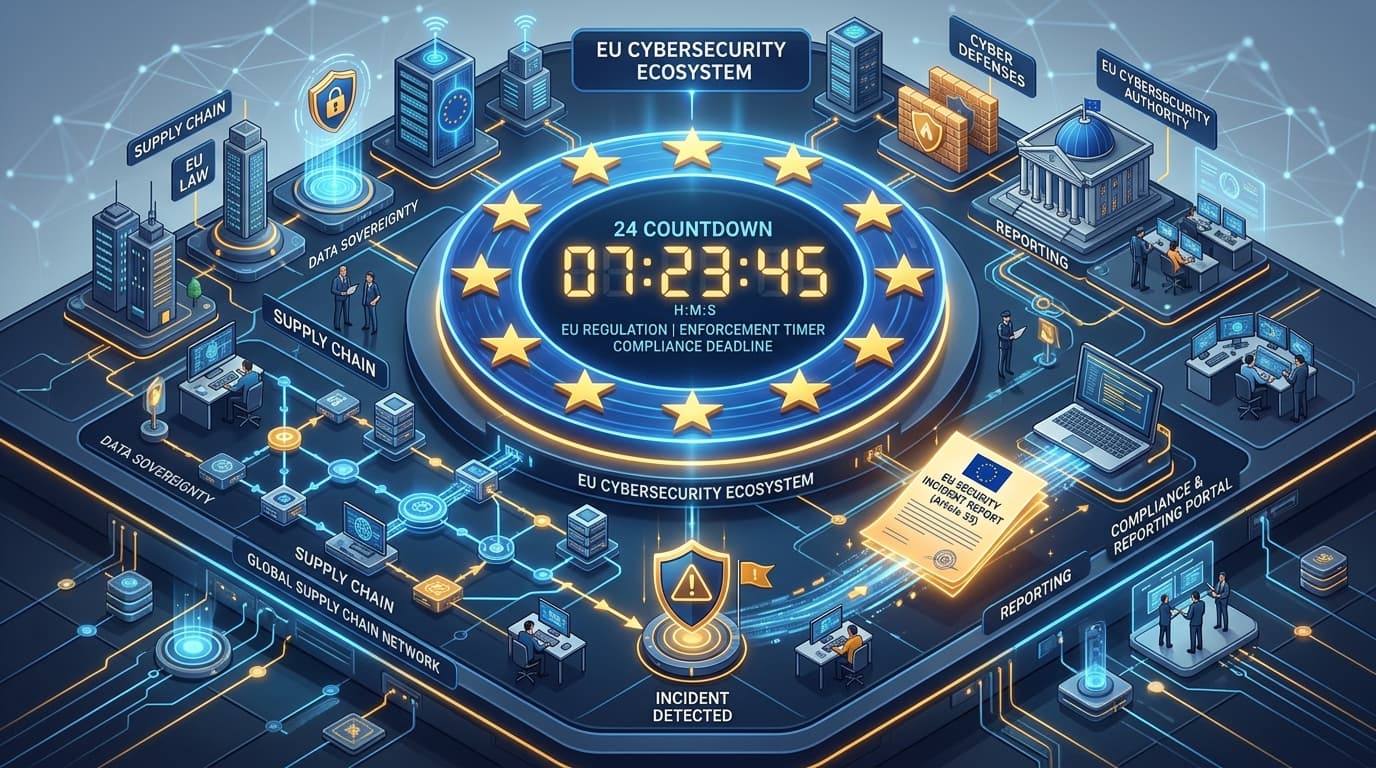
DORA replaces legacy fragmented notification regimes with a standardized, three-stage incident reporting framework. When an institution detects an ICT incident meeting defined severity criteria (affecting critical functions, client transaction volumes, data integrity, or geographic reach):
| Reporting Stage | Mandatory Deadline | Required Deliverables |
|---|---|---|
| Initial Notification | Within 4 hours of classification (no later than 24 hours from detection) | Basic incident details, affected critical functions, estimated blast radius |
| Intermediate Report | Within 72 hours | Root-cause indicators, ongoing mitigation steps, customer impact updates |
| Final Report | Within 1 month of incident resolution | Complete post-incident forensic root cause, total financial losses, permanent architectural fixes |
Core Pillar 2: Threat-Led Penetration Testing (TLPT / TIBER-EU)
Under Article 26 of DORA, significant financial entities identified by supervisory authorities must perform advanced Threat-Led Penetration Testing (TLPT) at least once every three years.
Unlike automated vulnerability scans or compliance checklists, TLPT mandates controlled live-fire red team simulations modeled after the TIBER-EU (Threat Intelligence-based Ethical Red Teaming) framework:
- Inclusion of Third-Party Cloud Providers: Where critical business services reside in the public cloud, third-party cloud providers must participate in the TLPT or participate in pooled testing exercises.
- Red Team Independence: Testing must be conducted by certified external red team providers adhering to strict ethical hacking accreditations (CREST, CHECK, or equivalent).
- Production Environment Mandate: Simulations must be performed on live production systems supporting critical economic functions, assessing real-time SOC detection and response capabilities.
Core Pillar 3: Register of Information & Cloud Concentration Oversight
DORA introduces unprecedented transparency into financial supply chains. Financial entities must maintain a comprehensive, audit-ready Register of Information detailing all contractual arrangements on the use of ICT services.
// Example DORA Register of Information Entity Mapping (JSON-LD)
{
  "@context": "https://eba.europa.eu/dora/v1/registry",
  "entityLeCode": "549300EXAMPLEBANKLEI01",
  "ictServiceContract": {
    "contractId": "CTR-2026-CLOUD-0042",
    "serviceProvider": "Amazon Web Services EMEA SARL",
    "serviceType": "CloudInfrastructureHosting",
    "criticalFunctionSupported": "CorePaymentClearingAndSettlement",
    "dataLocation": ["DE-FRA", "IE-DUB"],
    "subcontractingChainDepth": 3,
    "exitStrategyTestedDate": "2026-06-15",
    "multiCloudAlternative": "Available"
  }
}
Where an ICT provider is designated as a Critical ICT Third-Party Service Provider (CTPP), the Lead Overseer (assigned from one of the ESAs) possesses sweeping administrative powers:
- Conduct unannounced on-site inspections of commercial cloud datacenters and security operations centers.
- Request any operational telemetry, architecture blueprints, and source code review audits.
- Issue binding recommendations and impose periodic penalty payments of up to 1% of the provider's average daily worldwide turnover until compliance is achieved.
CISO Implementation & Audit Readiness Checklist
- Automate Incident Triage for 4-Hour Compliance: Calibrate security incident and event management (SIEM) playbooks to classify "Major ICT Incidents" against DORA criteria automatically within 2 hours of detection to allow 2 hours for executive review before regulatory submission.
- Audit Cloud Exit Strategies: Review contractual agreements with cloud providers to ensure explicit rights of audit, unrestricted transition assistance, and tested operational exit strategies that avoid concentration lock-in.
- Initiate TLPT Scoping Workshops: Identify critical economic functions, map end-to-end IT dependencies, and engage certified red team firms to prepare threat intelligence-led penetration testing blueprints.