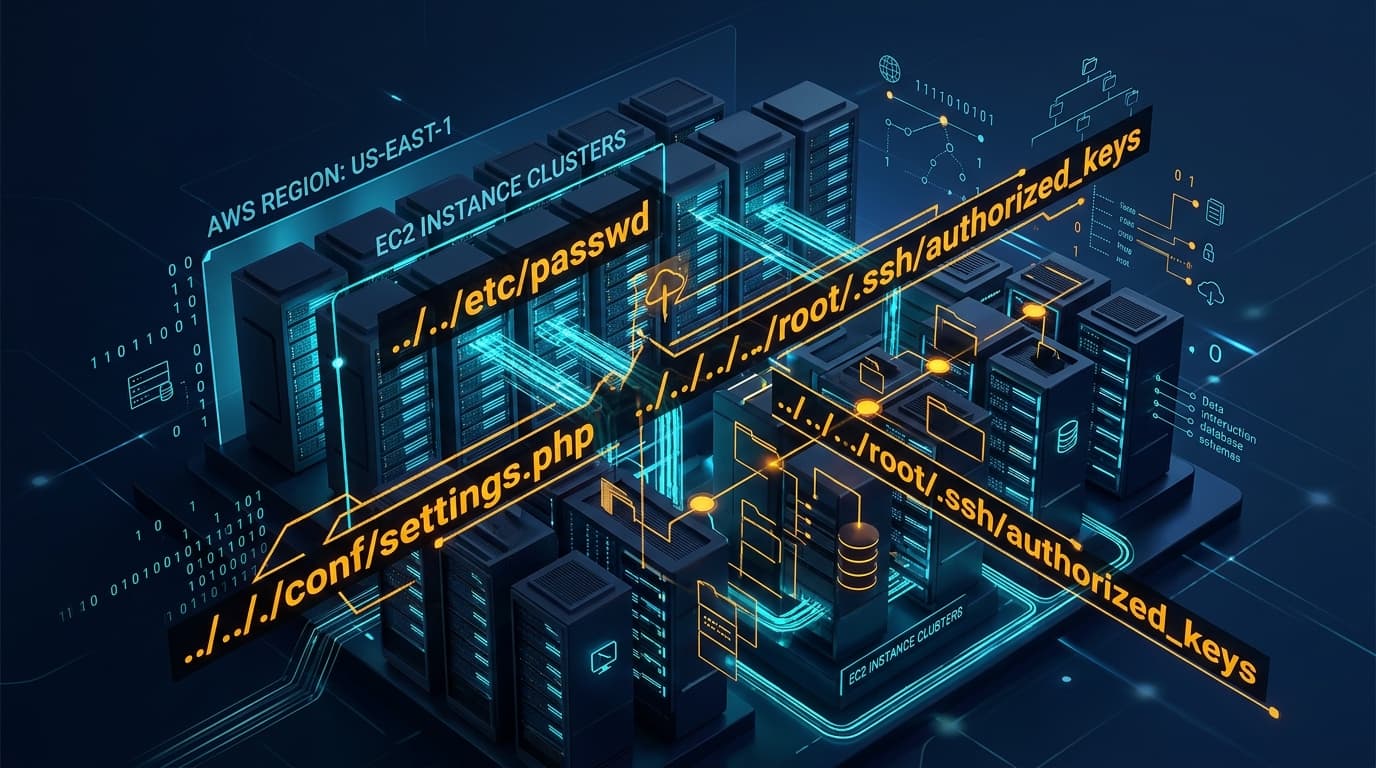
Executive Lead: Cloud Management Daemon Breach & Host Privilege Escalation
Amazon Web Services (AWS) has published security bulletin AWS-2026-009 addressing a critical privilege escalation and path traversal vulnerability in the official amazon-ssm-agent. Assigned common vulnerability identifier CVE-2026-81849 and scored at CVSS 8.8 (CVSS:3.1/AV:N/AC:L/PR:L/UI:N/S:U/C:H/I:H/A:H), the vulnerability allows authenticated users with constrained AWS Systems Manager (SSM) permissions to escape intended filesystem boundaries and overwrite arbitrary files across cloud instances with root or NT AUTHORITYSYSTEM authority.
AWS Systems Manager is ubiquitous across enterprise cloud deployments, managing millions of Amazon Elastic Compute Cloud (Amazon EC2) instances, container worker nodes, and on-premises hybrid enterprise servers. The agent runs as an unconfined privileged background daemon to execute operational documents, deploy patches, and collect system telemetry. A security breakdown in the agent's core plugins enables threat actors who possess minor developer or CI/CD permissions to achieve complete host-level compromise.
Technical Root Cause: Insecure Path Concatenation in aws:downloadContent Plugin
The defect exists specifically within the implementation of the aws:downloadContent plugin bundled with amazon-ssm-agent prior to release 3.3.4515.0. When an IAM user or automated automation role invokes ssm:SendCommand using the pre-defined AWS-DownloadContent document, the agent fetches specified source artifacts from Amazon S3, HTTP endpoints, or GitHub repositories and writes them to a local destination directory.
During the extraction and download phase, the Go-based plugin failed to sanitize relative directory traversal sequences (such as ../ or ..\) embedded within the source object's metadata or filename key:
// Flawed file path resolution logic in downloadContent plugin
func (p *Plugin) downloadFromS3(ctx context.Context, s3Source S3Source, destinationDir string) error {
    for _, item := range s3Source.Objects {
        // VULNERABILITY: Direct concatenation without filepath.Clean or boundary verification
        targetPath := filepath.Join(destinationDir, item.Key)

        // If item.Key is "../../../../etc/cron.d/backdoor", targetPath escapes destinationDir
        file, err := os.OpenFile(targetPath, os.O_CREATE|os.O_WRONLY|os.O_TRUNC, 0755)
        if err != nil {
            return err
        }
        defer file.Close()

        _, err = io.Copy(file, item.Reader)
        return err
    }
    return nil
}
Because filepath.Join cleans paths but evaluates dot-dot sequences relative to the base, an attacker providing an object key with multiple parent traversals completely strips away destinationDir, directing the output stream into arbitrary host paths such as /etc/cron.d/, /etc/sudoers.d/, or /etc/ld.so.preload on Linux, or C:WindowsSystem32 on Windows.
Attack Chain & Lateral Movement Mechanics
In enterprise cloud environments, organizations frequently implement least-privilege IAM policies intended to prevent developers from executing shell scripts directly on EC2 instances. For instance, security teams may restrict an IAM role to only downloading configuration assets:
{
    "Version": "2012-10-17",
    "Statement": [
        {
            "Effect": "Allow",
            "Action": "ssm:SendCommand",
            "Resource": "arn:aws:ssm:*:*:document/AWS-DownloadContent"
        }
    ]
}
Under this security policy, the user is barred from running AWS-RunShellScript or starting interactive terminal sessions via SSM Session Manager. However, exploiting CVE-2026-81849 completely invalidates this policy boundary:
- Staging Malicious Object: The attacker uploads a crafted reverse shell payload to an attacker-controlled or compromised S3 bucket with the object key named
../../../../etc/cron.d/escalate. - Issuing SendCommand: The attacker invokes
ssm:SendCommandspecifying theAWS-DownloadContentdocument and referencing the traversal object key. - Root File Overwrite: The victim instance's SSM agent downloads the object and writes it directly to
/etc/cron.d/escalatewith root file ownership and execute permissions. - Cron Execution: Within 60 seconds, the local cron daemon executes the payload, granting the adversary an interactive root reverse shell on the instance.
Remediation Playbook & Verification Commands
AWS has addressed CVE-2026-81849 in amazon-ssm-agent version 3.3.4515.0. Infrastructure and cloud operations teams must enforce the following remediation measures:
- Audit SSM Agent Versions Across Fleet:
Execute AWS CLI queries to inspect running agent versions across all registered managed instances:
# Query AWS Systems Manager for outdated agent builds aws ssm describe-instance-information --query "InstanceInformationList[?AgentVersion < '3.3.4515.0'].{InstanceId:InstanceId,AgentVersion:AgentVersion,PlatformType:PlatformType}" --output table - Trigger Automated Fleet-Wide Agent Update:
Use the
AWS-UpdateSSMAgentdocument to trigger immediate agent updates across all targeted instances:# Enforce immediate update to latest amazon-ssm-agent release aws ssm send-command --document-name "AWS-UpdateSSMAgent" --targets '[{"Key":"InstanceIds","Values":["*"]}]' --parameters '{"version":["3.3.4515.0"]}' --comment "Remediate CVE-2026-81849" - Enable SSM Agent Auto-Update Association:
Ensure that Systems Manager State Manager association
AWS-SSM-DefaultUpdateAgentAssociationis active across all AWS accounts to automatically ingest security patches. - Review IAM Policies for aws:downloadContent:
Audit IAM roles and permission boundaries to verify that untrusted entities cannot invoke
ssm:SendCommandagainst sensitive production instances without explicit multi-factor authorization.