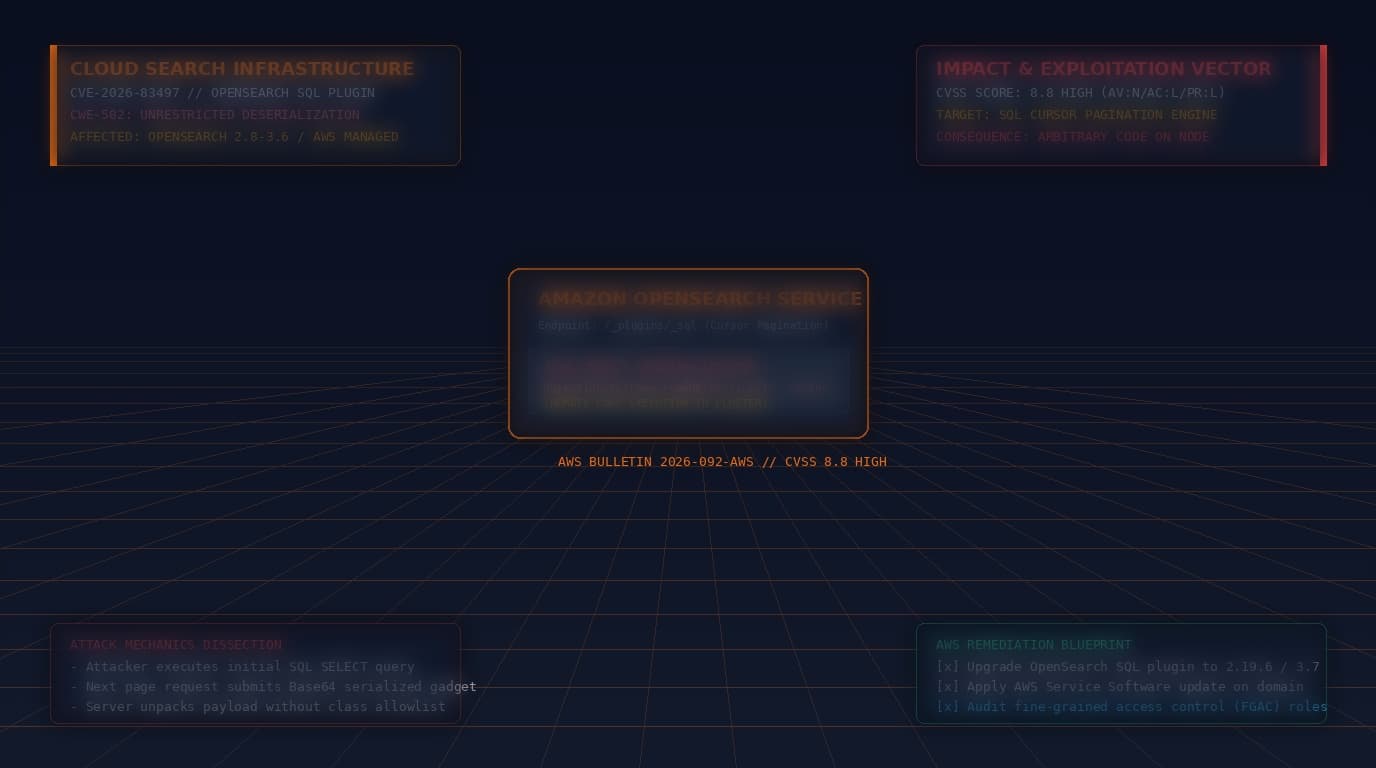
Executive Summary & Cloud Database Threat Context
Amazon Web Services (AWS) and the open-source OpenSearch project maintainers have issued an urgent security notice under AWS Security Bulletin 2026-092-AWS addressing a high-severity remote code execution vulnerability in the OpenSearch SQL plugin. Tracked as CVE-2026-83497 with a Common Vulnerability Scoring System (CVSS v3.1) base score of 8.8 (High), the defect allows an authenticated attacker possessing basic read or search privileges to execute arbitrary commands directly within the JVM runtime of OpenSearch data nodes.
OpenSearch is widely utilized as the primary search and analytics engine underpinning enterprise log aggregation, SIEM architectures, application performance monitoring (APM), and distributed document stores. The OpenSearch SQL plugin provides developers with SQL-compliant query syntax and paginated cursor retrieval against JSON document indices. Because OpenSearch cluster processes often execute with elevated container or host network access, compromising an OpenSearch node can expose vast repositories of enterprise telemetry, credential caches, and downstream cloud database secrets.
Vulnerability Taxonomy & Affected Versions
CVE-2026-83497 is classified under CWE-502: Deserialization of Untrusted Data. The flaw impacts both independent, self-hosted OpenSearch clusters and managed hyperscale cloud instances:
| Deployment Architecture | Vulnerable Engine Versions | Fixed Release Baseline | Required Operator Action |
|---|---|---|---|
| OpenSearch (Self-Managed / Kubernetes) | Versions 2.8.0 through 3.6.0 | OpenSearch SQL Plugin 2.19.6 / 3.7.0 | Upgrade OpenSearch cluster binary or rebuild plugin container images |
| Amazon OpenSearch Service (AWS Managed) | Domain engine versions 2.9 through 3.5 | Service Software Update (September 2026) | Apply Service Software Update via AWS Management Console or CLI |
| OpenSearch Serverless (AWS) | All collection types | Patched transparently by AWS | No customer action required; cloud backend automatically mitigated |
Root Cause Dissection: Insecure Java Deserialization in Cursor Pagination
When users issue SQL queries returning large result sets against the /_plugins/_sql endpoint, the SQL engine breaks the response into chunks using cursor-based pagination. To maintain state across stateless HTTP requests without keeping database locks open, the server encodes pagination metadata (such as internal shard routing keys, document IDs, and sort values) into an opaque Base64-encoded token returned as a cursor.
In vulnerable versions of the plugin, the cursor generation and parsing routine utilized native Java object serialization (java.io.ObjectInputStream and java.io.ObjectOutputStream) to serialize the internal CursorState object:
// Vulnerable Java snippet in CursorParser.java:
public CursorState parseCursor(String base64Cursor) throws IOException, ClassNotFoundException {
    byte[] decodedBytes = Base64.getDecoder().decode(base64Cursor);
    try (ByteArrayInputStream bais = new ByteArrayInputStream(decodedBytes);
         ObjectInputStream ois = new ObjectInputStream(bais)) {

        // FLAW: Unrestricted readObject() without look-ahead class filter or allowlist
        return (CursorState) ois.readObject();
    }
}
Because the ObjectInputStream was instantiated without configuring a ClassFilter (such as JEP 290 object serialization filtering), the JVM immediately begins resolving and executing class initializers embedded within the stream before verifying whether the deserialized object is genuinely an instance of CursorState.
An attacker with basic search access to the SQL endpoint can construct a malicious Java gadget chain (leveraging common libraries present on the OpenSearch classpath, such as Apache Commons, Jackson, or internal transport dependencies) and encode it as the cursor parameter in a pagination request:
POST /_plugins/_sql HTTP/1.1
Host: opensearch-cluster.internal:9200
Authorization: Basic dXNlcjpwYXNzd29yZDEyMw==
Content-Type: application/json

{
  "cursor": "rO0ABXNyABFqYXZhLnV0aWwuSGFzaE1hcAUrBzyVyawbAwACRgAKbG9hZEZhY3RvckkACXRocmVzaG9sZHhwP0AAAAAAAAx3CAAAABAAAAACdAAPbWFsaWNpb3VzX2dhZGdldHNy...[TRUNCATED_WEAPONIZED_GADGET_PAYLOAD]..."
}
When the OpenSearch node executes ois.readObject(), the gadget chain triggers code execution within the security context of the OpenSearch process (typically the opensearch service user), bypassing fine-grained document and field-level security controls.
Attack Trajectory & Threat Modeling in Enterprise Cloud Workloads
In observed enterprise attack chains, threat actors leverage the cursor deserialization flaw as a privilege escalation vector:
[Attacker / Low-Privilege Data Analyst Account]
        |
        | 1. Execute basic query: POST /_plugins/_sql {"query": "SELECT * FROM logs"}
        | 2. Capture response structure
        v
[OpenSearch Front-End / REST Handler]
        |
        | 3. Submit weaponized cursor payload via POST /_plugins/_sql {"cursor": "..."}
        v
[OpenSearch Data Node JVM Runtime]
        |
        | 4. ois.readObject() processes unvalidated class stream
        | 5. Gadget chain achieves Command Execution
        v
[Underlying Cluster Host / Container Pod]
        |
        |--> Exfiltrate AWS IAM Role Credentials via IMDS (http://169.254.169.254/)
        |--> Dump all index contents, bypassing Field-Level Security (FLS)
        |--> Establish reverse shell persistence across Kubernetes worker nodes
Remediation Blueprint & Defensive Playbook
Organizations operating OpenSearch must apply the following immediate mitigations:
1. Amazon OpenSearch Service Managed Domain Update
For managed AWS clusters, trigger a service software update via the AWS CLI or AWS Management Console:
# Check current service software version
aws opensearch describe-domain   --domain-name "corp-analytics-prod"   --query "DomainStatus.ServiceSoftwareOptions"

# Trigger automated zero-downtime service software update
aws opensearch update-package-status   --domain-name "corp-analytics-prod"   --service-software-update-options UpdateType=NOW
2. Self-Managed Cluster Plugin Upgrade
For self-hosted Kubernetes Helm or Docker deployments, upgrade the OpenSearch SQL plugin to version 2.19.6 (for 2.x branches) or 3.7.0 (for 3.x branches):
# Remove vulnerable SQL plugin
bin/opensearch-plugin remove opensearch-sql

# Install patched release
bin/opensearch-plugin install https://artifacts.opensearch.org/releases/plugins/opensearch-sql/2.19.6/opensearch-sql-2.19.6.zip

# Restart OpenSearch service daemon
systemctl restart opensearch
The upstream patch replaces Java native serialization with a cryptographically signed, JSON-serialized pagination token that strictly validates token schema before processing.
3. Restrict SQL Plugin Network Access
If immediate patching is not possible, restrict network access to the /_plugins/_sql endpoint using an Application Load Balancer (ALB) or API Gateway WAF rule:
# AWS WAF rule: Block external access to OpenSearch SQL API
{
  "Name": "Block-OpenSearch-SQL-Endpoint",
  "Priority": 1,
  "Action": { "Block": {} },
  "Statement": {
    "ByteMatchStatement": {
      "SearchString": "/_plugins/_sql",
      "FieldToMatch": { "UriPath": {} },
      "TextTransformations": [{ "Priority": 0, "Type": "LOWERCASE" }],
      "PositionalConstraint": "STARTS_WITH"
    }
  },
  "VisibilityConfig": {
    "SampledRequestsEnabled": true,
    "CloudWatchMetricsEnabled": true,
    "MetricName": "BlockOpenSearchSQL"
  }
}