Threat Overview & Industrial Exposure
Siemens ProductCERT and the Cybersecurity and Infrastructure Security Agency (CISA) have issued a joint advisory regarding a critical vulnerability tracked as CVE-2026-76880 (CVSS 9.8) impacting Siemens SIMATIC Energy Manager PRO. The software is widely deployed across manufacturing plants, chemical processing facilities, and power utilities to monitor energy consumption and integrate SCADA telemetry with enterprise ERP networks.
The flaw enables unauthenticated remote adversaries with network access to the software's OPC Unified Architecture (OPC UA) gateway port to execute arbitrary commands with NT AUTHORITY\SYSTEM privileges on the host Windows server, granting complete control over energy distribution telemetry and Historian databases.
Technical Root Cause: Insecure Binary Deserialization (CWE-502)
The vulnerability exists within the OPC UA Historian communication parser (OpcUaHistorianGateway.exe). The service listens by default on TCP port 4840 for energy metrics streamed from programmable logic controllers (PLCs) such as SIMATIC S7-1500 and ET 200SP stations.
When processing custom user extension objects encapsulated in OPC UA WriteRequest and HistoryUpdate packets, the server utilizes an unsafe .NET binary formatter without enforcing type restriction filters (TypeNameHandling.None). By supplying a gadget chain embedded within an unauthenticated OPC UA session establishment handshake, an attacker forces the server to execute arbitrary shellcode:
| Affected Software | Vulnerable Versions | Remediated Version |
|---|---|---|
| SIMATIC Energy Manager PRO | All versions prior to V7.4 Update 2 | Upgrade to V7.4 Update 2 or later |
| SIMATIC Energy Manager Basic | All versions prior to V7.3 SP1 | Upgrade to V7.3 SP1 or apply patch |
IEC 62443 Defense-in-Depth & Remediation Guide
Asset owners and operational technology (OT) engineers must execute the following remediation measures in accordance with IEC 62443-3-3 System Security Requirements:
- Immediate Patch Application: Deploy Siemens SIMATIC Energy Manager PRO V7.4 Update 2 across all operational workstations and supervisory servers.
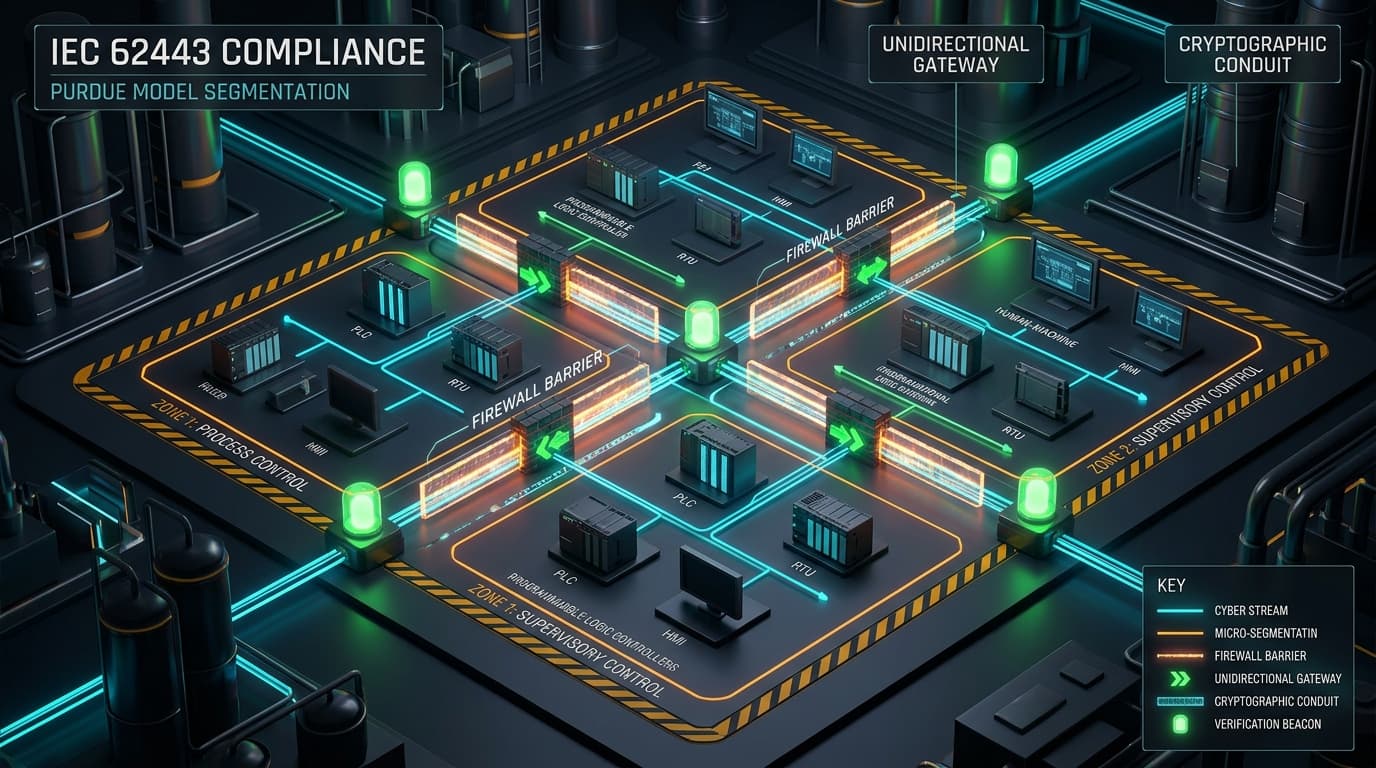
- Purdue Model Boundary Segmentation: Ensure TCP port 4840 and SCADA gateway interfaces are restricted to Level 2 (Supervisory Control) and Level 3 (Operations Management) internal networks, strictly blocking inbound traffic from corporate Level 4 networks.
- Enforce OPC UA Security Profiles: Disable unauthenticated OPC UA endpoints (
None:None) and mandate the Basic256Sha256 or Aes128_Sha256_RsaOaep cryptographic security policy with X.509 certificate authentication.
Regulatory Mandates & Statutory Enforcement Matrix
| Governance Pillar / Directive | Regulated Scope & Entities | Mandated Compliance Deadline | Statutory Enforcement & Penalties |
|---|---|---|---|
| Core Operational Resilience | Banking, Cloud Providers & Financial Institutions | Immediate Mandatory Enforcement | Supervisory audits, business restrictions & statutory fines |
| Incident Disclosure & Telemetry | Critical IT & Third-Party Cloud Infrastructure | Strict Statutory Reporting Window | Regulatory inquiry and executive liability under statutory acts |
| Data Governance & Risk Management | Enterprise Data Fiduciaries & Cloud Processors | Rolling 180-Day Audit Baseline | Statutory financial penalties and remediation embargoes |
Step-by-Step Technical Audit & Compliance Verification Playbook
Enterprise compliance and security operations teams must verify technical controls and audit readiness:
- Verify Immutable Audit Log Retention in Cloud Storage:
# AWS S3: Verify Object Lock retention compliance mode on SIEM audit bucket aws s3api get-object-lock-configuration --bucket enterprise-siem-compliance-logs # Output must confirm ObjectLockEnabled: Enabled with Compliance mode - Audit Cloud Workload Encryption & IAM Privileges:
# Query Azure Key Vault or AWS KMS for automated annual key rotation status aws kms list-keys --query "Keys[*].KeyId" --output text | xargs -n 1 aws kms get-key-rotation-status --key-id - Automated Regulatory Incident Notification Dispatch Test:
# Automated compliance deadline alert trigger verification
import time, datetime

def verify_compliance_window(incident_epoch: float, max_hours: int = 6):
    elapsed = (time.time() - incident_epoch) / 3600
    if elapsed > max_hours:
        print(f"CRITICAL: Statutory notification window exceeded ({elapsed:.1f}h / {max_hours}h)")
    else:
        print(f"Within compliance window: {max_hours - elapsed:.1f}h remaining")

verify_compliance_window(time.time() - 3600)
Continuous Threat Monitoring & Log Auditing Queries
Monitor SIEM logs for anomalous privilege escalation and unapproved administrative role assumptions:
-- Query SIEM audit trail for high-privilege IAM policy updates
SELECT timestamp, user_identity, event_name, request_parameters
FROM cloud_audit_logs
WHERE event_name IN ('PutRolePolicy', 'AttachUserPolicy', 'CreateSecurityGroupRule')
  AND status = 'Success'
ORDER BY timestamp DESC
LIMIT 50;