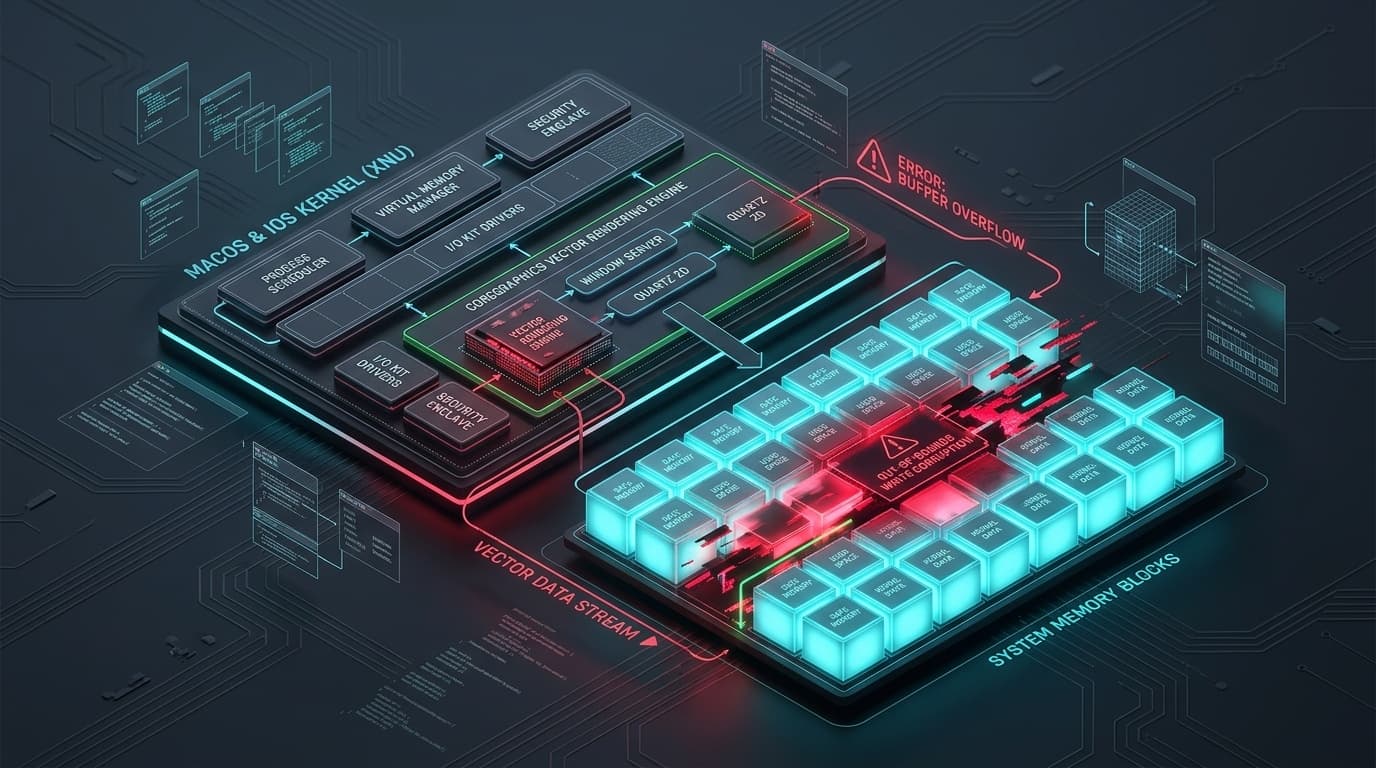
The PHP Development Team and The PHP Foundation have released emergency security updates across all active release branches to resolve a pair of critical memory corruption vulnerabilities, collectively designated "PHP2Shell". Tracked as CVE-2026-109618 and CVE-2026-109619 and rated 9.2 under the CVSS v4.0 standard, the flaws reside in the fundamental C runtime of the PHP interpreter itself—enabling unauthenticated remote adversaries to execute arbitrary code or harvest sensitive process memory from web servers before application code ever executes.
Because the vulnerability exists at the interpreter's native request-handling boundary rather than inside application-layer logic, virtually any web service exposing a PHP runtime to HTTP traffic is susceptible. Deployments operating under Apache HTTP Server's mod_php handler represent the highest risk tier, where an unauthenticated HTTP request triggers execution hijacking during early request initialization. Security telemetry networks, including Cloudflare, observed weaponized exploitation attempts emerging in global network traffic immediately preceding and following the coordinated public release.
| Specification Parameter | CVE-2026-109618 Detail | CVE-2026-109619 Detail |
|---|---|---|
| Vulnerability Designation | PHP Core Out-of-Memory Corruption | Session Upload Progress Buffer Mismanagement |
| CVSS v4.0 Rating | 9.2 (CRITICAL) | 9.2 (CRITICAL) |
| Common Weakness (CWE) | CWE-787 (Out-of-bounds Write) / CWE-400 | CWE-287 (Improper Authentication) / CWE-125 |
| Initial Discovery | Calif, Wiz Research, OpenAI Codex Security | Calif, Wiz Research, OpenAI Codex Security |
| Primary Attack Impact | Pre-execution RCE under mod_php, crash in FPM | Live worker memory leakage & RCE via session heap |
| Supported Branches Fixed | PHP 8.5.12, 8.4.27, 8.3.36, 8.2.35 | PHP 8.5.12, 8.4.27, 8.3.36, 8.2.35 |
| EOL Source Backports | PHP 8.1, 8.0, 7.4 (Source patches provided) | PHP 8.1, 8.0, 7.4 (Source patches provided) |
Attack Mechanics & Root Cause: Anatomy of the PHP2Shell Primitives
The PHP2Shell vulnerability suite targets the foundational C structures responsible for initializing incoming HTTP request state within the Zend Engine:
1. CVE-2026-109618: Out-of-Memory Request Parser Corruption
During the processing of multipart form-data requests (multipart/form-data), PHP's SAPI (Server Application Programming Interface) layer parses parameter boundaries and allocates internal memory buffers to stage uploaded content and headers. When an adversary transmits a crafted, deeply nested multipart request structured to exhaust the process memory ceiling (memory_limit), the memory allocator raises a fatal bail-out exception.
Historically, PHP handles memory allocation bail-outs via zend_bailout(), which uses longjmp() to abort execution and return control to the request shutdown handler. However, in vulnerable versions dating back to PHP 5.4, the multipart parser fails to clear active bucket pointers in the symbol table before the long jump occurs. Consequently, the request destructor executes against dangling pointers in heap memory, triggering a classic use-after-free or double-free condition that allows an attacker to overwrite function pointers in the Zend executor table.
/* Abstracted conceptual flaw in vulnerable multipart boundary parser */
void rfc1867_post_handler(...) {
    /* Allocates boundary tracking buffers */
    buf = emalloc_rel(boundary_len + 1);

    /* When input triggers memory_limit exhaustion: */
    if (allocated_memory > max_limit) {
        /* BAILOUT triggered WITHOUT resetting internal SAPI state */
        zend_error(E_ERROR, "Allowed memory size exhausted");
        /* Jumps directly to shutdown handler leaving corrupted pointers */
    }
}
2. CVE-2026-109619: Session Upload Progress Heap Mismanagement
PHP ships with the feature session.upload_progress.enabled toggled on by default. This capability tracks upload metrics in real-time by caching multipart byte offsets inside the user's session storage. An unauthenticated attacker can initiate a file upload containing a custom PHP_SESSION_UPLOAD_PROGRESS header while concurrently sending requests that manipulate session serialization routines.
Because the upload progress handler runs prior to the completion of user authentication checks or session validation, an adversary can manipulate session serialization formats to corrupt contiguous heap memory. This allows out-of-bounds reading of live worker memory (CWE-125), dumping fragments of concurrent web requests handled by the same worker pool—including HTTP Basic Authentication headers, CSRF tokens, database passwords, and private API keys.
Execution Impact Across Different PHP Server Environments
The practical exploitability of PHP2Shell varies according to the architectural SAPI running on the web server:
| Server Architecture / SAPI | Exploit Feasibility | Technical Behavior & Failure Mode |
|---|---|---|
Apache HTTPD with mod_php |
Immediate RCE (Critical) | Request runs directly inside the Apache process thread. Memory corruption directly controls the parent instruction pointer before script interpretation begins. |
| PHP-FPM (FastCGI Process Manager) | Memory Theft / Conditional RCE | FPM worker pools terminate upon early initialization crashes, mitigating certain direct RCE paths. However, live worker memory leakage succeeds, and secondary RCE is achievable via specific application file operations. |
| CLI-Server / FrankenPHP / LiteSpeed | Process Corruption / Denial of Service | Persistent worker threads remain susceptible to state corruption, leading to worker crashes, thread starvation, and potential memory disclosure. |
The Discovery Narrative & Coordinated Disclosure Collapse
The timeline leading to the release of the PHP2Shell fixes highlights both modern AI-assisted offensive research and structural bottlenecks in open-source governance:
- 2024 Retrospective Audit: According to a public retrospective published by The PHP Foundation, initial signals of the out-of-memory parsing defect were identified during a 2024 external security audit. However, because a concrete exploitation path could not be proven, and proposed architectural patches threatened backward compatibility, the defect languished in committee deliberations for months.
- AI-Assisted Weaponization: In October 2026, researchers from Wiz Research, Calif, and OpenAI's Codex Security team re-examined the code paths. Utilizing frontier AI models to model complex C memory layouts, researchers established a fully working end-to-end exploit in approximately one week—a milestone that previously would have required months of dedicated manual reverse engineering.
- Premature Disclosure & Leakage: On October 20, 2026, details regarding the upcoming emergency patches leaked to public developer forums, followed by the accidental publication of a proof-of-concept demonstration video. Vendor container builds containing preliminary patches were deployed to public registries, accelerating the disclosure deadline and prompting the PHP team to push the official release forward to October 21 at 14:00 UTC.
Defensive Playbook & Remediation Engineering
Organizations must treat PHP2Shell as a critical enterprise emergency. Upgrading application code (e.g. updating WordPress plugins or Laravel libraries) does not mitigate this flaw; the host or container PHP binary runtime must be patched.
1. Official Patch Version Matrix
Upgrade to the corresponding patched PHP release immediately:
| Branch | Vulnerable Versions | Mandatory Fixed Release | Support Status |
|---|---|---|---|
| PHP 8.5 | All versions < 8.5.12 | 8.5.12 | Active Support |
| PHP 8.4 | All versions < 8.4.27 | 8.4.27 | Active Support |
| PHP 8.3 | All versions < 8.3.36 | 8.3.36 | Active Support |
| PHP 8.2 | All versions < 8.2.35 | 8.2.35 | Security Only (EOL Dec 2026) |
| PHP 8.1, 8.0, 7.4 | All versions | Apply official git source backport | End of Life (Unofficial Source Backport) |
2. Operating System & Container Upgrade Commands
# For Ubuntu / Debian systems (Ondrej Sury PPA or standard repo):
sudo apt-get update
sudo apt-get --only-upgrade install php8.3-fpm php8.3-cli libapache2-mod-php8.3 php8.3-common -y
sudo systemctl restart php8.3-fpm && sudo systemctl restart apache2

# For RHEL / AlmaLinux / Rocky Linux (Remi repository):
sudo dnf check-update
sudo dnf upgrade php php-fpm php-common -y
sudo systemctl restart php-fpm && sudo systemctl restart httpd

# For Docker / Container deployments:
docker-compose pull
docker-compose up -d --force-recreate
3. Interim Hardening & Exposure Reduction
Where binary updates cannot be deployed immediately due to enterprise change freezes, system administrators can apply the following configuration mitigations to reduce the primary attack surface:
; /etc/php/8.3/fpm/php.ini and /etc/php/8.3/apache2/php.ini

; [Mitigation for CVE-2026-109619]
; Disables upload progress tracking to neutralize the default session attack vector
session.upload_progress.enabled = 0

; [Mitigation for PHP 8.5 environments]
fatal_error_backtraces = 0

; [Mitigation for CVE-2026-109618]
; Restrict maximum POST size at PHP and web server proxy boundaries
post_max_size = 8M
upload_max_filesize = 8M
Warning: Disabling
session.upload_progress.enabledcloses the known session serialization exploit vector but does not neutralize the underlying C memory corruption primitives or protect against CVE-2026-109618. Applying the official runtime binary patch is the only complete remediation.
Forensic Threat Hunting & Incident Response Queries
Security Operations Centers (SOCs) should execute forensic checks across web server logs and system journals to uncover anomalous activity preceding patch deployment:
# 1. Detect anomalous multipart upload progress probes in Apache / Nginx access logs
grep -iE "(PHP_SESSION_UPLOAD_PROGRESS|PHPSESSID)" /var/log/nginx/access.log /var/log/apache2/access.log | grep -E " (500|502) "

# 2. Inspect PHP-FPM error logs for unexpected SIGSEGV worker termination loops
grep -iE "(segfault|SIGSEGV|child.*exited on signal 11|Allowed memory size)" /var/log/php*-fpm.log

# 3. Audit Apache error logs for core dump notifications in mod_php
grep -iE "child pid.*exit signal Segmentation fault" /var/log/apache2/error.log

# 4. Check for unusually large PHPSESSID cookie values in request headers
awk '$0 ~ /PHPSESSID=[a-zA-Z0-9%_-]{64,}/ {print $1, $4, $7}' /var/log/nginx/access.log