Executive Summary
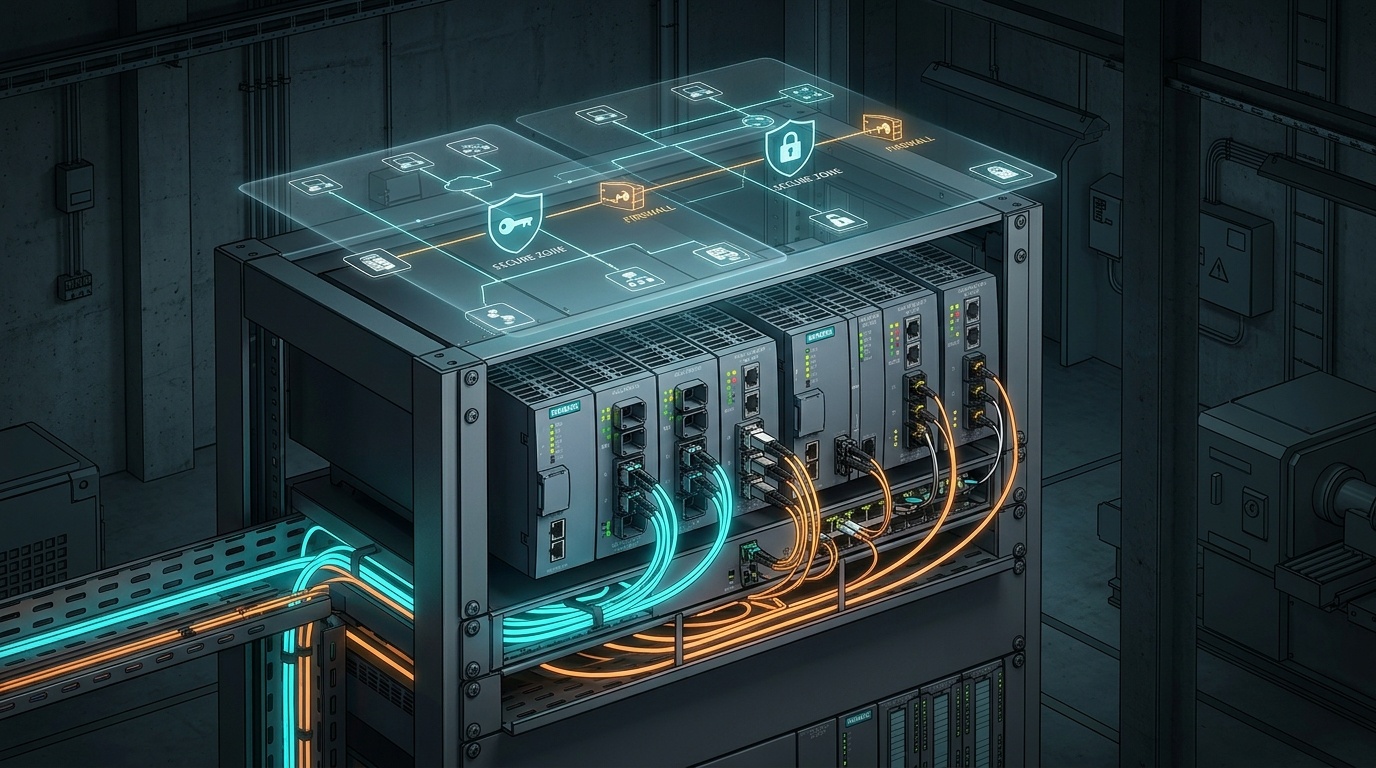
Siemens ProductCERT and the Cybersecurity and Infrastructure Security Agency (CISA) have issued critical advisories regarding CVE-2026-68840, a severe vulnerability in the firmware verification routine of Siemens SCALANCE X Industrial Ethernet switches. SCALANCE managed switches serve as the foundational backbone for operational technology (OT) networks worldwide, connecting programmable logic controllers (PLCs), distributed control systems (DCS), and human-machine interfaces (HMIs) across manufacturing plants, water treatment facilities, and power grids.
The flaw, which holds a CVSS v3.1 rating of 9.8 (Critical), permits an unauthenticated attacker with network adjacency to bypass cryptographic signature verification, upload compromised firmware binaries, and gain persistent, privileged execution within the switch operating system.
Vulnerability Deep Dive: Time-of-Check Time-of-Use Flaw in BootROM
The core weakness originates within the switch's secondary stage bootloader and web management firmware update daemon. When a firmware image is pushed via TFTP or the HTTPS administrative interface, the device performs an RSA signature check. However, a Time-of-Check to Time-of-Use (TOCTOU) race condition in the temporary flash memory buffer allows an attacker to swap the verified binary before it is committed to non-volatile flash storage.
// Conceptual representation of the TOCTOU firmware verification flaw
int verify_and_flash_firmware(const char *temp_buffer, size_t img_len) {
    // Stage 1: Cryptographic verification of image header
    if (crypto_verify_rsa_signature(temp_buffer, img_len) != STATUS_OK) {
        log_security_alert("Firmware signature verification failed");
        return -1;
    }

    // VULNERABLE WINDOW: Memory pointer not locked; DMA transfer or asynchronous TFTP thread
    // can overwrite temp_buffer before write_flash_block executes
    usleep(10000); // Internal hardware stabilization delay

    // Stage 2: Flashing execution without re-verifying hash
    return write_flash_block(FLASH_PARTITION_OS, temp_buffer, img_len);
}
Operational Impact on Purdue Model & IEC 62443 Compliance
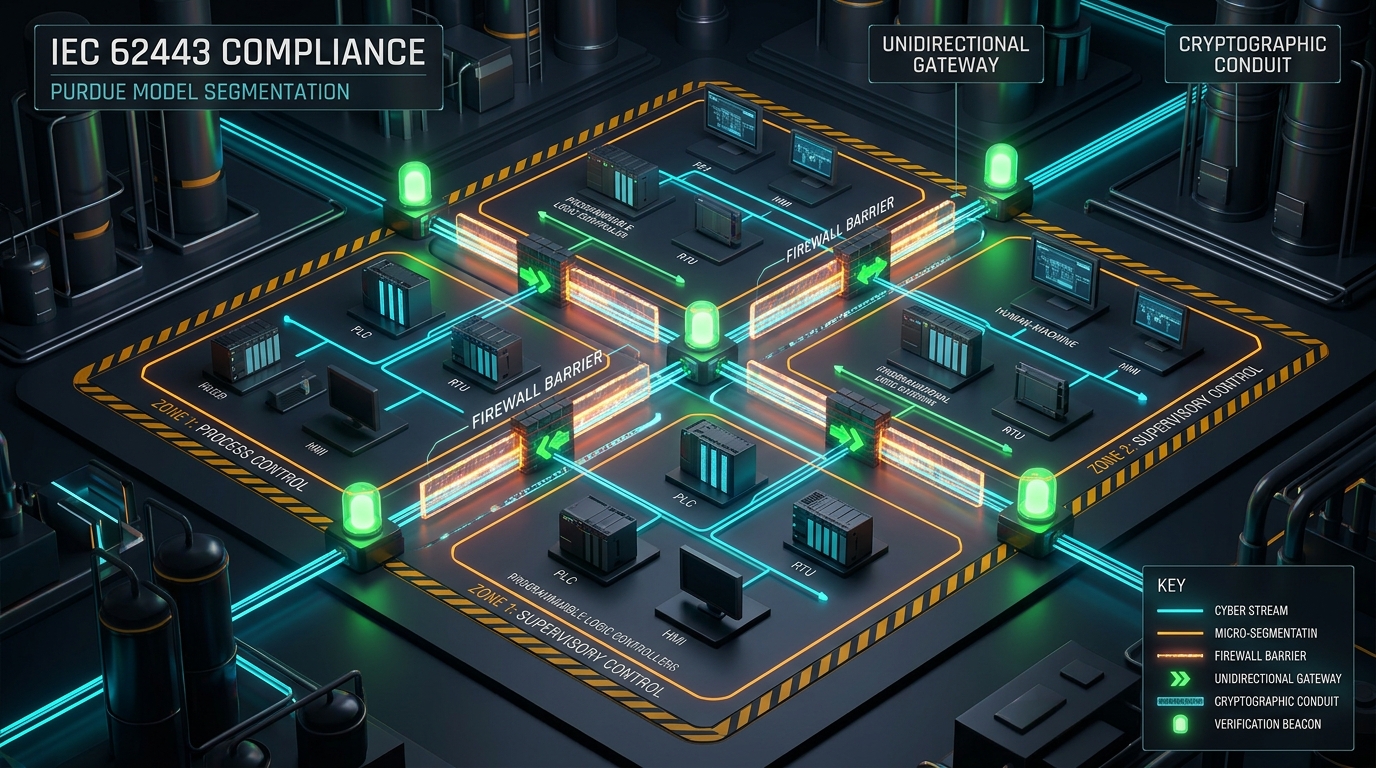
Under the Purdue Enterprise Reference Architecture (PERA), SCALANCE switches operate at Level 2 (Control Systems) and Level 1 (Basic Control), routing real-time deterministic traffic like PROFINET IO and Modbus TCP between engineering workstations and field PLCs.
By compromising a SCALANCE switch at the firmware level, an adversary achieves total control over network traffic within the industrial zone. This breaks the fundamental segmentation required by IEC 62443-3-2 and IEC 62443-3-3 (Security Level 3/4 requirements). An attacker can:
- Fabricate Sensor Telemetry: Inject spoofed temperature, pressure, or rotational speed measurements into HMI monitoring feeds, blinding plant operators to physical anomalies.
- Intercept Safety Signals: Delay or drop emergency stop (E-Stop) commands sent over PROFINET Safety protocols.
- Establish Covert Command & Control: Utilize the compromised switch as an invisible persistence implant immune to standard IT endpoint detection and response (EDR) agents.
Remediation & Defense-in-Depth Checklist
Siemens has made firmware updates available across affected product lines. Industrial asset owners should execute the following remediation roadmap:
- Deploy Remediated Firmware: Upgrade SCALANCE X-200 series to firmware
v5.2.4, SCALANCE X-300 tov4.1.6, and SCALANCE XM-400 tov6.3.1. - Engage Hardware Write-Protect Jumpers: Where supported, physically toggle the hardware write-protect switch on switch mainboards to prevent non-volatile memory writes without physical access.
- Deactivate Insecure Protocols: Permanently disable TFTP, Telnet, and HTTP in the switch configuration, enforcing SSHv2 and HTTPS with TLS 1.3 only.
- Implement IEEE 802.1X Port Authentication: Enforce strict certificate-based authentication on all switch ports to prevent unauthorized rogue hardware connections.