Executive Overview
Emerson Power & Water Solutions, in coordination with CISA, has disclosed a critical security flaw designated CVE-2026-69880 in its flagship Ovation Distributed Control System (DCS) OCR400 Controller line. The vulnerability, rated with a maximum CVSS v3.1 score of 9.8 (Critical), allows an unauthenticated network adversary to trigger a remote heap memory corruption, achieving arbitrary code execution within the controller's real-time operating system (RTOS).
The Ovation architecture is widely deployed in mission-critical infrastructure, including fossil-fuel and combined-cycle power generating stations, nuclear balance-of-plant systems, renewable energy facilities, and municipal wastewater treatment operations. Compromise of an active controller can directly disrupt turbine speed governor loops, boiler feedwater valves, or electrical frequency stabilizers.
Technical Root Cause: Heap Buffer Overflow in Synchronization Daemon
The OCR400 controller utilizes a proprietary peer-to-peer telemetry protocol over UDP port 5150 to synchronize control points and status registers across redundant controller pairs. When an incoming packet arrives, the synchronization service unpacks structured point records.
The routine responsible for unpacking variable-length string descriptors failed to validate that the record length field did not exceed the fixed 512-byte allocation in RTOS heap memory. By transmitting a series of specially crafted UDP datagrams with oversized length prefixes, an attacker can overwrite adjacent heap metadata, hijack the RTOS execution flow, and inject arbitrary machine instructions.
// Vulnerable snippet in Ovation point descriptor unpacking routine
void process_ovation_sync_packet(const uint8_t *packet_data, size_t packet_len) {
    uint16_t descriptor_len = read_uint16(packet_data + OFFSET_DESC_LEN);

    // VULNERABLE: Missing boundary check against fixed HEAP_BUFFER_SIZE (512 bytes)
    char *point_desc = (char *)rtos_heap_alloc(HEAP_BUFFER_SIZE);

    // Unchecked memcpy causes heap overflow into RTOS task control block (TCB)
    memcpy(point_desc, packet_data + OFFSET_DESC_BODY, descriptor_len);

    update_controller_point_table(point_desc);
}
Threat Modeling & Industrial Attack Scenarios
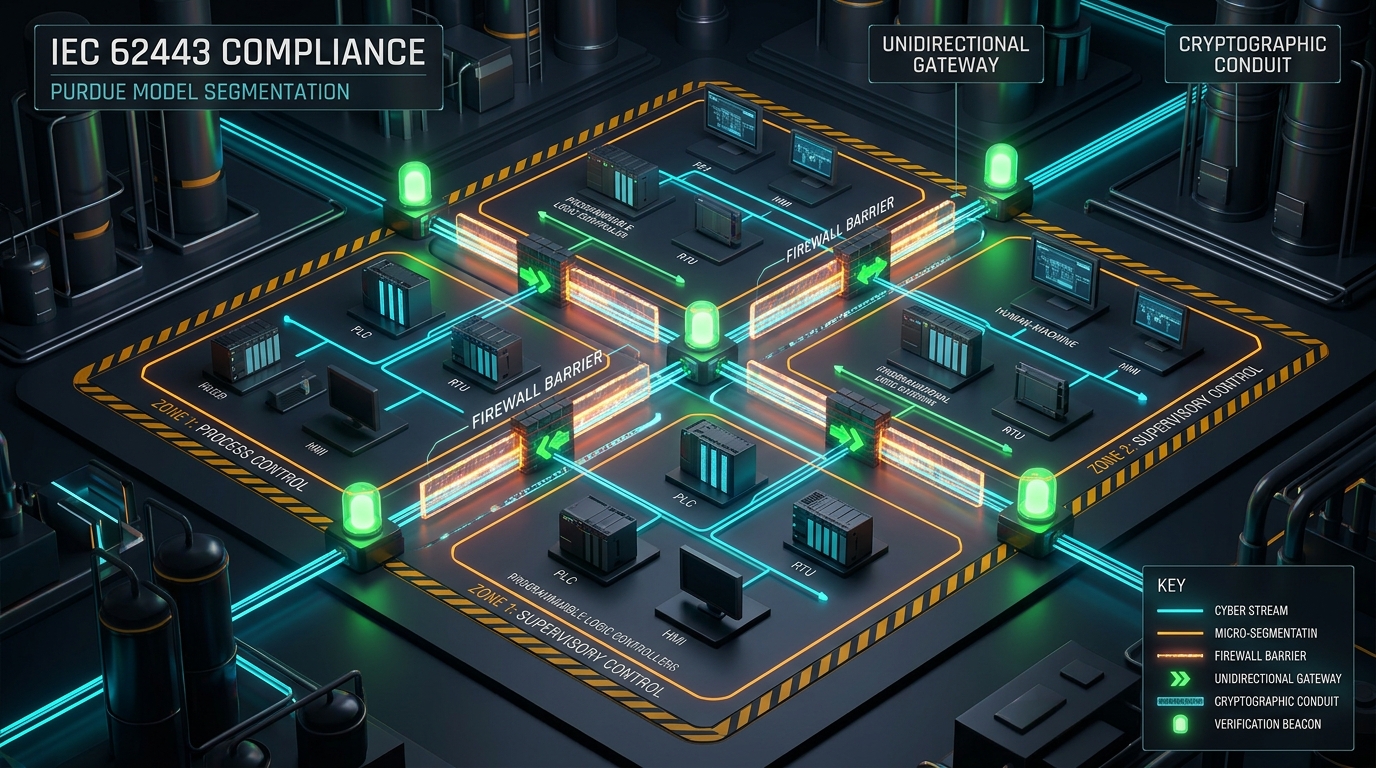
Within the IEC 62443 industrial security framework, controller hardware resides at Level 1 (Direct Control) of the Purdue Model. While controller networks should never be directly connected to enterprise IT or the public Internet, real-world attack campaigns (such as PIPEDREAM and Industroyer) routinely breach IT networks, pivot through engineering workstations, and target the controller bus.
An attacker weaponizing CVE-2026-69880 can execute several destructive actions:
- Turbine Overspeed Induction: Alter logic loops controlling steam or gas turbine fuel intake, overriding mechanical safety setpoints and risking catastrophic equipment destruction.
- Firmware Freeze / Blackout Trigger: Crash controller execution tasks simultaneously across redundant OCR400 pairs, forcing immediate protective plant shutdowns and power grid frequency instability.
- Stealth Logic Manipulation: Modify internal PID controller coefficients while sending normal state values back to the SCADA historian, preventing operators from diagnosing physical wear.
Mitigation & Defense-in-Depth Playbook
Power plant operators and utility asset owners are advised to execute immediate defense-in-depth measures:
- Apply Firmware Patch: Upgrade Emerson OCR400 controller firmware to version
3.6.2or higher as specified in Emerson Advisory PWS-2026-004. - Isolate UDP Port 5150: Enforce strict firewall rules at the boundary of Level 1 and Level 2, blocking all incoming UDP traffic on port 5150 except between authenticated redundant controller pairs.
- Deploy Hardware Data Diodes: Ensure all data flow from Level 1 Ovation controllers to Level 2/3 historians is strictly unidirectional using physical optical data diodes.
- Enable Real-Time Industrial Network Monitoring: Implement passive OT network intrusion detection sensors tuned to identify malformed Ovation synchronization packets and unauthorized controller configuration commands.