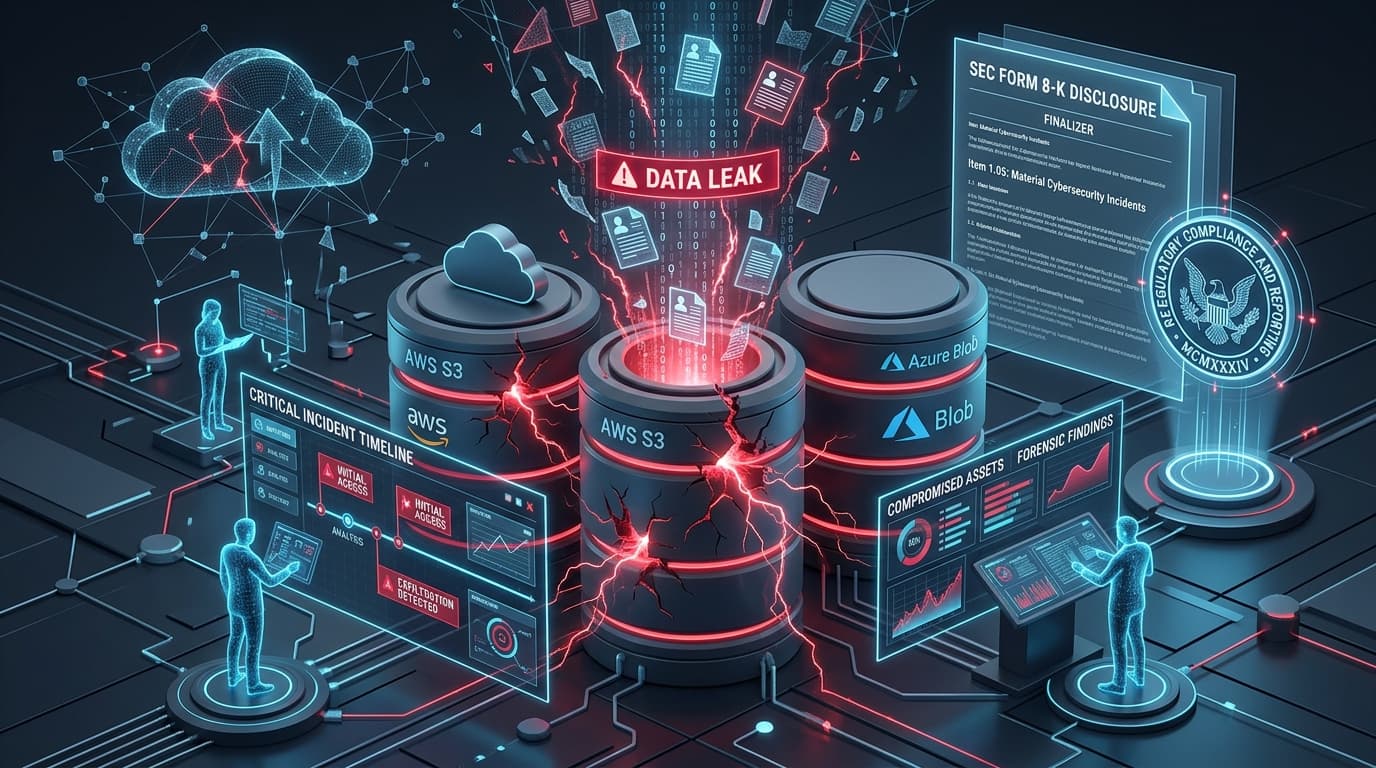
A forensic cross-industry analysis of recent U.S. Securities and Exchange Commission (SEC) Form 8-K Item 1.05 filings reveals that misconfigured cloud object storage repositories and long-lived Identity and Access Management (IAM) service tokens are now the dominant vector behind material enterprise cybersecurity incidents. Public corporations across finance, retail, and technology are facing multimillion-dollar extortion demands stemming from unattended cloud data lakes.
The SEC Item 1.05 Disclosure Landscape
Adopted in late 2023 and aggressively enforced through 2026, Item 1.05 of Form 8-K requires public issuers to disclose any cybersecurity incident determined to be "material" within four business days of that determination. Issuers must describe the nature, scope, and timing of the incident, as well as its reasonably likely impact on financial condition and operational results.
The regulatory window has fundamentally altered corporate crisis management. While threat actors previously leveraged extended disclosure ambiguity to pressure victims privately, the public nature of SEC filings has accelerated breach disclosure timelines and exposed recurring architectural deficiencies in enterprise cloud migrations.
Forensic Root Cause: Cloud Credential Leakage & Bucket Over-Privilege
Contrary to common perceptions that material breaches require sophisticated zero-day exploits, primary EDGAR disclosures and supporting incident response post-mortems indicate that initial access routinely traces to:
- Stale IAM Access Keys in CI/CD Artifacts: Programmatic AWS/Azure/GCP credentials embedded in legacy public code repositories or unencrypted container image registries.
- Permissive S3/Blob Bucket Policies: Analytics data lakes configured with
Principal: *or open read access to "All Authenticated Users," enabling anyone with an active cloud account to query corporate logs. - Session Token Hijacking via Infostealers: Developer and administrative browser session cookies stolen by malware strains (e.g., Lumma, RedLine) allowing threat actors to bypass Multi-Factor Authentication (MFA) on cloud management consoles.
// Example of high-risk misconfigured AWS S3 Bucket Policy discovered in forensic filings
{
  "Version": "2012-10-17",
  "Statement": [
    {
      "Sid": "AllowPublicReadForAnalytics",
      "Effect": "Allow",
      "Principal": "*",
      "Action": [
        "s3:GetObject",
        "s3:ListBucket"
      ],
      "Resource": [
        "arn:aws:s3:::enterprise-data-lake-prod/*",
        "arn:aws:s3:::enterprise-data-lake-prod"
      ]
    }
  ]
}
Comparative Metric Analysis of Recent SEC 8-K Filings
| Disclosed Impact Metric | Observed Trend in 2026 Filings | Primary Mitigation Requirement |
|---|---|---|
| Average Time to Materiality Determination | 7.2 Days from Initial Discovery | Cross-functional CISO, CFO, and Legal Incident Review Committees |
| Predominant Attack Vector | Compromised Cloud IAM Credentials & Storage Leaks (68%) | Mandatory short-lived STS tokens and IAM credential expiration policies |
| Extortion Model | Data Exfiltration Without Ransomware Encryption (81%) | Granular DLP, VPC Service Controls, and outbound bandwidth anomalies |
| Regulatory Follow-up | SEC Enforcement inquiries regarding internal materiality delays | Deterministic SOC materiality scoring rubrics and immutable audit trails |
Remediation & Governance Roadmap for Public Companies
To prevent material data exfiltration and ensure rigorous compliance with federal disclosure standards, security teams must deploy the following controls:
1. Enforce Cloud Provider Block Public Access & SCPs
Deploy AWS Service Control Policies (SCPs) and Azure Policy definitions at the root management group level that strictly forbid creating publicly accessible storage buckets:
# AWS CLI: Enable account-wide S3 Block Public Access
aws s3control put-public-access-block   --account-id 123456789012   --public-access-block-configuration     "BlockPublicAcls=true,IgnorePublicAcls=true,BlockPublicPolicy=true,RestrictPublicBuckets=true"
2. Eliminate Permanent IAM User Keys
Deprecate static IAM access keys in favor of OpenID Connect (OIDC) identity federation for GitHub Actions and GitLab CI/CD pipelines, ensuring cloud credentials exist only for the lifespan of an individual build job.
3. Deploy Automated Data Egress Anomalies Detection
Configure cloud monitoring alarms that trigger immediate alerts when outbound data transfer from object storage repositories exceeds standard baseline thresholds by more than 300%.