Regulatory Disclosure & Incident Summary
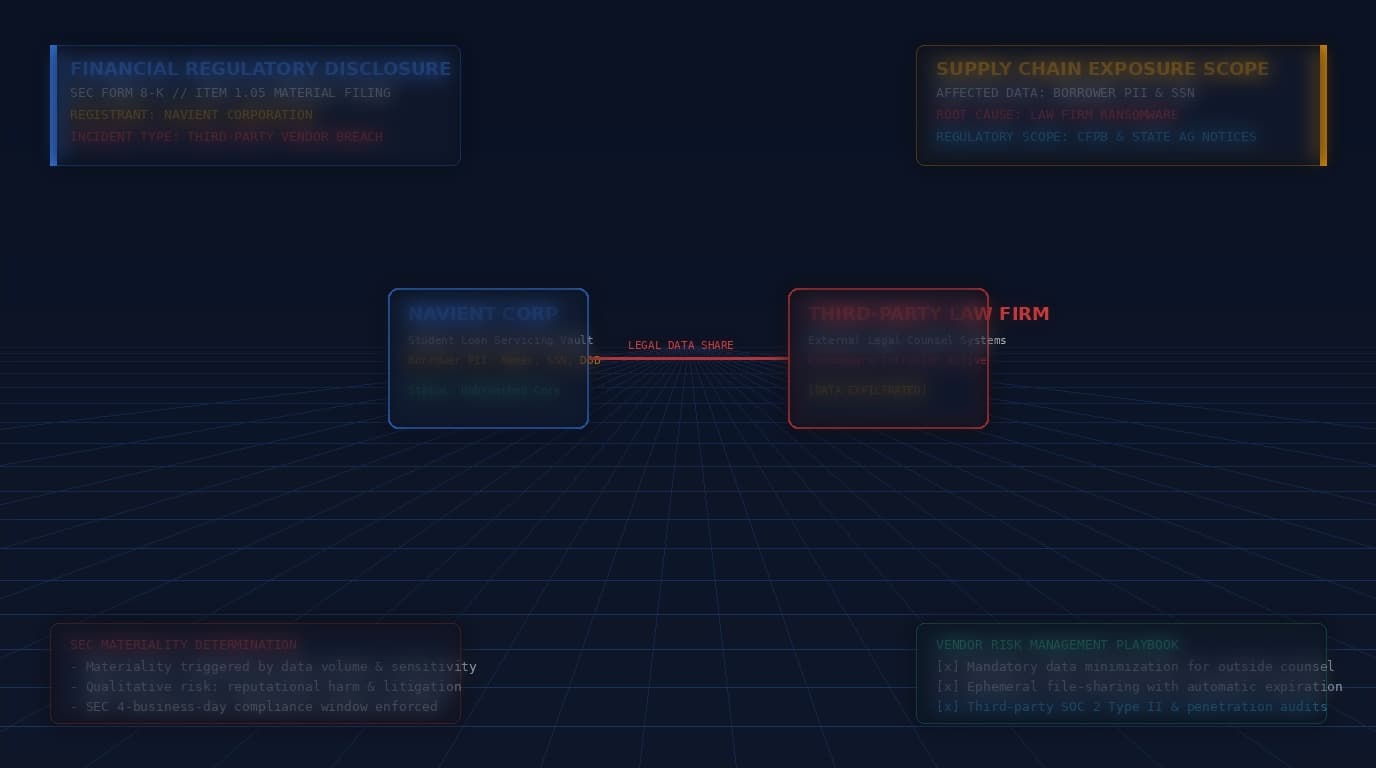
Navient Corporation (NASDAQ: NAVI), a leading provider of student loan servicing, education finance management, and asset recovery solutions, has submitted a formal Form 8-K Item 1.05 disclosure to the U.S. Securities and Exchange Commission (SEC). The filing reports a material cybersecurity incident resulting from a sophisticated ransomware intrusion against an independent third-party law firm retained by Navient for default litigation, loan collection recovery, and bankruptcy representation.
According to the regulatory disclosure, threat actors breached the law firm's internal infrastructure, encrypted administrative and document storage environments, and successfully exfiltrated extensive archival repositories containing personally identifiable information (PII) and sensitive financial records of student loan borrowers. Crucially, the disclosure clarifies that Navient's proprietary enterprise network, customer servicing platforms, core databases, and corporate applications were not breached or directly accessed. Nonetheless, because the exfiltrated legal discovery and litigation hold records contained unencrypted borrower Social Security numbers and account portfolios, Navient determined that the incident triggered mandatory public reporting obligations under federal securities regulations.
Data Exposure Anatomy & The Legal Supply Chain Vulnerability
Law firms and litigation support vendors represent premier targets for extortion cartels and advanced persistent threat (APT) groups due to the high density of confidential corporate disclosures, non-public intellectual property, and unredacted customer PII transferred during legal proceedings. In the case of loan servicers like Navient, outside counsel routinely receives batch files containing decades of borrower documentation required to file proofs of claim in bankruptcy court or substantiate collection actions.
| Data Classification Category | Exfiltrated Elements Identified in 8-K | Regulatory & Compliance Blast Radius |
|---|---|---|
| Identity & PII Data | Full legal names, residential addresses, dates of birth, Social Security Numbers (SSNs) | State Breach Notification Statutes (all 50 states), CFPB Title V Safeguards |
| Financial Account Identifiers | Loan account numbers, promissory note copies, payment schedules, balance histories | Gramm-Leach-Bliley Act (GLBA), FTC Safeguards Rule |
| Bankruptcy & Court Records | Affidavits of debt, discharge petitions, income verification records | Federal Rules of Bankruptcy Procedure, judicial seal compliance |
| Enterprise Corporate Data | Navient outside counsel billing records, fee agreements, engagement scopes | Corporate governance, attorney-client privileged communication safeguards |
SEC Form 8-K Item 1.05 Materiality Determination Dynamics
Navient's submission underscores the evolving operational reality of the SEC's landmark cybersecurity disclosure framework (Release No. 33-11216). Under Item 1.05 of Form 8-K, public registrants must determine whether an incident is "material" within four business days of discovery. Crucially, the rule makes no distinction between direct intrusions into registrant-owned networks and third-party vendor compromises that involve registrant data.
Navient's disclosure highlights several key dimensions of modern corporate materiality:
- Qualitative Risk Over Direct Financial Loss: While Navient did not suffer business interruption or ransomware extortion demands against its own operations, the qualitative exposure—comprising consumer class-action litigation, state attorney general inquiries, Consumer Financial Protection Bureau (CFPB) enforcement scrutiny, and reputational injury—justified a formal finding of materiality.
- The Four-Day Clock in Third-Party Compromises: Determining materiality in supply chain attacks presents acute friction because registrants depend entirely on the vendor's forensic timeline. Navient's filing indicates that outside counsel notified the company following preliminary forensic confirmation by third-party incident response firms, triggering Navient's internal disclosure committee to initiate the SEC reporting clock.
- DOJ Delay Provisions: Navient confirmed that the incident was not subject to a national security delay request from the Department of Justice under Rule 1.05(c), allowing transparent disclosure to public equity markets and credit rating agencies.
Legal Sector Attack Mechanics & Supply Chain Defense Breakdown
Historically, mid-sized and boutique law firms operate with significantly lower cybersecurity expenditure and defensive maturity than the Fortune 500 financial institutions they represent. Threat intelligence tracking law firm extortion reveals standard exploitation playbooks:
[Initial Access]
  |-- Compromised VPN / RDP Gateway (Unpatched Ivanti / Fortinet / Citrix)
  |-- Phishing & Session Cookie Theft targeting Partner Microsoft 365 Accounts
        |
        v
[Internal Reconnaissance & Privilege Escalation]
  |-- Active Directory Domain Compromise via BloodHound & Mimikatz
  |-- Discovery of Centralized Document Management Systems (iManage, NetDocuments)
        |
        v
[Data Exfiltration]
  |-- Rclone / Megasync exfiltration of unencrypted Client Matter Folders
  |-- Transfer of multi-terabyte litigation archives to attacker VPS
        |
        v
[Double Extortion Ransomware Execution]
  |-- Deployment of BlackCat/ALPHV, Akira, or LockBit variants across legal servers
  |-- Extortion demand issued simultaneously to Law Firm and Corporate Clients
In many instances, corporate legal teams transfer massive, historical customer files over SFTP or cloud sharing links during discovery phases, but fail to enforce automated data retention and data destruction schedules once the litigation closes. Consequently, decade-old borrower archives remain stored on the law firm's network indefinitely, transforming standard legal archives into high-risk data repositories.
Third-Party Legal Risk Management Playbook
Enterprise CISOs, chief legal officers, and vendor management teams must immediately implement structured governance over outside counsel data lifecycles:
1. Enforce Cryptographic Data Minimization & Secure Clean Rooms
Never provide external law firms with unredacted Social Security numbers or full account databases if truncated or tokenized identifiers suffice for court filings. When raw data sharing is legally mandatory, require outside counsel to access records via a virtual desktop infrastructure (VDI) clean room with clipboard restrictions and data loss prevention (DLP) controls, preventing data from residing on vendor-owned storage.
2. Contractual Audit Rights & Cybersecurity Baselines
Revise outside counsel engagement agreements to mandate strict, enforceable cybersecurity baselines:
- Mandatory multi-factor authentication (MFA) with FIDO2 hardware tokens on all external VPNs, remote desktop interfaces, and email accounts.
- Annual SOC 2 Type II compliance reports and independent third-party penetration test attestations.
- Strict 24-hour incident notification windows compelling outside counsel to disclose suspicious network anomalies before ransomware encryption occurs.
3. Automated Data Destruction & Certificate of Disposal
Institute strict data retention policies compelling legal vendors to certify the cryptographic destruction of customer and borrower files within 30 days of litigation closure or bankruptcy case completion. Conduct regular verification audits to ensure law firms do not maintain orphaned data archives.