A Historic Precedent: The SEC's First "Shadow AI" Material Breach Filing
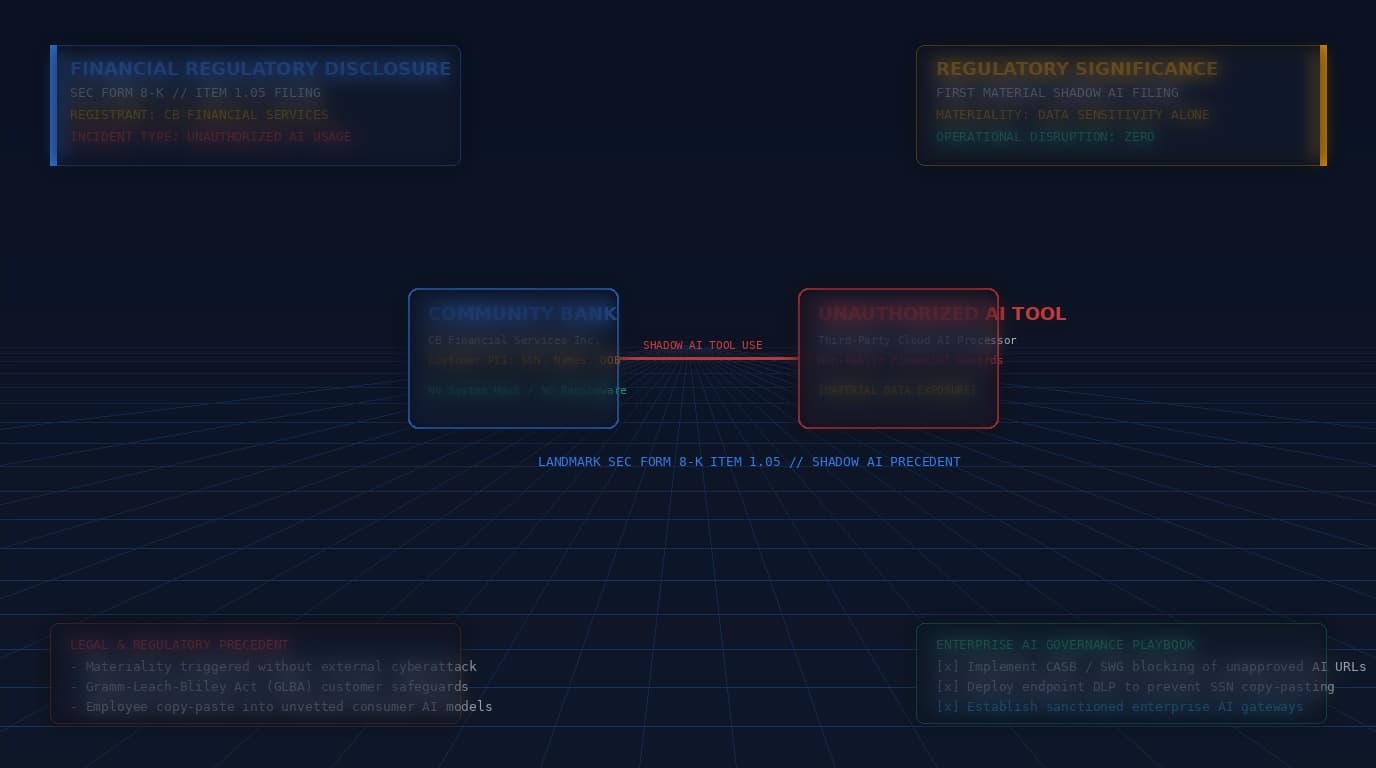
In a regulatory filing that has reverberated across corporate boardrooms, legal counsel chambers, and enterprise cybersecurity departments, CB Financial Services, Inc. (NASDAQ: CBFV)—the parent holding company of Pennsylvania-based Community Bank—has submitted a formal Form 8-K Item 1.05 disclosure to the U.S. Securities and Exchange Commission (SEC).
Unlike conventional 8-K disclosures driven by ransomware cartels, zero-day perimeter exploits, or cloud bucket misconfigurations, CB Financial Services disclosed a material cybersecurity incident resulting entirely from unauthorized internal employee usage of an artificial intelligence tool. The filing represents the first documented instance where a publicly traded financial institution determined that the use of "shadow AI" by internal staff met the threshold of a material cybersecurity incident under federal securities law.
Incident Anatomy: How Employee AI Usage Triggered a Material Breach
According to the official Form 8-K disclosure, the bank became aware on May 5, 2026, that an employee at Community Bank utilized an unauthorized, third-party AI software application to perform data processing tasks. In doing so, the employee input unredacted files containing non-public customer personally identifiable information (PII).
On May 7, 2026, the company's disclosure committee formally determined that the unauthorized transmission of customer records constituted a material cybersecurity incident:
| Incident Dimension | Disclosed Reality & Technical Specifics | Regulatory & Industry Significance |
|---|---|---|
| Root Cause Vector | Employee copy-pasting customer records into unvetted consumer AI application | Shadow AI operational risk supersedes external adversary intrusion |
| Exposed Data Elements | Full legal customer names, Social Security numbers (SSNs), dates of birth | Statutory breach under GLBA Safeguards Rule and state PII statutes |
| Core Infrastructure Impact | Zero downtime; core banking, ATM, and payment networks unbreached | Demonstrates that operational interruption is NOT required for materiality |
| Consolidated Financial Risk | Company does not expect material impact on financial results | Qualitative regulatory, litigation, and reputational materiality asserted |
The Legal Evolution of Qualitative Materiality Under SEC Item 1.05
The CB Financial Services filing establishes a vital legal milestone under the SEC's cybersecurity disclosure rules adopted in 2023. Historically, corporate registrants argued that cybersecurity disclosures were only warranted if an incident caused quantifiable balance-sheet damage, extortion payments, or prolonged operational paralysis.
CB Financial Services' determination proves that the volume and inherent sensitivity of customer data alone can trigger mandatory disclosure. When non-public financial records containing Social Security numbers are transmitted to external, consumer-grade AI platforms, the data may be retained for model retraining, logged in cleartext on third-party servers, or accessed by outside contractors without corporate confidentiality agreements.
Under the Gramm-Leach-Bliley Act (GLBA) Safeguards Rule, financial institutions are fiduciarily obligated to protect customer information from unauthorized access or use. The moment customer SSNs entered an unvetted cloud AI model, the bank lost custody of the data, precipitating mandatory breach notification obligations to affected customers, federal regulators, and state Attorneys General.
Shadow AI Attack Chains & The Enterprise Productivity Dilemma
The incident at Community Bank underscores a ubiquitous vulnerability across modern enterprises: the gap between employee demand for AI productivity and corporate security guardrails.
[Well-Intentioned Bank Employee]
  |-- Tasked with summarizing customer loan portfolio or auditing account records
  |-- Finds internal tools slow or manual; opens unauthorized web AI tool in browser
        |
        v
[Clipboard Transfer of Unredacted Financial Records]
  |-- Copies Excel spreadsheet containing 5,000 customer rows: [Name, SSN, DOB, Balance]
  |-- Pastes data into prompt box of free/unmanaged consumer AI service
        |
        v
[External AI Cloud Infrastructure (Untrusted Domain)]
  |-- Third-party AI vendor logs prompt text in telemetry databases
  |-- Model terms of service permit training on user prompts
  |-- Bank loses cryptographic custody and audit trail
        |
        v
[Discovery & Forensic Realization]
  |-- IT / CASB alerts on large text upload to unapproved generative AI domain
  |-- Disclosure Committee convenes: Mandatory Form 8-K Item 1.05 filed within 4 days
Enterprise Shadow AI Defense & Governance Playbook
To prevent unauthorized AI tools from causing material regulatory disclosures, financial institutions and enterprises must implement multi-layered technological and administrative controls:
1. Enforce Web Gateway (SWG) and CASB AI Blocking Policies
Configure Cloud Access Security Brokers (CASB) and Secure Web Gateways (such as Cloudflare Gateway, Zscaler, or Netskope) to block access to unapproved generative AI web domains by default:
# Example CASB policy rule logic:
Rule: Block-Unsanctioned-GenAI
Condition:
  Category == "Generative AI" AND ApplicationStatus == "Unapproved"
Action:
  BLOCK request AND display user educational interstitial:
  "Access to unsanctioned AI tools is prohibited under GLBA Policy.
   Please use the enterprise-approved AI portal at ai.internal.bank.com."
2. Deploy Endpoint Data Loss Prevention (DLP) Regex Scanning
Implement endpoint DLP agents that monitor clipboard actions and browser input fields, actively blocking paste operations containing sensitive data patterns:
# DLP regex pattern blocking Social Security Numbers:
Regex: (?!000|666|9d{2})d{3}-(?!00)d{2}-(?!0000)d{4}
Action: Block paste event into web browser + trigger immediate SOC alert
3. Provide Secure, Sanctioned Enterprise AI Environments
Outright bans on AI frequently fail because employees seek productivity workarounds. Organizations must provide enterprise-grade, zero-data-retention AI subscriptions (such as Microsoft 365 Copilot or private Azure OpenAI instances) bound by strict Business Associate Agreements (BAAs) ensuring prompts are never used to train foundation models.