Executive Lead & Supply Chain Threat Overview
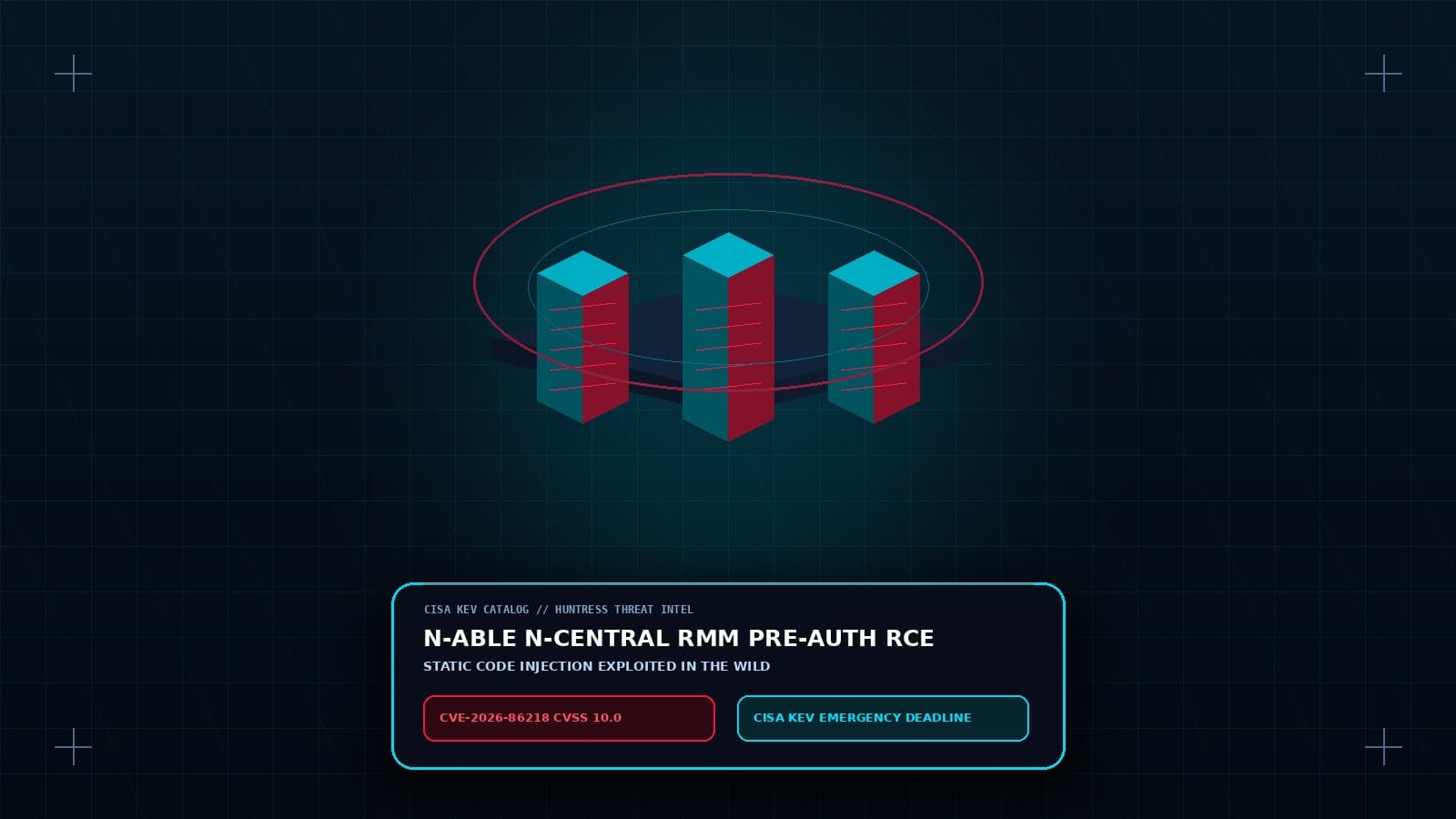
The Cybersecurity and Infrastructure Security Agency (CISA) has issued an urgent binding mandate by adding CVE-2026-18577 to its Known Exploited Vulnerabilities (KEV) catalog. Classified with a maximum severity rating of CVSS 9.8 Critical, the flaw represents an authentication bypass vulnerability using an alternate path or channel (CWE-288) within N-able N-central—one of the world's premier Remote Monitoring and Management (RMM) platforms deployed by thousands of Managed Service Providers (MSPs) and enterprise IT operations teams globally.
In modern IT ecosystems, RMM platforms occupy a position of ultimate trust. An N-central central server maintains persistent, highly privileged agent communication channels with hundreds of thousands of client workstations, domain controllers, virtualization hypervisors, and cloud workloads across multiple distinct corporate tenants. In-the-wild exploitation demonstrates that threat actors are actively leveraging this flaw to bypass web authentication, hijack MSP root consoles, and stage downstream automated ransomware distribution across entire customer bases in coordinated supply chain intrusions.
Vulnerability Mechanics & Alternate Path Dissection
The core vulnerability arises from a severe discrepancy between how the frontend reverse proxy (handling incoming HTTPS requests on TCP port 443) and the backend application service (running Java-based enterprise services) interpret and normalize URI path hierarchies.
N-central relies on URL pattern filters defined in its web application deployment descriptors (web.xml) to protect administrative routes beneath /admin/, /dms2/, and /api/system/. However, the application container supports alternate path notations and URL parameter matrix segments (e.g., semicolon path delimiters or URL-encoded path traversals such as /public/..;/admin/ or /services/..%2fadmin/):
POST /public/..;/api/system/users/provision HTTP/1.1
Host: rmm.mspcloud.net
User-Agent: Mozilla/5.0 (Windows NT 10.0; Win64; x64)
Content-Type: application/json
Content-Length: 184

{
  "username": "superadmin_emergency",
  "password": "TemporaryAttackerPassword2026!",
  "role": "SuperAdministrator",
  "organizationId": 0,
  "mfaEnabled": false
}
When processing this request:
- The edge authentication filter examines the raw request path (
/public/..;/...), matches it against the public, unauthenticated URI prefix whitelist (/public/*), and permits the request to pass without validating session cookies or bearer tokens. - The internal servlet container strips the matrix segment (
..;) during canonical path normalization, resolving the target URI to the privileged administrative handler (/api/system/users/provision). - The administrative service executes the instruction under the security context of the root application daemon, provisioning a full super-administrator identity with global multi-tenant access.
Downstream Threat Campaigns & Post-Compromise Tactics
Cyber threat intelligence indicates that sophisticated initial access brokers and ransomware syndicates utilize CVE-2026-18577 as an operational force multiplier:
- Automated Script Deployment: Using N-central's native Automation Manager and Direct Support tools, attackers dispatch base64-encoded PowerShell scripts to all connected agents simultaneously. These scripts run with
NT AUTHORITYSYSTEMprivileges on Windows endpoints. - EDR/XDR Neutralization: Attackers leverage N-central's administrative features to disable third-party endpoint detection and response (EDR) agents, modify local firewall rules, and delete volume shadow copies (
vssadmin delete shadows /all /quiet). - Domain Controller Hijacking: Because MSPs typically install N-central agents on domain controllers to monitor Active Directory health, attackers dump the Active Directory database (
NTDS.dit) and Kerberos Golden Tickets within minutes of server compromise. - Ransomware Orchestration: Mass deployment of ransomware binaries (such as BlackCat, LockBit, or Akira derivatives) is executed across thousands of client workstations concurrently, crippling enterprise operations across disparate geographical regions.
Affected Software Builds & Remediation Matrix
| Product Family | Vulnerable Builds | Patched Release Baseline | Deployment Status |
|---|---|---|---|
| N-able N-central (On-Premises) | Versions prior to 2024.1 Hotfix 2 | N-central 2024.1 HF2 or 2024.2+ | Emergency patch mandatory |
| N-able N-central (Legacy 2023.x) | All 2023.x branches | Upgrade to 2024.1 HF2+ | Unsupported / End-of-Life |
| N-able N-central Cloud (SaaS) | Managed by Vendor | Remediated by N-able Operations | Mitigated upstream |
Defensive Playbook & Emergency Incident Response
Managed service providers and enterprise administrators operating self-hosted N-central infrastructure must execute the following immediate countermeasures:
1. Immediate Perimeter Access Restriction
Block all public internet access to the N-central web management console (TCP ports 80, 443, 8443). Restrict management ingress exclusively to static corporate IP addresses or dedicated administrative IPsec/WireGuard VPN tunnels:
# Linux iptables: Enforce strict IP whitelist for N-central web ingress
iptables -A INPUT -p tcp -s 203.0.113.50 --dport 443 -j ACCEPT
iptables -A INPUT -p tcp -s 198.51.100.25 --dport 443 -j ACCEPT
iptables -A INPUT -p tcp --dport 443 -j DROP
2. Apply Official Vendor Hotfix
Download and install N-central 2024.1 Hotfix 2 or later from the official N-able partner portal. Verify that the update normalizes all incoming URI paths before evaluating authentication filters and rejects requests containing unexpected URI matrix characters or double-encoded path separators.
3. Forensic Verification of Administrative Accounts
Perform an exhaustive audit of all user accounts within the N-central administrative console:
- Inspect user creation logs for unauthorized profiles generated without corresponding ticketing system records.
- Audit scheduled automated tasks in the Automation Manager for unfamiliar scripts, remote downloading routines, or execution flags.
- Verify agent communication logs for bulk script dispatches targeting all client groups.
4. Endpoint Containment & Credential Invalidation
If indicators of compromise are identified on the N-central host, immediately disconnect the N-central server from the network to prevent further script dispatch to client agents. Force a global password reset across all managed domain controllers and rotate all local administrator account passwords managed by the RMM platform.