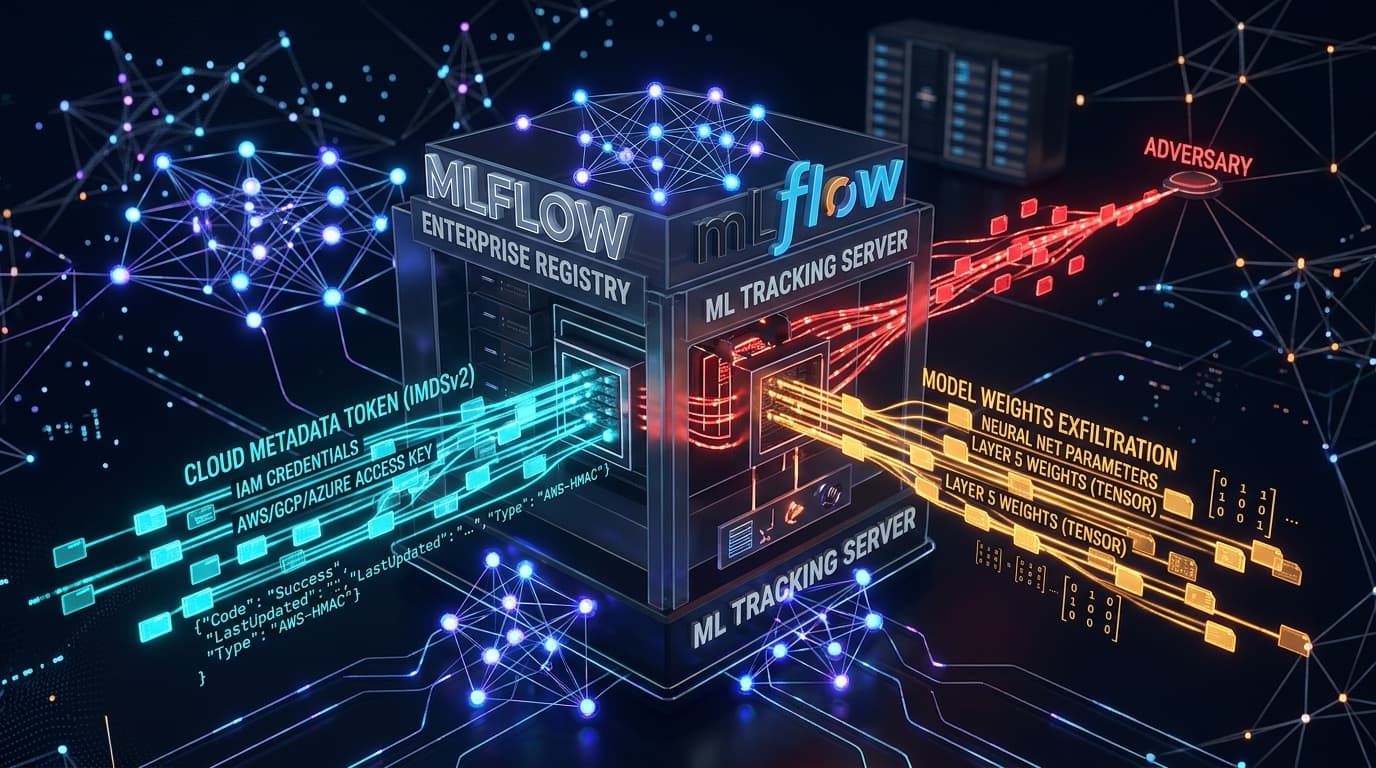
The Cybersecurity and Infrastructure Security Agency (CISA) has officially added CVE-2026-64849 to its Known Exploited Vulnerabilities catalog. The vulnerability affects MLflow, the ubiquitous open-source platform managed by the Linux Foundation and Databricks for managing the complete machine learning lifecycle, including experiment tracking, model packaging, and centralized model registries.
Rated with a maximum-severity CVSS v3.1 score of 9.8 (CVSS:3.1/AV:N/AC:L/PR:N/UI:N/S:U/C:H/I:H/A:H), the vulnerability enables unauthenticated or low-privileged remote attackers to weaponize the MLflow tracking server into an internal proxy, issuing arbitrary network requests to cloud infrastructure endpoints and exfiltrating sensitive cloud instance metadata.
Technical Mechanics: Unvalidated Model Artifact URI Scheme Handling
The flaw stems from how the MLflow tracking server ingests and logs artifact locations during model version registration and run evaluations:
- Arbitrary URI Ingestion: When users log model runs or register new candidate model artifacts via REST API endpoints (such as
/ajax-api/2.0/mlflow/runs/createor/api/2.0/mlflow/artifacts/list), the server accepts arbitrary user-supplied artifact location URIs without enforcing an allowlist of permitted schemes. - Server-Side Request Trigger: When the tracking server attempts to inspect or download the specified artifact metadata, it issues an outbound HTTP request directly from the server host.
- Cloud Metadata Exfiltration: By specifying link-local metadata IP addresses (such as
http://169.254.169.254/latest/meta-data/iam/security-credentials/on AWS orhttp://metadata.google.internal/computeMetadata/v1/on GCP), an adversary extracts temporary administrative cloud tokens returned in the HTTP response body.
AI infrastructure clusters typically operate with high-privilege cloud IAM roles to read training datasets from S3 buckets and provision multi-GPU compute instances. An SSRF flaw in an ML tracking server allows threat actors to inherit these cloud privileges and compromise entire enterprise cloud tenants.
Affected MLflow Releases & Upgrades
| MLflow Package / Edition | Affected Release Versions | Remediated Release | Remediation Status |
|---|---|---|---|
| MLflow Open Source (PyPI) | Versions prior to 2.15.1 | MLflow 2.15.1 or later | Emergency Directive Action Required |
| Databricks Managed MLflow | Cloud Runtime Environments | Automated Platform Patch | Platform Safeguards Active |
| Self-Hosted Kubernetes Helm Deployments | Chart versions using MLflow < 2.15.1 | Update Container Image Tag | Immediate Redeployment Mandated |
DevSecOps Audit & Cloud Hardening Playbook
Platform engineers and MLOps teams must execute the following remediation protocol across MLflow host environments:
# Audit installed MLflow package version in Python environment
pip show mlflow | grep -E "Name|Version"

# Inspect MLflow server access logs for metadata IP address queries
grep -E "169.254.169.254|metadata.google" /var/log/mlflow/mlflow.log

# Enforce AWS IMDSv2 to require session tokens for metadata queries
aws ec2 modify-instance-metadata-options     --instance-id i-0123456789abcdef0     --http-tokens required     --http-endpoint enabled
Recommended AI Security Safeguards
- Upgrade MLflow Instantly: Upgrade self-hosted MLflow tracking servers to version 2.15.1 or higher via pip (
pip install --upgrade mlflow), which strictly validates artifact schemes and blocks SSRF redirect loops. - Enforce IMDSv2: Mandate AWS Instance Metadata Service Version 2 (IMDSv2) across all cloud compute nodes, ensuring SSRF requests lacking
X-aws-ec2-metadata-tokenheaders are rejected by the hypervisor. - Network Egress Filtering: Place MLflow tracking servers within private subnets with strict egress security group rules preventing direct connections to internal cloud metadata endpoints or private peer VPCs.