Executive Threat Advisory: Critical Flaw in Industrial Engineering Software
Japanese industrial automation giant Mitsubishi Electric, in collaboration with the Cybersecurity and Infrastructure Security Agency (CISA) ICS-CERT team, has published an urgent industrial advisory (ICSA-26-260-02) addressing a critical authentication vulnerability affecting GX Works3 and its bundled Motion Control Settings engineering software.
Assigned CVE-2026-15688, the vulnerability has received a CVSS v4.0 base score of 9.2 (CVSS:4.0/AV:L/AC:L/AT:N/PR:L/UI:N/VC:H/VI:H/VA:H/SC:H/SI:H/SA:H) and a CVSS v3.1 score of 8.8. The flaw enables an attacker with local access to an engineering workstation (EWS) to completely bypass password authentication mechanisms safeguarding industrial Programmable Logic Controller (PLC) project files and motion control parameters.
Industrial OT Context & Threat Vector: The Engineering Workstation (EWS)
GX Works3 is the flagship configuration and programming suite for Mitsubishi Electric's MELSEC iQ-R and iQ-F series PLCs, which drive automated assembly lines, semiconductor fabrication plants, automotive robotics, and water treatment pumping stations worldwide.
To prevent unauthorized access and protect intellectual property, engineers protect PLC project blocks and motion configuration routines using Block Passwords. These passwords restrict who can read, modify, or download ladder logic diagrams and servo control profiles to operational field devices.
Under CVE-2026-15688, the authentication verification routine in GX Works3 suffers from Incorrect Implementation of Authentication Algorithm (CWE-303). By executing the application under a debugging or memory manipulation tool, an attacker can modify specific instructions within the running executable module in memory. This forces the validation logic to accept invalid passwords, unlocking full read/write access to proprietary control routines.
Attack Mechanics & Safety Operational Impact
Industrial cybersecurity teams analyzing the exploit mechanism highlight severe operational hazards:
| Exploitation Phase | Technical Mechanism | Operational & Physical Impact |
|---|---|---|
| 1. Workstation Compromise | Attacker obtains low-privileged execution on an engineering laptop via phishing or lateral movement from corporate IT. | Access to proprietary .gx3 project archives and network interfaces mapped to the OT shop floor. |
| 2. Memory Manipulation | Attacker launches GX Works3 and dynamically patches memory offsets in the authentication evaluation thread. | Authentication bypass; password prompts accept arbitrary or null input strings. |
| 3. Logic Overwrite | Attacker tampers with motion control safety limits, interlocks, or PLC sequencing ladder logic. | Equipment damage, production halts, physical safety hazards, or silent sabotage of manufacturing tolerances. |
| 4. PLC Download | Modified control program is written over Ethernet/CC-Link IE to physical PLCs on the plant floor. | Persistent physical alteration of automated machinery without triggering perimeter alarms. |
Remediation Playbook & IEC 62443 Defense-in-Depth
Because all versions of GX Works3 and Motion Control Settings are affected prior to upcoming patch releases, industrial operators must implement compensatory architectural controls under the IEC 62443 cybersecurity framework:
1. Engineering Workstation Access Control (IEC 62443-4-2)
- Restrict local administrative and debugging privileges on all engineering laptops and maintenance terminals. Prevent non-administrative users from attaching debuggers (
DebugPrivilege) to running processes. - Enforce Endpoint Detection and Response (EDR) agents configured to block unapproved DLL injection, memory modification, and API hooking on OT engineering assets.
- Store all golden PLC project backups on encrypted, write-once storage repositories with cryptographic hash verification.
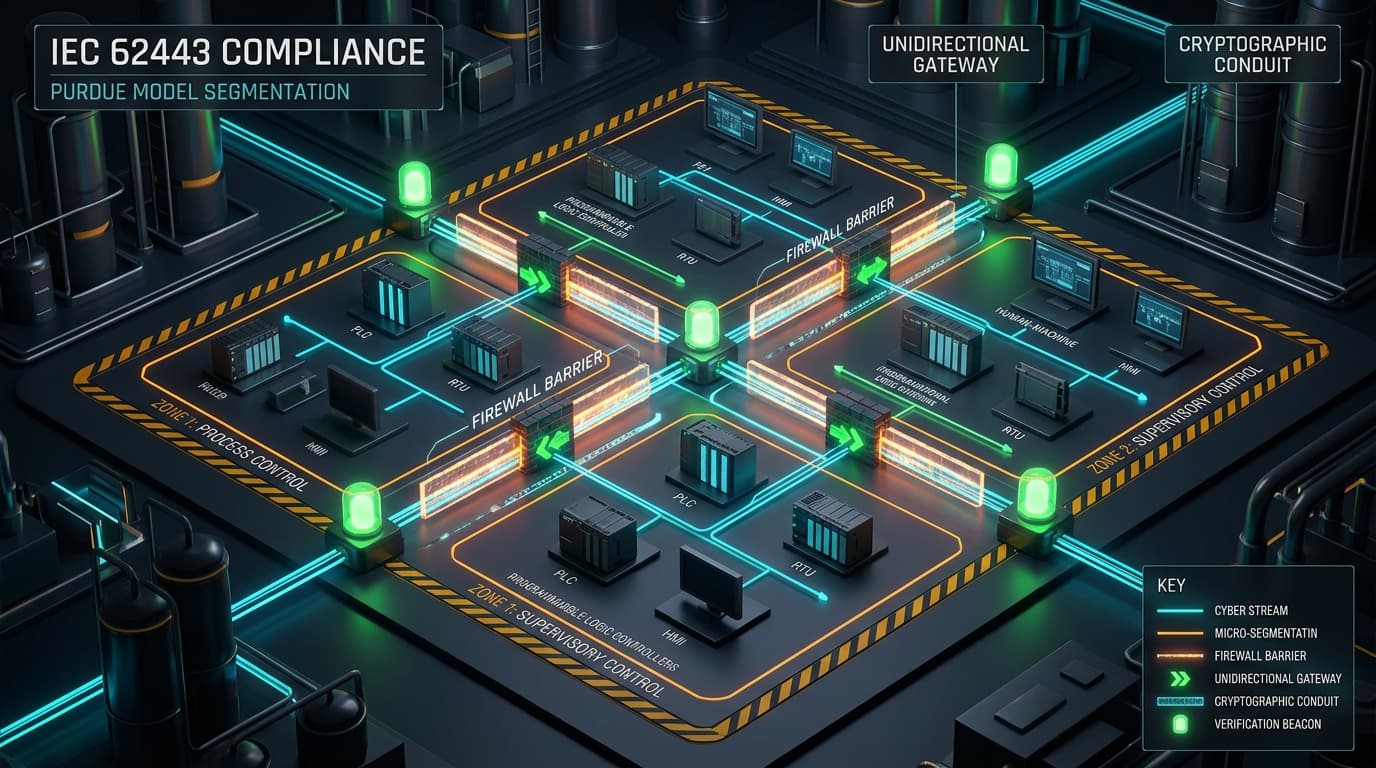
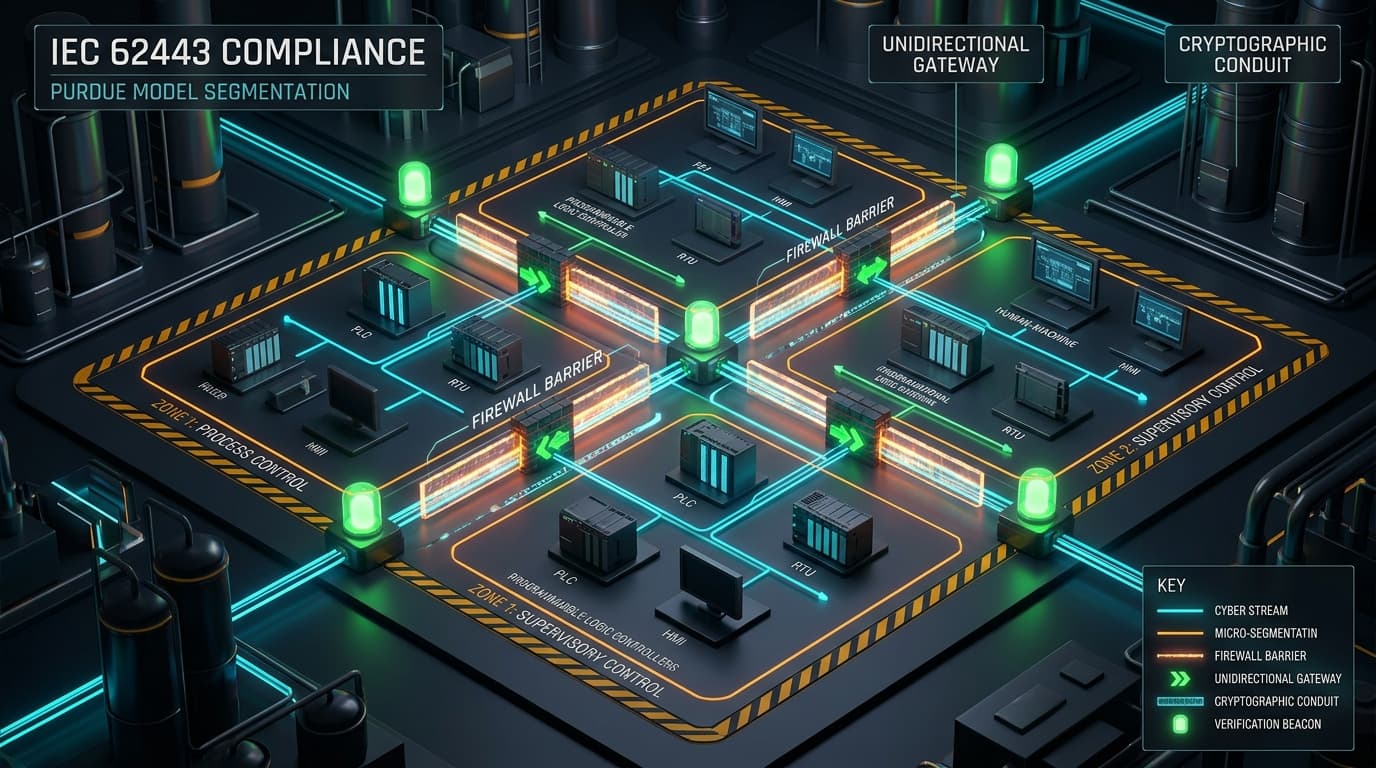
2. Purdue Model & Conduit Segmentation (IEC 62443-3-2)
- Isolate Engineering Workstations in dedicated OT Management Zones (Purdue Level 3/3.5). Never allow direct, unrestricted communication between corporate IT networks and PLC programming ports.
- Mandate physical or cryptographic multi-factor authentication (MFA) on jump hosts used to access OT engineering subnets.
- Configure OT network intrusion detection systems (NIDS) to alert on any
Write ProgramorPLC Stopcommands transmitted outside scheduled maintenance windows.