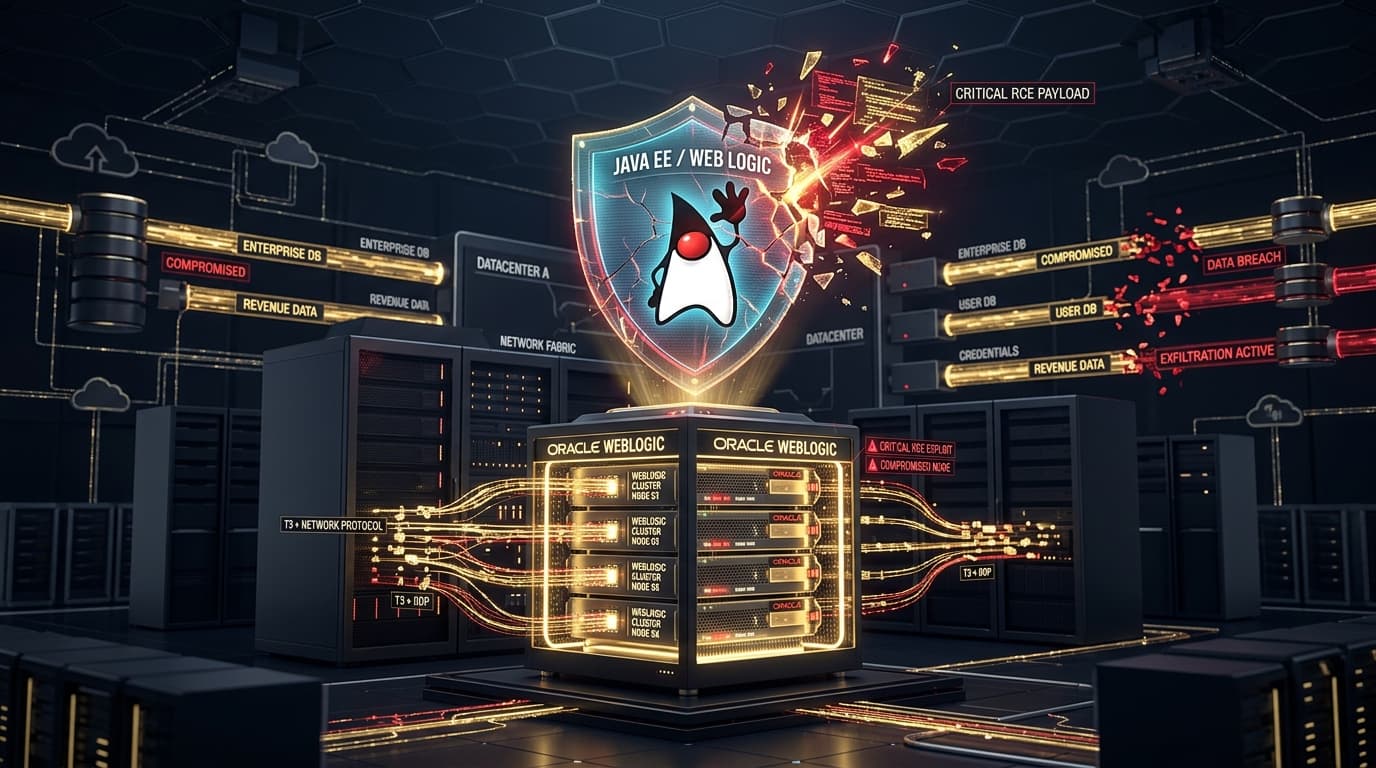
Executive Lead: Maximum-Severity Remote Code Execution in Enterprise Core Java Middleware
Oracle has issued an urgent Critical Security Patch Update (CSPU) addressing a devastating, maximum-severity vulnerability in Oracle WebLogic Server, designated as CVE-2026-83021. Carrying a maximum possible Common Vulnerability Scoring System (CVSS v3.1) base score of 10.0 Critical (CVSS:3.1/AV:N/AC:L/PR:N/UI:N/S:C/C:H/I:H/A:H), the vulnerability enables unauthenticated remote adversaries with network access over standard enterprise middleware protocols to achieve total operating system compromise across WebLogic clusters.
Oracle WebLogic Server serves as the central application runtime for mission-critical enterprise systems worldwide, including core banking platforms, telecommunications billing backbones, Oracle E-Business Suite (EBS), and government transactional portals. Coupled with active in-the-wild exploitation of companion vulnerability CVE-2026-64849, threat intelligence telemetry indicates that advanced persistent threat (APT) groups and financial crime syndicates are actively scanning enterprise address ranges to weaponize these defects for persistent backdoor implantation and corporate data exfiltration.
Protocol Dissection: Deserialization Bypass in T3 and IIOP Transports
WebLogic Server utilizes specialized binary protocols—specifically the T3/T3S protocol (Oracle's proprietary remote method invocation protocol) and IIOP (Internet Inter-ORB Protocol)—to facilitate high-speed clustering, Enterprise JavaBeans (EJB) remoting, and cross-node transaction coordination. These protocols listen on the primary WebLogic listener port (default TCP 7001 for cleartext and TCP 7002 for SSL/TLS).
CVE-2026-83021 resides in the WebLogic Server Core deserialization validation filter. While Oracle had implemented comprehensive blacklists and allowlists in weblogic.rjvm.InboundMsgAbbrev and JEP 290 object input filters to restrict dangerous Java gadget classes (such as Apache Commons Collections or Spring framework gadgets), security researchers identified an architectural bypass:
- Nested Stream Wrapper: Threat actors encapsulate malicious serialized Java gadget chains inside legitimate WebLogic JMX/RMI management wrapper classes that pass initial class allowlist validation.
- Secondary Deserialization Trigger: When the WebLogic server unpacks the outer envelope during protocol handshake negotiation, an unvalidated internal reflection routine invokes
readObject()on the inner stream without reapplying the security filter. - Unauthenticated Execution: Because the T3/IIOP protocol handshake precedes user authentication, the malicious bytecode executes immediately in the context of the running WebLogic JVM process (frequently running as
oracleorroot).
Active Exploitation & Companion Threat: CVE-2026-64849
Threat intelligence centers have observed active weaponization targeting financial institutions and government agencies. Attackers leverage automated Python and Go exploit stagers to probe exposed WebLogic instances:
# Characteristic T3 handshake exploit signature
POST / HTTP/1.1
Host: target-middleware.internal:7001
User-Agent: Mozilla/5.0
Content-Type: application/x-t3

t3 12.2.1
AS:255
HL:19
MS:10000000
[Injected Malicious Serialized Java Gadget Payload]
Once the payload executes, threat actors establish persistence via memory-only Java webshells injected directly into the WebLogic servlet context (e.g., Behinder or Godzilla webshells). This provides full command execution without writing physical files to disk, evading signature-based endpoint antivirus scanners.
Impact Matrix Across Enterprise Java Infrastructure
| Stage | Threat Actor Tactic | Vulnerable Component | Enterprise Impact |
|---|---|---|---|
| 1. Reconnaissance | Scans TCP 7001/7002 for open WebLogic T3/IIOP protocol headers. | Network Perimeter / DMZ | Identifies exposed WebLogic administration and managed servers. |
| 2. Deserialization | Sends nested serialized gadget chain bypassing JEP 290 filters. | weblogic.rjvm Core Subsystem |
Executes arbitrary bytecode in JVM process before authentication. |
| 3. Privilege Escalation | Spawns OS command shell or injects in-memory Java webshell. | Java Virtual Machine (JVM) | Acquires full operating system access on host middleware server. |
| 4. Database Exfiltration | Extracts database connection pool passwords from config.xml. |
JDBC DataSources | Dumps production Oracle Database, financial ledgers, and customer PII. |
Comprehensive Remediation & Hardening Playbook
1. Immediate Patch Deployment via OPatch
Apply the official Oracle September 2026 Critical Security Patch Update via the opatch utility:
# Stop WebLogic Admin and Managed Servers
$DOMAIN_HOME/bin/stopWebLogic.sh

# Apply Oracle CPU patch
cd /opt/oracle/patches/CVE-2026-83021/
$ORACLE_HOME/OPatch/opatch apply

# Verify patch application
$ORACLE_HOME/OPatch/opatch lsinventory

# Restart WebLogic domain
$DOMAIN_HOME/bin/startWebLogic.sh
2. Disable T3 and IIOP Protocols at WebLogic Administration Console
If remote T3 or IIOP communication is not strictly required across external network segments, disable these protocols or restrict them via Connection Filters:
# WebLogic Connection Filter configuration in config.xml
# Restrict T3 and T3S access exclusively to internal clustering subnet
weblogic.security.net.ConnectionFilterImpl

# Rule syntax:
#
192.168.10.0/24 7001 7002 allow t3 t3s
0.0.0.0/0 * deny t3 t3s iiop iiops
3. Strict Perimeter Segmentation
Under no operational circumstances should WebLogic management ports (TCP 7001, 7002) be directly reachable from the public internet:
- Front all WebLogic applications with hardened reverse proxies (such as Oracle HTTP Server, NGINX, or Cloudflare) enforcing strict HTTP/HTTPS termination.
- Ensure reverse proxies explicitly drop or reject any incoming traffic utilizing the T3 or IIOP protocols.