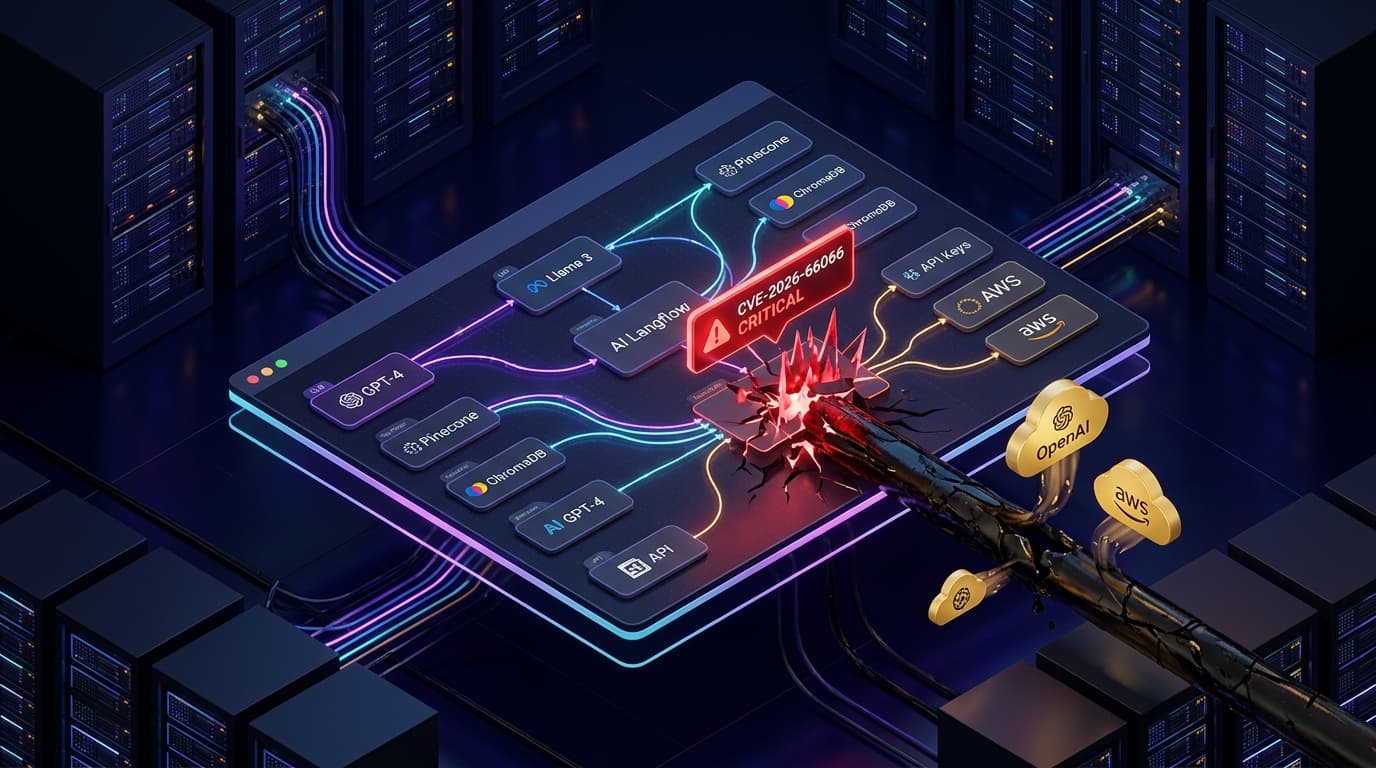
Threat actors have initiated widespread, automated exploitation campaigns targeting Langflow, an open-source visual orchestration framework widely used to build Retrieval-Augmented Generation (RAG) and multi-agent AI pipelines.
According to research published by VulnCheck, attackers are actively weaponizing multiple recently disclosed vulnerabilities—chief among them CVE-2026-66066 and CVE-2026-5027—to siphon cloud secrets, disable host logging, and enlist high-performance AI compute servers into cryptocurrency botnets.
The Target: Cloud API Keys & LLM Credentials
Because Langflow connects frontier models (OpenAI, Anthropic, Google) with enterprise vector databases and cloud storage, its runtime processes typically hold broad, high-privilege credentials. Telemetry from VulnCheck canary honeypots indicates that incoming exploit payloads specifically query:
OPENAI_API_KEYand Azure OpenAI endpoint tokens.AWS_ACCESS_KEY_IDandAWS_SECRET_ACCESS_KEYenvironment variables.- Internal Langflow administrative hashes located at
/root/.cache/langflow/secret_key. - SSH private key pairs (
~/.ssh/id_rsa) and user shell execution histories (~/.bash_history).
Attack Vector & Post-Exploitation Sequence
The primary vulnerability, CVE-2026-66066, stems from an input processing disparity between Ruby on Rails Active Storage and the libvips image processing library. Threat actors upload specially crafted image payloads that trigger remote code execution within the host context.
Once initial execution is established, adversaries execute an aggressive containment evasion script:
- Disabling Endpoint Telemetry: Attackers immediately execute
systemctl stop auditdand delete log streams to obscure secondary execution footprints. - Deploying Persistent Backdoors: Threat actors drop lightweight Python proxy scripts and legitimate remote support utilities (SimpleHelp) to maintain interactive access.
- Cryptomining Ingestion: On GPU-equipped AI training instances, automated scripts download and configure XMRig Monero cryptominers, exhausting server compute.
"AI orchestration engines are the new enterprise database. They hold the keys to every downstream LLM API and cloud data lake. Leaving them exposed to the public internet is an existential risk."
Hardening Recommendations
Organizations developing or hosting Langflow instances must implement the following safeguards immediately:
- Update to the Latest Langflow Release: Upgrade instances to version 1.0.19 or higher to patch known input-validation flaws.
- Remove Public Internet Exposure: Langflow development interfaces should be placed strictly behind authenticated VPNs or corporate identity-aware proxies (Zero Trust Network Access).
- Rotate Cloud API Secrets: If a Langflow instance was reachable on port 7860 without authentication, assume stored
OPENAI_API_KEYand AWS credentials have been compromised and rotate them immediately.