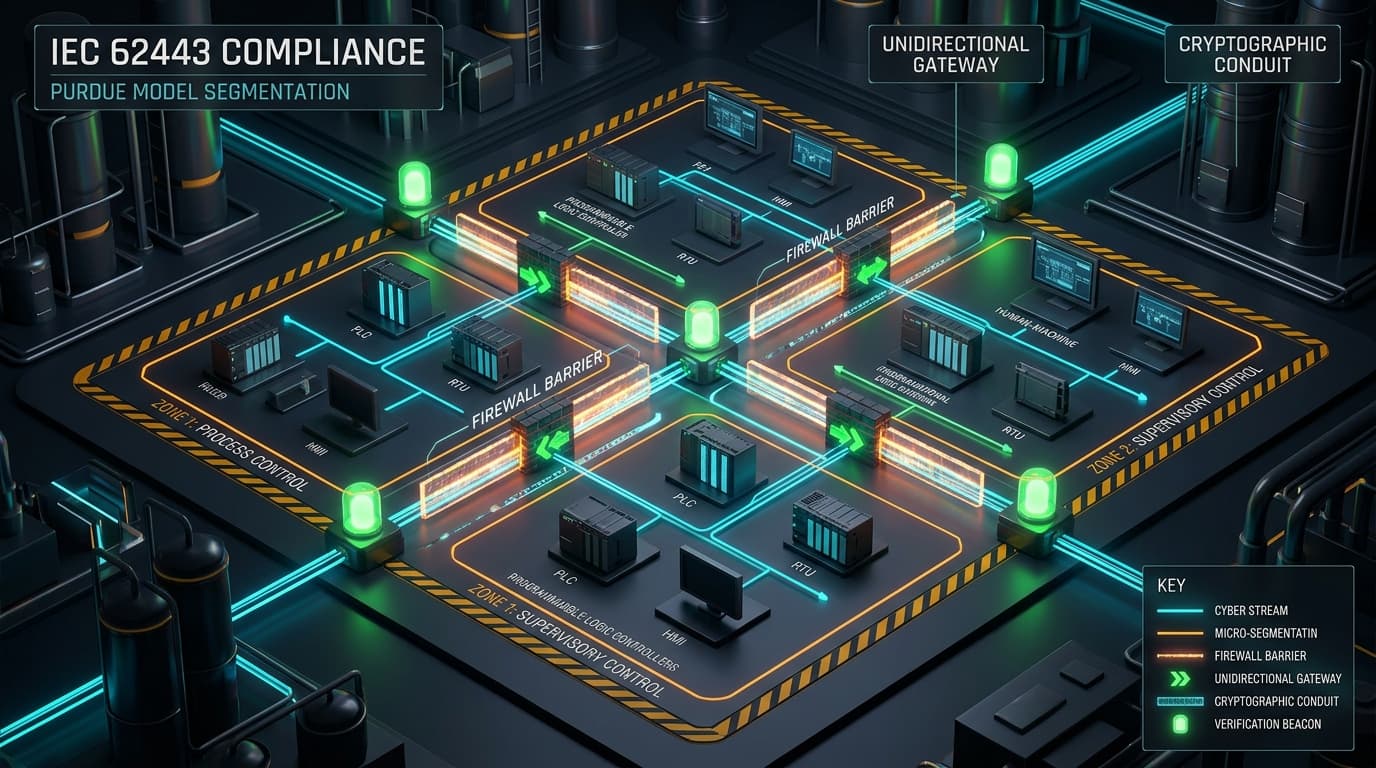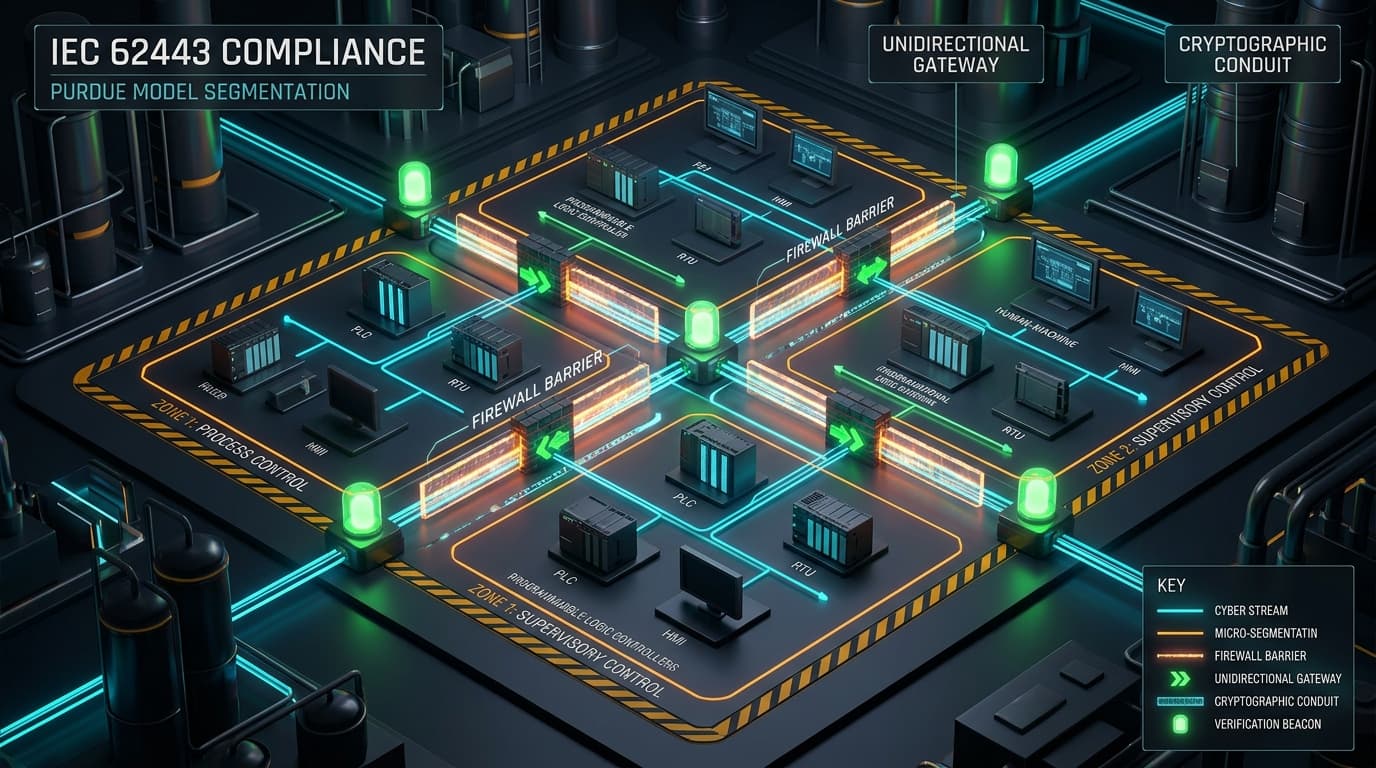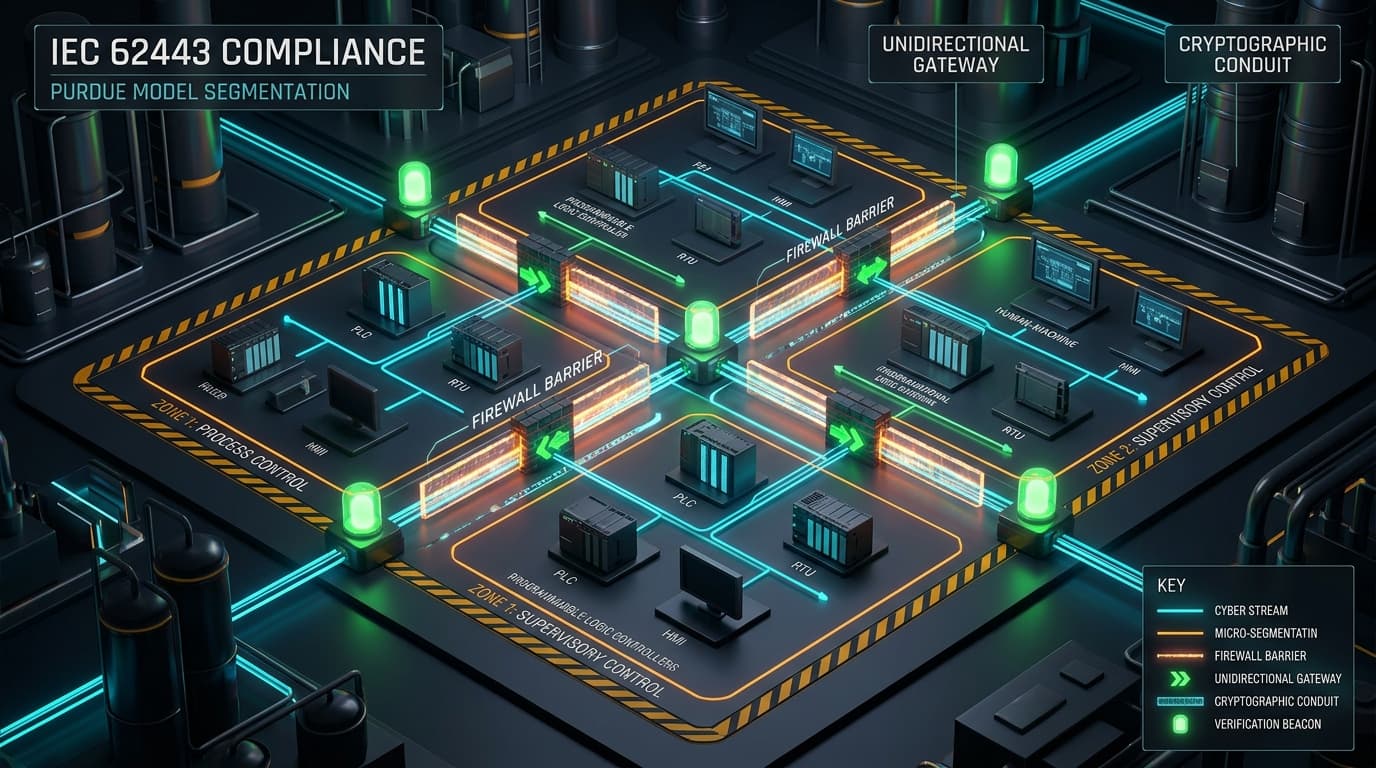
Securing modern industrial operations against advanced cyber threats requires moving beyond legacy perimeter defenses. The ISA/IEC 62443 standard represents the definitive international framework for establishing cyber resilience across Industrial Automation and Control Systems (IACS). Specifically, IEC 62443-3-2 defines the rigorous methodology of partitioning operational networks into defensible Zones and Conduits, preventing lateral adversary traversal from enterprise IT environments to physical safety and control systems.
The Fundamental Breakdown: Zones and Conduits Methodology
In many legacy manufacturing plants and critical infrastructure facilities, operational networks evolved as flat Layer 2 domains where engineering workstations, programmable logic controllers (PLCs), human-machine interfaces (HMIs), and IT maintenance jump-boxes shared unrestricted routing. In such topologies, a single compromised VPN credential or phishing payload on the corporate network enables an attacker to send unauthenticated broadcast commands to field controllers.
IEC 62443-3-2 eliminates flat networks by introducing two core architectural constructs:
- Security Zone: A logical or physical grouping of cyber assets that share common security requirements, criticality levels, and operational roles. For example, a safety instrumented system (SIS) operates in a dedicated, isolated Zone separate from supervisory SCADA servers.
- Security Conduit: The designated logical or physical communication channel that connects two or more Zones. All traffic passing between Zones must traverse a Conduit equipped with security controls—such as stateful inspection firewalls, protocol filters, or unidirectional data diodes.
Security Level Targets (SL-T 1 Through SL-T 4)
IEC 62443 establishes four Security Levels (SL) reflecting the capabilities and motivation of potential threat actors:
| Security Level (SL) | Adversary Profile & Motivation | Mandatory Conduit Security Controls |
|---|---|---|
| SL-1 | Protection against casual or unintentional disruption | Basic packet filtering, port isolation, default credential removal |
| SL-2 | Protection against intentional attack with simple means & low resources | Stateful firewall inspection, role-based access control, encrypted sessions |
| SL-3 | Protection against intentional attack with sophisticated means & moderate resources | Deep packet inspection (DPI) of ICS protocols, multi-factor authentication, network anomaly detection |
| SL-4 | Protection against sophisticated state-sponsored attack with extensive resources | Hardware-enforced unidirectional gateways (data diodes), cryptographic hardware tokens, complete air-gap isolation |
Deep Packet Inspection (DPI) on Industrial Conduits
Traditional IT firewalls evaluate traffic only at Layer 3 and Layer 4 (IP addresses and TCP/UDP ports). However, industrial protocols like Modbus TCP (Port 502), EtherNet/IP (Port 44818), and DNP3 (Port 20000) inherently lack authentication. If a firewall allows Port 502 bidirectionally, an attacker can transmit write commands that disrupt physical machinery.
IEC 62443-compliant Conduits require Deep Packet Inspection (DPI) to enforce command-level granularity:
# Snort/Suricata Rule: Alert and Drop Unauthorized Modbus Write Commands to PLC Zone
drop tcp $CORP_HMI_NET any -> $SAFETY_PLC_ZONE 502 (
    msg:"IEC-62443 VIOLATION: Unauthorized Modbus Function 05/06/16 Force Coil/Write Holding Register";
    flow:to_server,established;
    content:"|00 00|"; offset:2; depth:2; # Modbus Protocol ID
    byte_test:1,>,0,7;                     # Unit Identifier check
    content:"|05|"; distance:0; depth:1;  # Function Code 05: Force Single Coil
    classtype:industrial-control-protocol-violation;
    sid:902644301; rev:1;
)
Practical Implementation Steps for Industrial Engineers
Asset owners, automation engineers, and industrial cybersecurity teams should execute the following deployment sequence:
1. Asset Identification & Data-Flow Mapping
Perform passive network discovery to catalog all IP and MAC addresses across the plant floor. Document all communicating asset pairs, including protocol types, cycle times, and operational functions.
2. Define Zone Boundaries Along the Purdue Model
Map physical and logical equipment to the Purdue Enterprise Reference Architecture (PERA):
- Level 3 (Operations Management): Historians, MES servers, and domain controllers.
- Level 2 (Supervisory Control): Operator workstations, engineering consoles, and SCADA servers.
- Level 1 (Basic Control): PLCs, RTUs, and distributed control modules.
- Level 0 (Process): Physical sensors, actuators, valves, and motors.
3. Interpose Industrial Firewalls & Validate SL-T Requirements
Install ruggedized industrial firewalls along all inter-zone conduits. Enforce zero-trust default-deny rules, permitting only cryptographically verified engineering sessions into Level 1 controller domains.