Executive Summary: Moving Beyond the Flat Industrial Network
For decades, operational technology (OT) and industrial automation networks relied on the flawed assumption of the "air gap"—the belief that physical disconnection from corporate IT and the Internet provided sufficient defense. In the era of Industrial IoT (IIoT), remote vendor telemetry, and predictive maintenance cloud gateways, air gaps are virtually non-existent. When threat actors breach an enterprise corporate network, they frequently discover a completely flat, unsegmented industrial architecture where an compromised IT jump host can directly transmit unauthenticated Modbus, EtherNet/IP, or PROFINET commands to physical machinery.
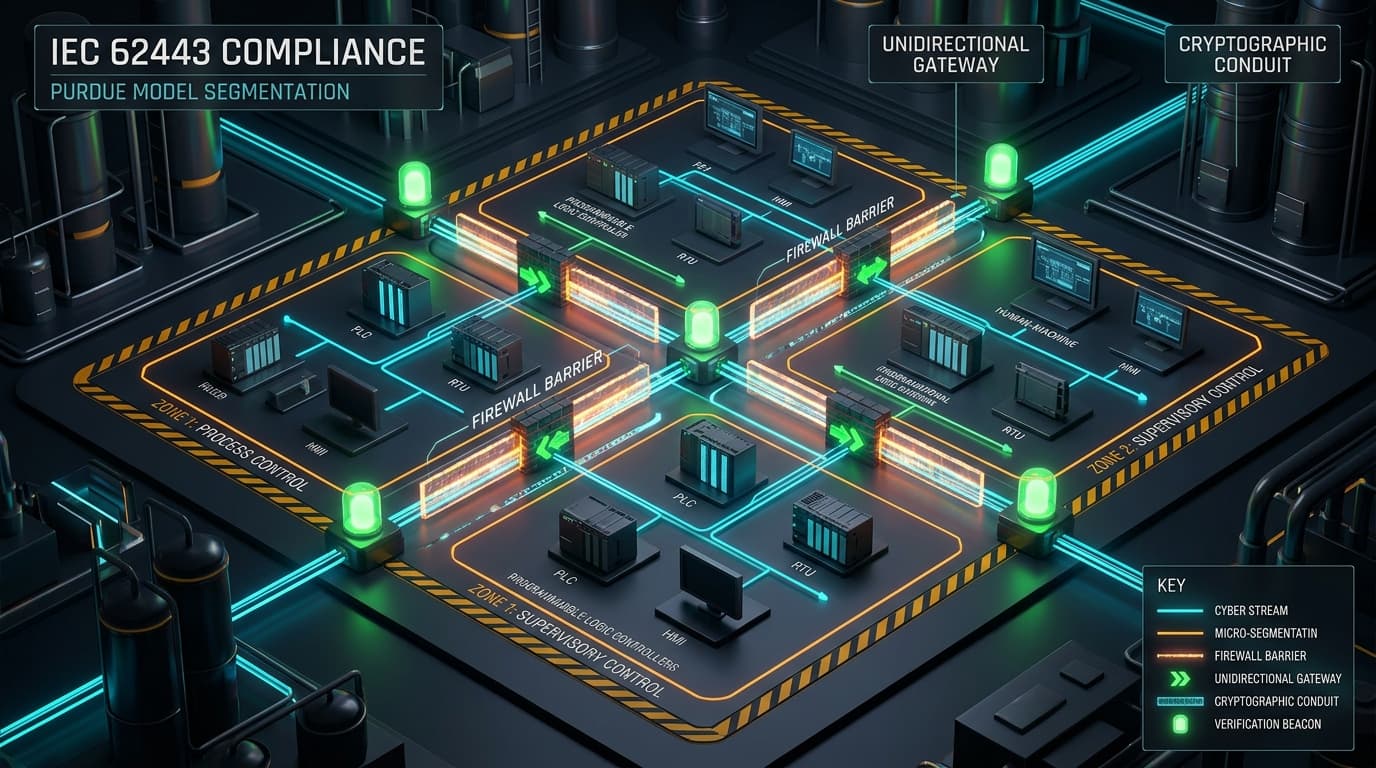
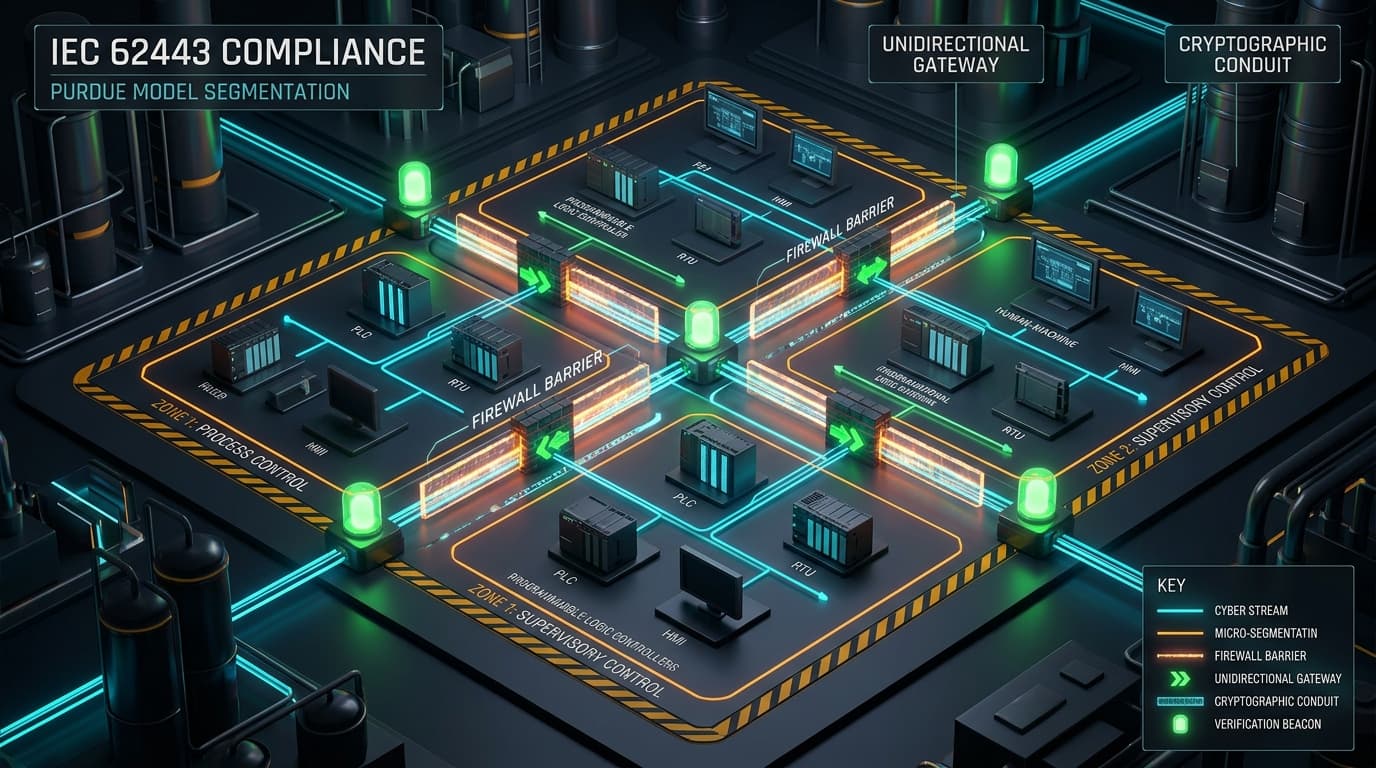
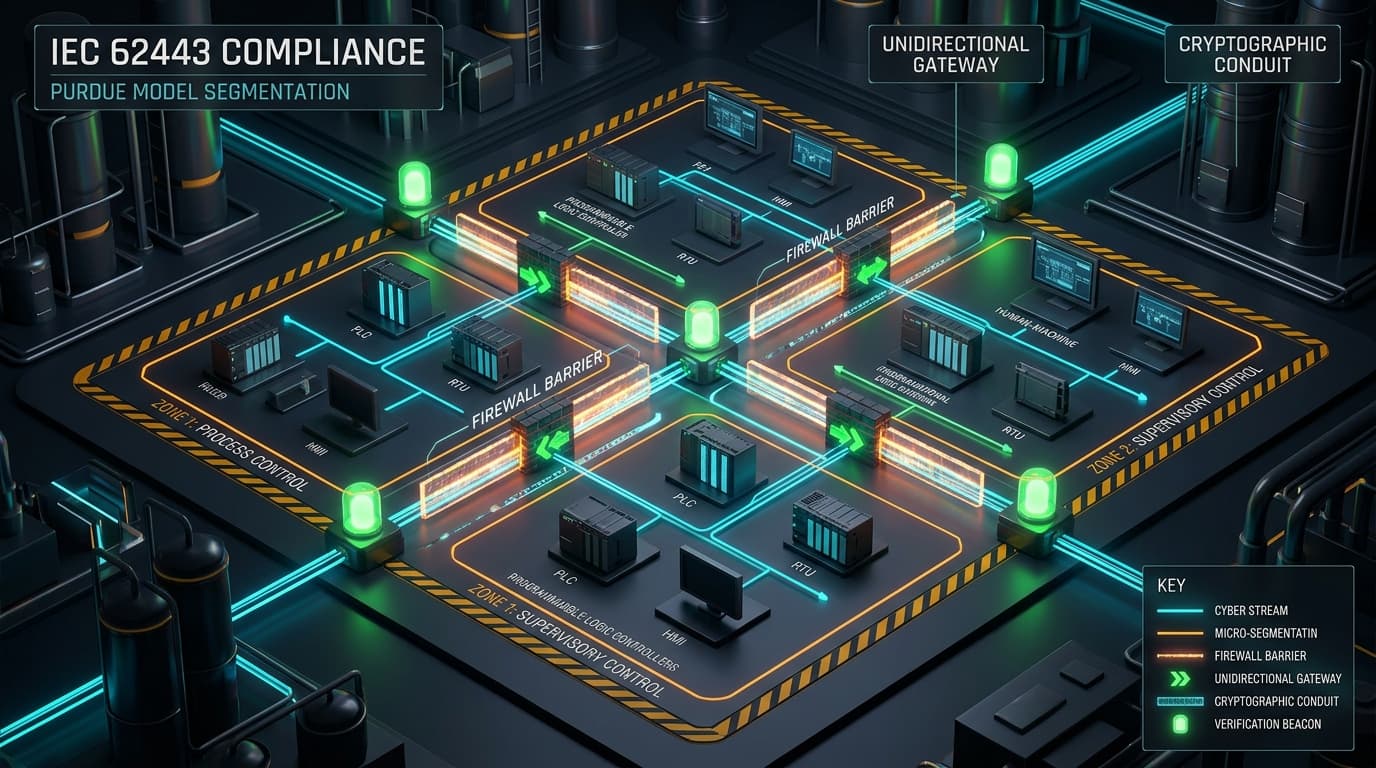
The IEC 62443-3-2 standard (Security risk assessment for system design) provides the definitive engineering framework to dismantle this vulnerability. By formally partitioning the System Under Consideration (SuC) into discrete Zones and governing all inter-zone communication through cryptographically protected Conduits, asset owners can contain cyber incidents before digital disruption translates into catastrophic kinetic or physical damage.
Demystifying IEC 62443-3-2: Zones, Conduits, and Security Levels
The standard introduces three fundamental structural constructs that replace ad-hoc firewall rules with rigorous risk-based zoning:
- Security Zone: A logical or physical grouping of cyber assets that share identical cybersecurity requirements, identical criticality, and a common operational boundary. Assets within a zone communicate freely, but perimeter entry is strictly filtered.
- Security Conduit: The dedicated, monitored logical or physical communication pathway connecting two or more distinct zones. All network traffic between zones must pass through a conduit that enforces perimeter controls, stateful inspection, or hardware-enforced unidirectionality.
- Security Level Target (SL-T): A quantifiable defense tier (SL-1 through SL-4) assigned to each zone during the initial Cyber Risk Assessment (ZCR):
- SL-1: Protection against casual or coincidental unauthorized access.
- SL-2: Protection against intentional violation using simple means with low resources.
- SL-3: Protection against intentional violation using sophisticated means with moderate resources (e.g., sophisticated ransomware syndicates).
- SL-4: Protection against intentional violation using sophisticated means with extensive resources (e.g., state-sponsored Advanced Persistent Threats targeting critical national infrastructure).
Segmenting the Purdue Model: Zone & Conduit Mapping Architecture
To align IEC 62443-3-2 with the classic Purdue Enterprise Reference Architecture (PERA), security architects must enforce boundary firewalls and protocol filters across distinct levels:
| Purdue Level | Designated Zone | Assigned SL-T | Conduit Security Mechanism |
|---|---|---|---|
| Level 4 / 5 | Enterprise IT & Cloud ERP Zone | SL-T 1 / 2 | Enterprise NGFW with IPS, TLS 1.3 decryption, and corporate identity provider (IdP) inspection |
| Level 3.5 | Industrial Demilitarized Zone (IDMZ) | SL-T 3 | Dual-homed jump hosts, reverse proxies, and termination of all direct routing; MFA enforced |
| Level 3 | Site Operations & Supervisory SCADA Zone | SL-T 3 | Industrial NGFW enforcing strict access to historians and domain controllers; read-only replication |
| Level 2 | Area Control & HMI Zone | SL-T 3 | Internal micro-segmentation switches; dedicated conduits per manufacturing unit or process line |
| Level 1 | Basic Process Control (PLCs, RTUs, IEDs) | SL-T 4 | Deep Packet Inspection (DPI) firewalls blocking unauthorized program downloads; port 502/tcp whitelist |
| Level 0 | Physical Machinery & Safety Instrumented Systems (SIS) | SL-T 4 | Dedicated, physically isolated safety zone; zero routable IP packets; hardwired interlocks |
Deep Packet Inspection (DPI) & Industrial Protocol Enforcement
Traditional IT firewalls operate at Layer 4, permitting all traffic over an open TCP port (such as Modbus on port 502 or DNP3 on port 20000). In an OT environment, this is fatal: an attacker possessing access to the conduit can issue malicious write commands (e.g., Modbus Function Code 0x05 Write Single Coil or 0x10 Write Multiple Registers) while the firewall observes ordinary port 502 communication.
An IEC 62443-compliant conduit requires Layer 7 Deep Packet Inspection (DPI) capable of distinguishing harmless telemetry queries from destructive state changes:
# Snort/Suricata Rule: Alert and Drop Unauthorized Modbus Write Commands to Water Treatment PLCs
drop tcp 192.168.10.0/24 any -> 192.168.20.50 502 (
    msg:"IEC-62443 CONDUIT VIOLATION: Unauthorized Modbus FC 0x10 Write to PLC-01";
    flow:established,to_server;
    content:"|00 00|"; offset:2; depth:2; # Modbus Protocol ID
    byte_test:1,=,0x10,7; # Function Code 0x10 (Write Multiple Registers)
    classtype:attempted-admin;
    sid:9001001; rev:1;
)
Engineering Implementation Checklist for Plant Operators
- Inventory SuC Assets: Execute passive asset discovery using passive network taps to catalog every PLC, RTU, HMI, and managed switch without introducing active scan latency into deterministic process loops.
- Perform Detailed Risk Assessment (ZCR): Calculate unmitigated risk scores for each process cell based on potential environmental, financial, and life-safety impacts.
- Establish the Industrial DMZ (Level 3.5): Terminate all direct IP routing between corporate Active Directory and plant-floor systems. Mandate separate, non-federated forest credentials for industrial jump hosts.
- Enforce Unidirectional Data Diodes: Deploy physical hardware optical diodes between the plant historian (Level 3) and corporate data lakes (Level 4) to ensure data exfiltration flows strictly outward with zero possibility of reverse inbound packet injection.
- Audit Conduits Continuously: Ingest firewall and switch syslog feeds into an OT-specific SIEM/SOAR platform configured to detect anomalous protocol commands and inter-zone routing anomalies.