Operational Context: Why Flat OT Networks Spell Catastrophe
Industrial facilities—including electrical power substations, oil refineries, water treatment facilities, and pharmaceutical manufacturing plants—face an unprecedented wave of targeted state-sponsored and cybercriminal intrusions. Adversaries exploit the historic convergence between Enterprise IT (ERP systems, corporate email, cloud telemetry) and Operational Technology (OT) networks controlling physical machinery.
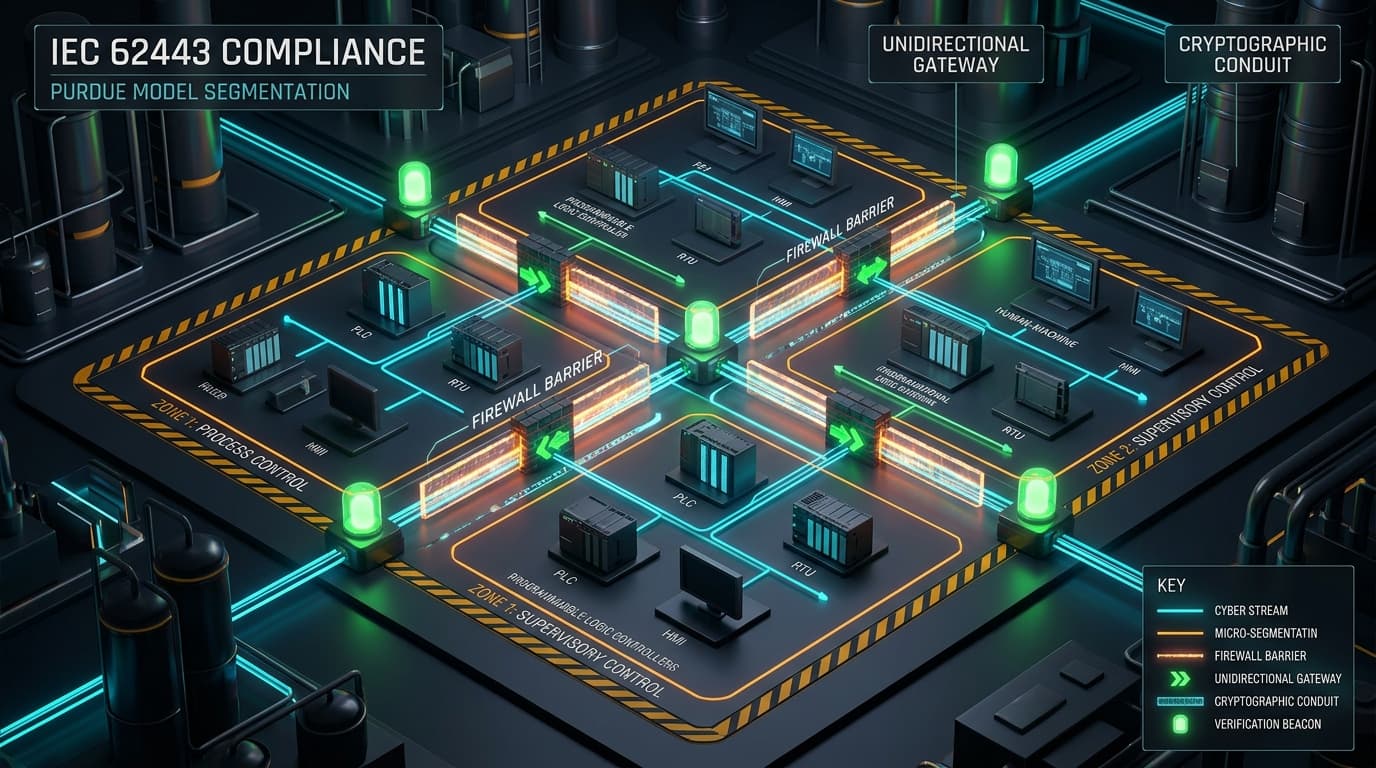
When threat actors gain initial access to an IT network via phishing or perimeter VPN vulnerabilities, a flat, unsegmented operational network allows effortless lateral movement into Programmable Logic Controllers (PLCs), Remote Terminal Units (RTUs), and Safety Instrumented Systems (SIS). The IEC 62443-3-2 standard (Security Risk Assessment and System Design) provides the universal engineering methodology to partition industrial assets into distinct Security Zones interconnected solely via rigorously controlled Conduits.
Mapping the Purdue Model to IEC 62443 Security Zones
The traditional Purdue Enterprise Reference Architecture (PERA) classifies industrial operations into functional hierarchies. IEC 62443 formalizes these levels into cryptographically isolated security zones based on criticality, consequences of failure, and threat exposure.
| Purdue Level | Industrial Function | IEC 62443 Zone Designation | Security Level Target (SL-T) | Typical Assets & Protocols |
|---|---|---|---|---|
| Level 4 / 5 | Enterprise Network / Cloud | External IT Zone | SL-T 1 | ERP, Corporate Active Directory, Email, S3/Azure Cloud Telemetry. |
| Level 3.5 | Industrial DMZ (IDMZ) | Demilitarized Transition Conduit | SL-T 3 | Jump hosts, Historian mirrors, Patch management, Read-only replicas. |
| Level 3 | Site Operations & Supervisory | Operations Zone | SL-T 2 / 3 | Engineering Workstations (EWS), Primary Historian, SCADA servers. |
| Level 2 | Area Supervisory Control | Control Zone | SL-T 3 | Human-Machine Interfaces (HMIs), Batch automation, OPC UA gateways. |
| Level 1 | Basic Process Control | Real-Time Automation Zone | SL-T 4 | PLCs, RTUs, Drive controllers (Modbus/TCP, CIP, Profinet, DNP3). |
| Level 0 | Physical Process | Safety & Actuator Zone | SL-T 4 | Pumps, valves, sensors, Safety Instrumented Systems (SIS/Triconex). |
Security Level Capabilities (SL 1 to SL 4) Explained
IEC 62443 defines four progressive tiers of security capability based on attacker sophistication:
- SL 1 (Casual / Unintentional): Protection against casual or coincidental misuse, misconfiguration, and basic script-kiddie scanning.
- SL 2 (Intentional with Low Resources): Protection against cybercriminals using generic publicly available exploits and automated scanning tools.
- SL 3 (Intentional with Moderate Resources): Protection against specialized threat groups with domain-specific knowledge of SCADA protocols and OT hardware. Requires multi-factor authentication on all conduits, cryptographic message authentication, and automated anomaly detection.
- SL 4 (Nation-State with Extensive Resources): Protection against Advanced Persistent Threat (APT) actors with unlimited funding, zero-day capabilities, and hardware tampering tooling. Mandates unidirectional security gateways (hardware data diodes) and out-of-band physical verification.
Conduit Implementation: Practical Firewall Rulesets & Industrial DPI
A Conduit is a dedicated communication channel that connects two or more security zones. All traffic crossing a conduit must be inspected, authorized, and logged. Cleartext industrial protocols such as Modbus/TCP (Port 502) or EtherNet/IP (Port 44818) must never traverse directly between Level 4 and Level 1.
1. Industrial DMZ Conduit Ruleset (nftables)
#!/usr/sbin/nft -f
# IEC 62443-3-2 Industrial DMZ Gateway Conduit Ruleset
flush ruleset

table inet ot_conduit_filter {
    chain input {
        type filter hook input priority 0; policy drop;
        iif "lo" accept
        ct state established,related accept
    }

    chain forward {
        type filter hook forward priority 0; policy drop;

        # Rule 1: Allow ONLY Historian Mirror in IDMZ to replicate from Level 3
        ip saddr 192.168.30.50 ip daddr 10.10.35.50 tcp dport 443 accept

        # Rule 2: Allow Engineering Jumphost with MFA to access Level 3 EWS via RDP over TLS
        ip saddr 10.10.35.100 ip daddr 192.168.30.10 tcp dport 3389 ct state new,established accept

        # Rule 3: STRICTLY DROP any direct IT-to-PLC (Modbus/TCP 502) packets
        tcp dport 502 log prefix "[IEC62443-VIOLATION-MODBUS]: " drop
        tcp dport 44818 log prefix "[IEC62443-VIOLATION-ENIP]: " drop

        # Default drop with audit log
        log prefix "[CONDUIT-DENY]: " drop
    }
}
2. Operational Engineering Hardening Checklist
- Hardware Data Diodes: Deploy physical photodiode-based unidirectional transmitters for transmitting operational telemetry from Level 3 to Enterprise Level 4, rendering inbound exploitation physically impossible.
- Safety Instrumented System (SIS) Isolation: Physical air-gapping of Level 0/1 Safety Systems from standard process control networks; no shared switches or dual-homed NICs permitted.
- Protocol-Aware Deep Packet Inspection (DPI): Configure industrial firewalls to enforce command whitelisting (e.g., allow Modbus Function Code 03 "Read Holding Registers", but block Function Code 06/16 "Write Registers" from non-engineering hosts).