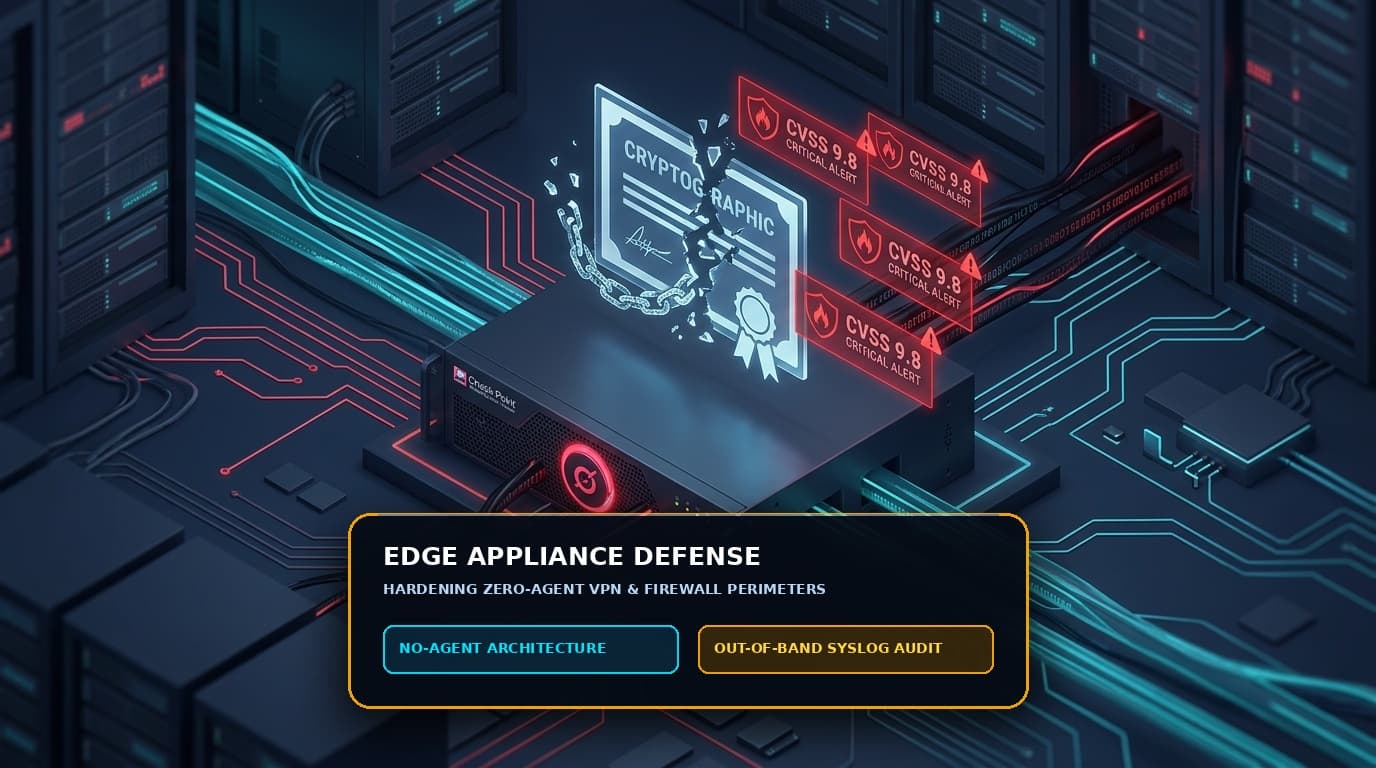
Two of the three fastest remediation deadlines CISA set this year landed on the same class of device. SonicWall SMA1000 appliances got three days in September. FortiClient EMS got three days in April. Neither is a server you can put an agent on.
This is not coincidence, and it is not new. Network edge appliances have been the preferred initial-access route for both ransomware affiliates and espionage crews for several years, and the reasons are structural rather than technical. Understanding why is what makes the checklist below worth working through in order.
Why this device class, every time
They are internet-facing by definition. No phishing required, no user to fool, no initial access broker to pay. The device answers unauthenticated requests because that is its job.
You cannot instrument them. Most are appliances running a locked-down operating system. No EDR agent, no file integrity monitoring, no way to see process execution. Your detection stack is simply absent from the one box most likely to be attacked first.
They terminate credentials and sessions. A compromised VPN concentrator is not a foothold, it is a credential harvesting position with a view of everything that authenticates through it.
They are patched slowly. Updating a firewall means a maintenance window, a change ticket, and somebody willing to own the outage risk. That friction is measured in weeks. Exploitation is measured in days.
The patch is not the hard part. Getting approval to install it at short notice is the hard part, and that is a process problem you can fix before the next advisory lands.
1. Find out what is actually exposed
Do this from outside your own network — a cloud host, a mobile connection, anything that is not your corporate egress. Checking from inside tells you nothing, because inside is where the management interface is supposed to be reachable.
- Enumerate every edge device you own, including the ones deployed by teams that no longer exist and the branch offices nobody inventories.
- Check whether management interfaces answer from the public internet. Shodan and Censys already know; you should too.
- Record the firmware version of each. You cannot triage an advisory without knowing which boxes are in scope.
The recurring finding in incident reports is not an exotic exploit. It is a management interface someone opened during a migration three years ago and never closed.
2. Isolate the management plane properly
Patching removes one vulnerability. Architecture removes the class. Concretely:
- Bind management to a dedicated out-of-band interface, not the data plane.
- Restrict access to a named jump host range with an explicit permitted-IP list, and require VPN or a privileged access workstation to reach it.
- Enforce phishing-resistant MFA on every administrative account, including the local break-glass account.
- Disable any management protocol you are not actively using. SSH left permanently enabled on an appliance is a standing invitation.
Treat these boxes the way you treat a domain controller. They deserve it, and almost nobody does it.
3. Pre-authorise the emergency change
This is the control that determines whether a three-day deadline is achievable, and it costs nothing to put in place.
Negotiate it during a quiet period, not during an active exploitation event:
- Define the trigger precisely — confirmed active exploitation per CISA KEV, or a vendor advisory stating exploitation in the wild.
- Grant standing approval to patch edge devices under that trigger, without per-instance sign-off.
- Name who can invoke it, and name their deputies. One person on holiday should not stall this.
- Require retrospective documentation within 48 hours. The audit trail is preserved; the delay is not.
Organisations that patch edge devices fast are not the ones with better engineers. They are the ones who did this paperwork in advance.
4. Patching is step one of an incident response, not the end of one
If a vulnerable, internet-reachable device was exposed during a known exploitation window, assume it was reached. SonicWall’s remediation guidance for the September SMA1000 advisory made this explicit: contact support for an indicator review, and if indicators are found, re-image or redeploy the appliance and change all credentials. That is the vendor stating that a patch alone is insufficient.
The post-patch sequence:
- Rotate every credential the device held or could reach — admin accounts, RADIUS and TACACS secrets, API keys, VPN pre-shared keys, certificates.
- Diff the running configuration against a known-good backup from before the window. Look for new administrative users, altered NAT rules, new service routes and changed logging destinations.
- Check whether logging was disabled or redirected. That is a common early move for an attacker who intends to stay.
- Review authentication logs for successful logins from unfamiliar geographies or outside working hours.
Patching a device that was compromised three weeks ago simply closes the door behind the intruder.
5. Detection when you cannot install an agent
You are not blind, you are limited to what the device will tell you. Get syslog off the appliance to a collector you control, and alert on:
| Signal | Why it matters |
|---|---|
| Configuration change outside a change window | These devices should be boring. Deviation is signal. |
| New administrative account created | Among the first persistence steps on an appliance. |
| Logging destination modified or disabled | An attacker preparing to work unobserved. |
| Successful admin auth from an unexpected source | The management plane should have a tiny, known source set. |
| Outbound connections initiated by the appliance | An edge device calling out to the internet is rarely legitimate. |
| Firmware or image change | Should only ever follow a ticket you can point to. |
None of these are exploit signatures. They are the generic tail of a successful compromise, which is why they keep working when the next CVE arrives.
6. Track end of support like a vulnerability
An appliance past end of support is permanently unpatchable. It will never show up in your scanner as critical, because there is no fix to be missing, and it quietly fails PCI-DSS requirement 6.3 along with an increasing number of cyber insurance conditions.
Keep a dated replacement schedule for every edge device and start the procurement conversation twelve months out. The alternative is discovering the constraint during an active exploitation event, which is the most expensive possible moment to learn it.
What to do this week
If you take only two things from this: run the external exposure check in section one, and start the conversation in section three. The first tells you whether you have a problem right now. The second decides whether you can do anything about it when the next advisory lands with a three-day clock attached.