Executive Lead: Critical Authentication Bypass in Core SD-WAN Orchestration
Hewlett Packard Enterprise (HPE) Aruba Networking has issued critical security bulletin HPESBNW05100 addressing a maximum-severity vulnerability in its flagship EdgeConnect SD-WAN Orchestrator (formerly Silver Peak). Cataloged as CVE-2026-63455—and accompanied by the closely coupled defect CVE-2026-63456—the vulnerability carries a near-maximum CVSS v3.1 base score of 9.8 (CVSS:3.1/AV:N/AC:L/PR:N/UI:N/S:U/C:H/I:H/A:H).
EdgeConnect SD-WAN Orchestrator functions as the central management plane and cryptographic policy distribution point for global enterprise Software-Defined Wide Area Networks (SD-WAN). It controls routing overlays, IPsec tunnel key exchanges, business intent policies, and WAN optimization appliances deployed across distributed enterprise branches, data centers, and multi-cloud environments. The flaw allows an unauthenticated remote attacker with network access to the Orchestrator web interface to completely bypass administrative authentication by transmitting crafted HTTP headers, seizing total control over global network routing fabrics.
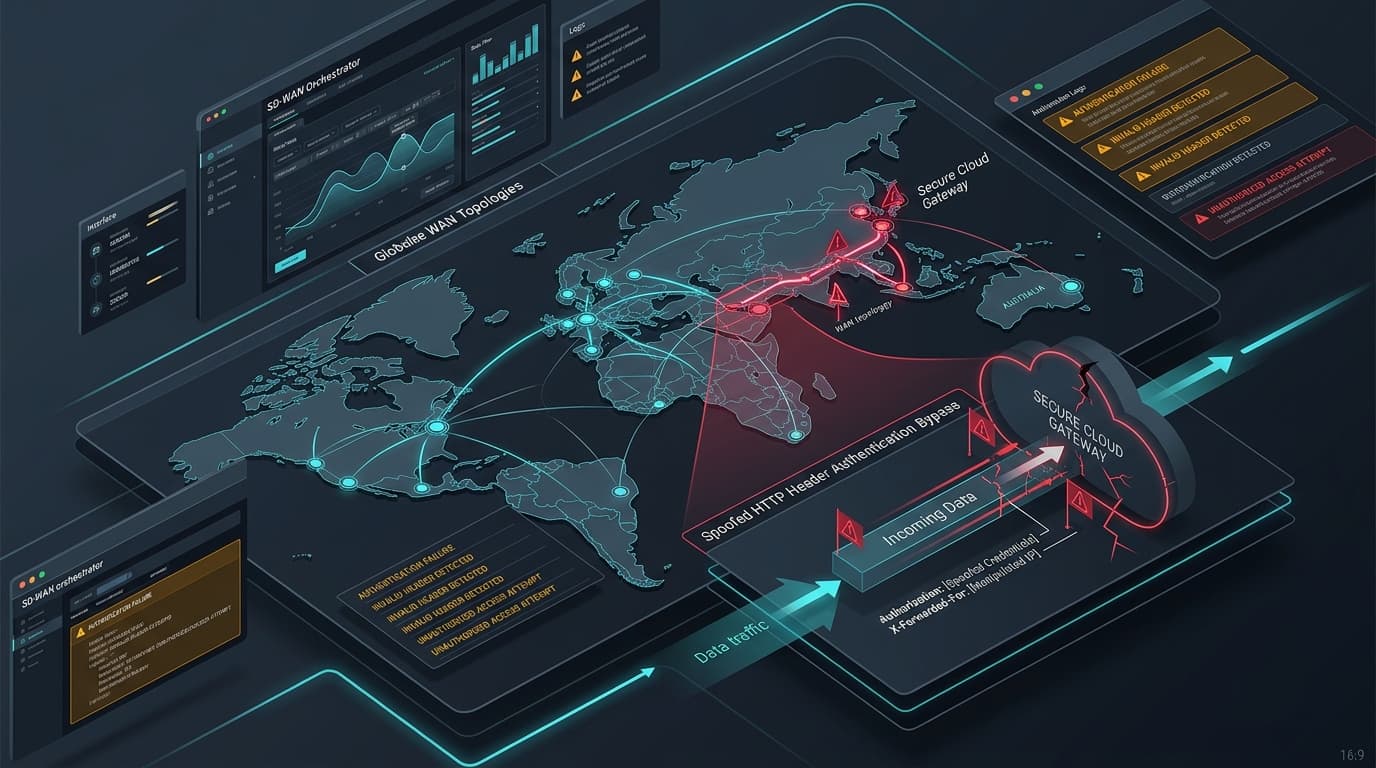
Attack Mechanics: REST API Header Spoofing and Trust Boundary Confusion
The root cause of CVE-2026-63455 resides in the architectural relationship between EdgeConnect Orchestrator's reverse proxy layer and its internal REST API microservices:
- Reverse Proxy Header Trust: The Orchestrator deployment architecture utilizes an ingress reverse proxy to terminate incoming TLS client connections and forward requests to internal API services running on local ports. Internal microservices rely on custom HTTP request headers (such as internal client identity and role-forwarding attributes) to determine the caller's authorization context.
- Ingress Header Stripping Failure: In affected versions (9.6.2.x and 9.6.3.x), the ingress reverse proxy failed to sanitize or strip untrusted client-supplied identity headers. If an external client crafted a request directly to administrative endpoints (such as
/gms/rest/authenticationor/gms/rest/system) with specific forged internal authorization tokens in the HTTP headers, the proxy forwarded them unmodified. - Unauthenticated Session Elevation: The backend REST framework, assuming that incoming internal headers had been validated by the front-end proxy, instantiated an unauthenticated session with full super-administrator (
admin) privileges. This allowed attackers to query telemetry, download cryptographic keys, alter routing policies, and deploy arbitrary configuration scripts across all connected SD-WAN edge appliances.
# Conceptual depiction of the header spoofing authentication bypass
[Unauthenticated Remote Attacker]
       │
       ▼ (Sends HTTP POST /gms/rest/system with forged internal identity headers)
[Front-End Ingress Proxy]
       │ (FAILS to sanitize client-supplied internal authorization headers)
       ▼
[Internal Orchestrator REST Microservice]
       │ (Trusts forwarded internal header; assumes caller is pre-authenticated admin)
       ▼
[Full Administrative Session Instantiated] --> Global SD-WAN Fabric Compromise
Enterprise Impact: Interception and Disruption of Global Traffic
Compromising an enterprise SD-WAN orchestrator grants an adversary strategic access to all wide-area communications:
- Traffic Redirection & Man-in-the-Middle: Threat actors can modify Business Intent Overlays (BIO) to route sensitive branch-to-data-center traffic through adversary-controlled intermediate hops, allowing the decryption and inspection of unencrypted internal traffic.
- Mass Appliance Reconfiguration: Because the Orchestrator centrally manages thousands of distributed EdgeConnect appliances, an attacker can push malicious firmware images or script extensions simultaneously to every branch appliance in the organization.
- Enterprise-Wide Blackout: Disabling active tunnel policies or revoking IPsec keys across the orchestrator can sever communication between headquarters, regional offices, and public cloud VPCs within seconds, causing catastrophic business operational downtime.
Version Comparison & Patch Matrix
| Product Release Branch | Vulnerable Builds | Patched / Remediation Release | CVSS v3.1 Severity |
|---|---|---|---|
| HPE EdgeConnect SD-WAN Orchestrator 9.6.2.x | ≤ 9.6.2.40208 | Upgrade to 9.6.2.40209 or newer | CVSS:3.1/AV:N/AC:L/PR:N/UI:N/S:U/C:H/I:H/A:H (9.8) |
| HPE EdgeConnect SD-WAN Orchestrator 9.6.3.x | ≤ 9.6.3.40137 | Upgrade to 9.6.3.40138 or newer | CVSS:3.1/AV:N/AC:L/PR:N/UI:N/S:U/C:H/I:H/A:H (9.8) |
| EdgeConnect Physical / Virtual Appliances (EC-V) | Edge appliance data plane | Unaffected directly (Orchestrator plane flaw) | Downstream impact if Orchestrator compromised |
Defensive Playbook & Hardening Protocol
Network engineering and security operations teams must execute the following remediation checklist:
1. Apply Official HPE Aruba Networking Patches
Download the patched Orchestrator builds from the official HPE Support Center and execute the standard upgrade procedure:
# Verify current Orchestrator build via CLI
orchestrator-cli show version

# Apply maintenance release
orchestrator-cli system upgrade --image Orchestrator-9.6.3.40138.tar.gz
2. Restrict Management Plane Access via Layer 3 ACLs
- Isolate Orchestrator: Never expose EdgeConnect Orchestrator web ports (TCP 443 / 8443) directly to the public internet. Ensure the management interface resides strictly on a dedicated, non-routable Out-of-Band (OOB) management network.
- Configure IP Allowlisting: Restrict administrative web access and REST API access exclusively to authorized jump hosts and internal administrative subnets.
- Audit Web Server Access Logs: Inspect access logs for direct calls to
/gms/rest/endpoints originating from unauthorized external IP addresses or containing anomalous internal identity header values.