Executive Lead: Critical Authentication Breakdown in Azure Identity Fabric
The Microsoft Security Response Center (MSRC) has disclosed a critical security vulnerability impacting Azure Active Directory B2C (Azure AD B2C), Microsoft's enterprise customer identity and access management (CIAM) platform integrated within the Microsoft Entra product family. Cataloged under universal vulnerability identifier CVE-2026-33843, the flaw carries a CVSS v3.1 base score of 9.1 (CVSS:3.1/AV:N/AC:L/PR:N/UI:N/S:U/C:H/I:H/A:N).
Azure AD B2C orchestrates authentication and single sign-on (SSO) for millions of consumer-facing applications, e-commerce platforms, banking portals, and government digital services globally. Classified formally under CWE-288 (Authentication Bypass Using an Alternate Path or Channel), the defect enables an unauthenticated, remote adversary to interact with alternate token issuance endpoints, circumvent primary authentication verifications, and mint forged authorization contexts. This enables threat actors to escalate privileges into administrative roles or impersonate legitimate corporate identities across federated cloud services without possessing valid credentials.
Attack Mechanics & Root Cause: CWE-288 Alternate User Journey Routing
The core defect in CVE-2026-33843 stems from how Azure AD B2C custom policies and Identity Experience Framework (IEF) pipelines parse and resolve stateful user journeys across dual-protocol routing interfaces:
- Dual Endpoint Disparity: Azure AD B2C provides both standard OpenID Connect / OAuth 2.0 endpoints (such as
/authorizeand/token) and auxiliary protocol conversion handlers designed to maintain backward compatibility with legacy SAML 2.0 and WS-Federation claims providers. - State Token Decoupling: When an authentication request is routed through specific custom policy sub-journeys, the backend identity broker handles session state via an internal correlation identifier (
orchestration_step_token). In affected builds, an alternate execution branch failed to enforce cryptographic binding between the user identity verified in step 1 and the final claim-issuing technical profile executed in step 3. - Claim Forgery & Elevation: By directing an authentication initiation payload to an unadvertised alternate path handler, an unauthenticated attacker could supply an unverified identity attribute (such as a target user principal name or administrative role claim). The token issuance engine, relying on the flawed alternate routing logic, embedded the unauthenticated claims directly into the final signed JSON Web Token (JWT) issued to the relying party application.
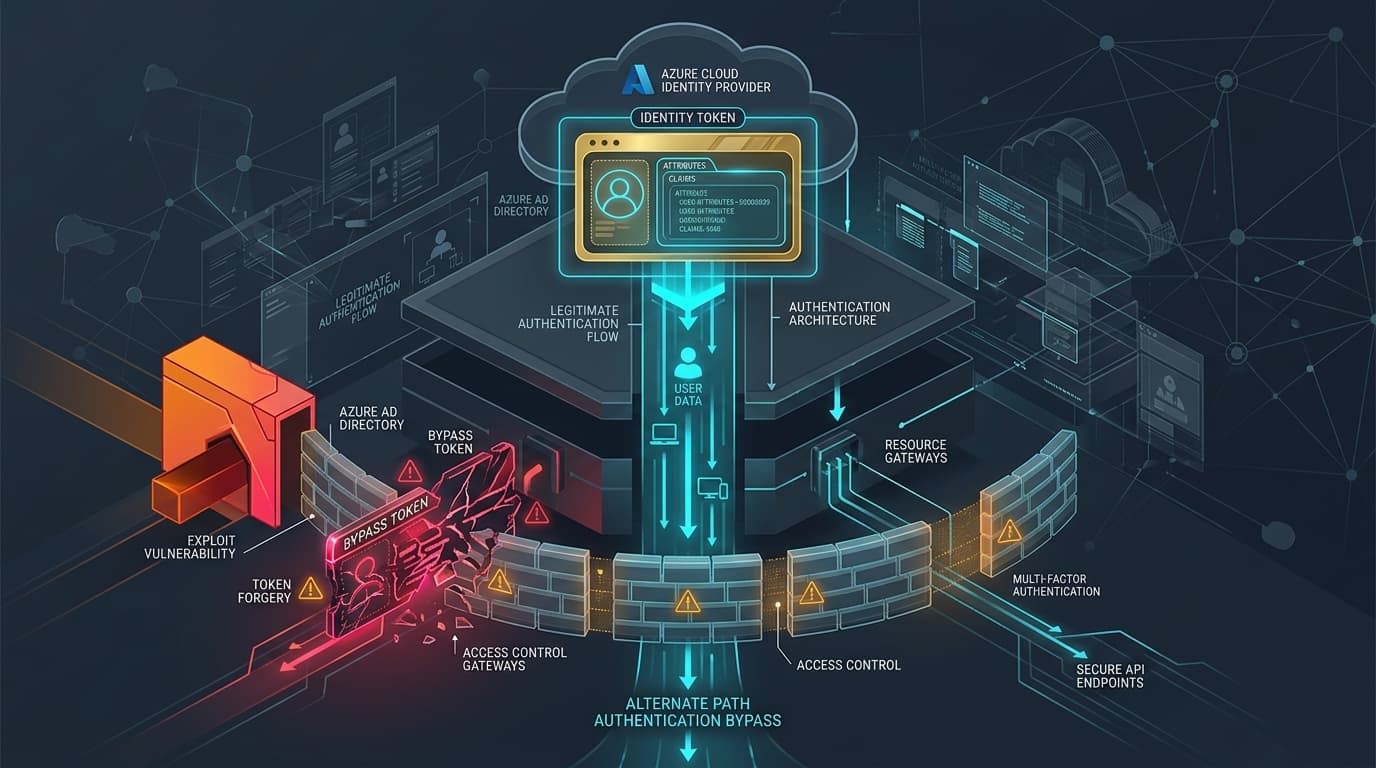
# Architectural flow of the alternate path authentication bypass
[Unauthenticated Attacker]
       │
       ▼ (Directs request to legacy protocol transition endpoint)
[Azure AD B2C Alternate Pipeline (/te/tenant.onmicrosoft.com/B2C_1A_signup_signin/oauth2/v2.0/authorize)]
       │
       ▼ (State correlation token fails cryptographic caller verification)
[Identity Experience Framework Engine]
       │
       ▼ (Bypasses MFA & Password Step; processes ClaimTransformation)
[Signed JWT ID Token Minted with Admin Claims]
       │
       ▼
[Complete Impersonation of Enterprise / Consumer Identity]
Enterprise Blast Radius & CIAM Risk Profile
Unlike enterprise workforce identity systems where employees authenticate against internal Active Directory forests, CIAM environments present distinct threat modeling parameters:
- High-Volume Consumer Account Takeover: Attackers weaponizing CVE-2026-33843 can selectively target executive, administrator, or customer service agent identities across enterprise web portals, bypassing multi-factor authentication (MFA) challenges entirely.
- Federated Cloud API Pivoting: Because Azure AD B2C tokens are frequently validated by microservices and API gateways (such as Azure API Management or Kong) using standard RS256 signature verification, downstream backend APIs accept the forged JWTs as fully authentic, allowing unauthorized data exfiltration from underlying databases.
- Silent Persistence: An adversary who successfully elevates their privileges through the alternate channel can register secondary authenticator methods, establish rogue API keys, or create administrative sub-accounts that persist even after vendor-side mitigation is applied.
Version Comparison & Architecture Matrix
| Identity Service | Component / Profile | Vulnerability Status | CVSS v3.1 Severity |
|---|---|---|---|
| Azure Active Directory B2C | Custom Policies / IEF Alternate Path Handlers | Vulnerable (CWE-288) — Remediated by Microsoft | CVSS:3.1/AV:N/AC:L/PR:N/UI:N/S:U/C:H/I:H/A:N (9.1) |
| Microsoft Entra ID (Standard Workforce) | Core Tenant Authentication Engine | Unaffected | Does not utilize IEF custom user journey broker |
| Azure AD B2C Built-in User Flows | Standard Out-of-Box Sign-in / Sign-up Flows | Protected via Central Microsoft Gateway Update | Backend validation patched |
Defensive Playbook & Actionable Security Audit
Because Azure AD B2C is a cloud-native Software-as-a-Service offering, Microsoft has rolled out the core security fix across its global infrastructure. However, organizations operating custom policies must audit their environments to detect historical exploitation and reinforce their defensive perimeter:
1. Audit Azure AD B2C Sign-In Logs in Microsoft Sentinel
Execute Kusto Query Language (KQL) queries across Azure Log Analytics to identify anomalous authentication events utilizing legacy protocol endpoints:
// KQL query to detect unexpected alternate endpoint logins in Azure B2C
SigninLogs
| where AppDisplayName contains "B2C" or ResourceDisplayName contains "B2C"
| where AuthenticationProcessingDetails has "AlternatePath" or UserAgent has "CustomPolicyCaller"
| project TimeGenerated, Identity, UserPrincipalName, IPAddress, Location, AppDisplayName, Status, AuthenticationRequirement
| order by TimeGenerated desc
2. Restrict Custom Policy Redirect URIs
- Audit Application Registrations: Review all registered OAuth 2.0 / OIDC client applications in the B2C tenant. Remove wildcard redirect URIs (such as
https://*.example.com) that allow token capture via open redirectors. - Validate Token Lifetime Constraints: Reduce Access Token lifetimes to 15–30 minutes and configure Refresh Token revocation upon user role modifications or credential changes.
- Enforce Conditional Access: Mandate Microsoft Entra Conditional Access policies for administrative users accessing Azure management consoles or custom policy editors.