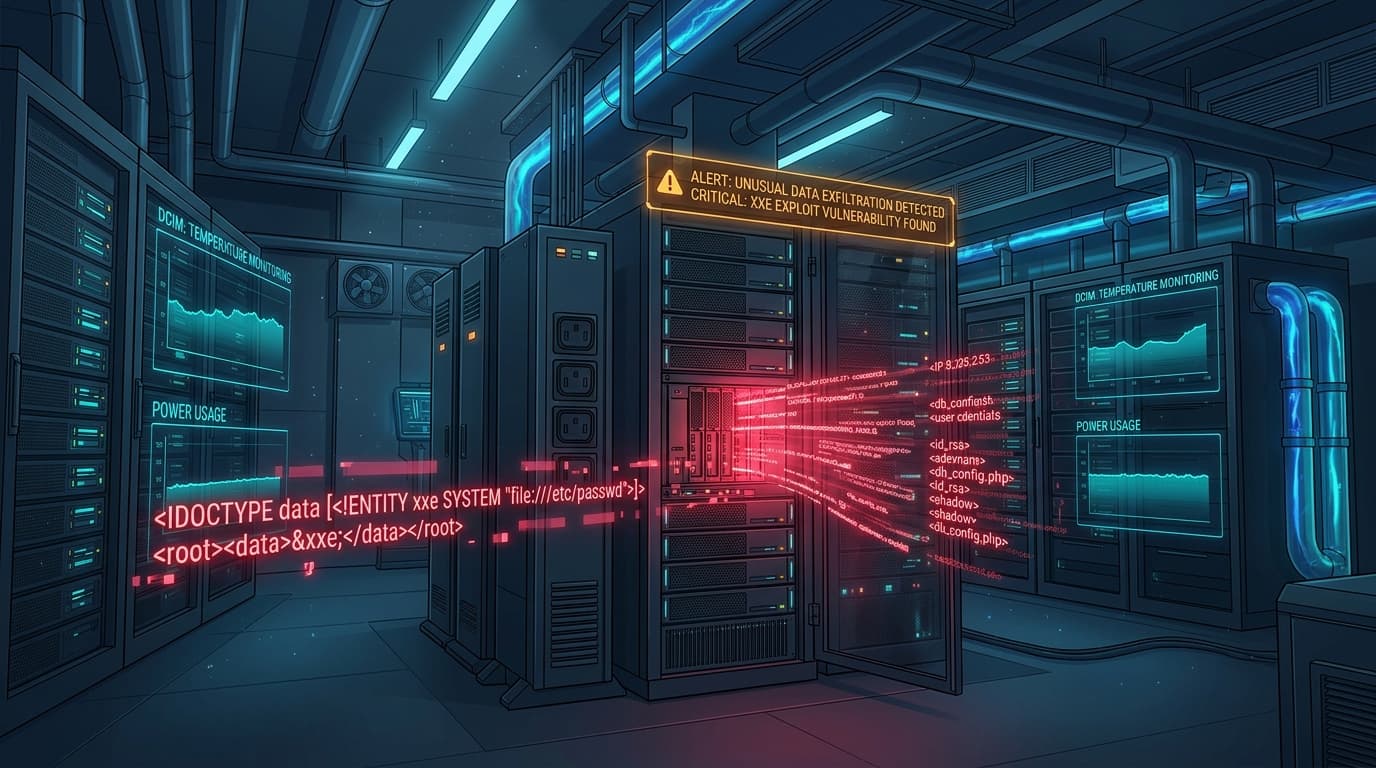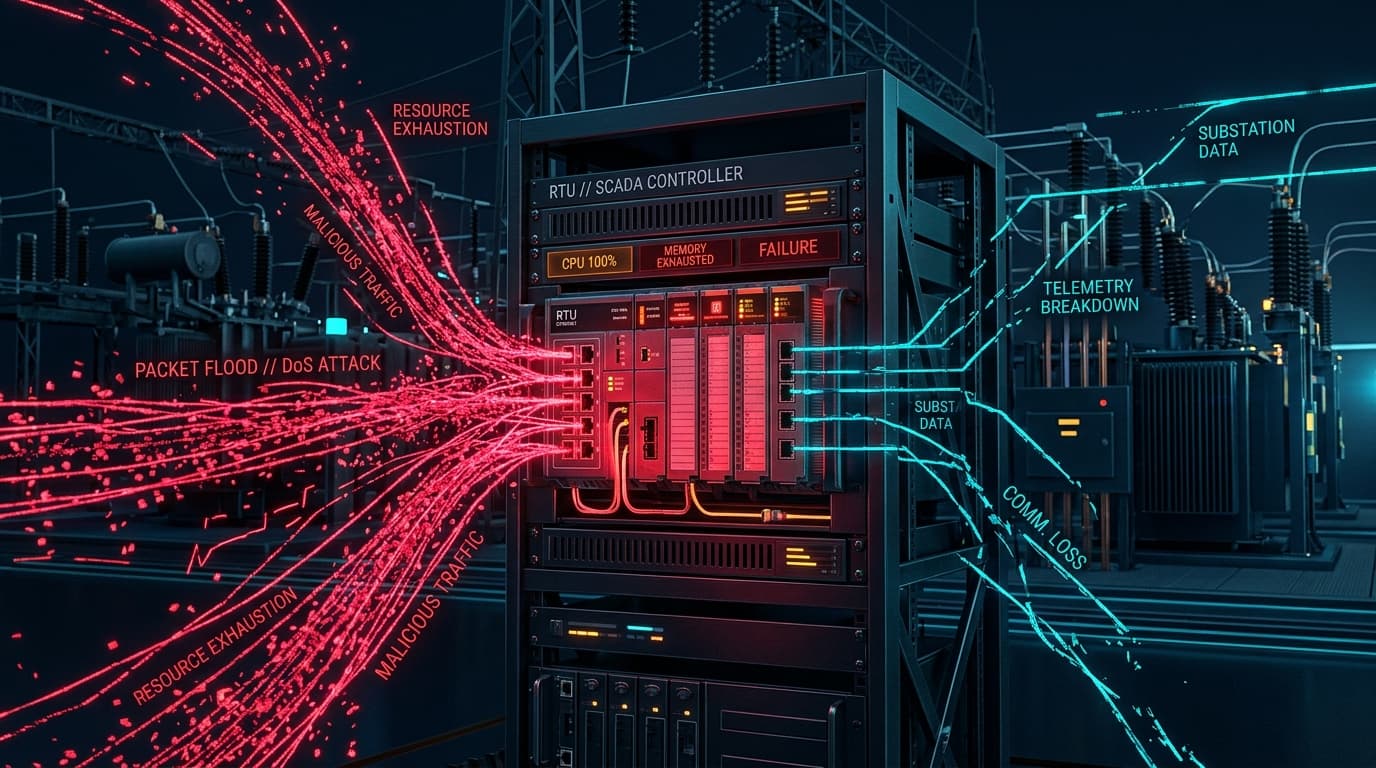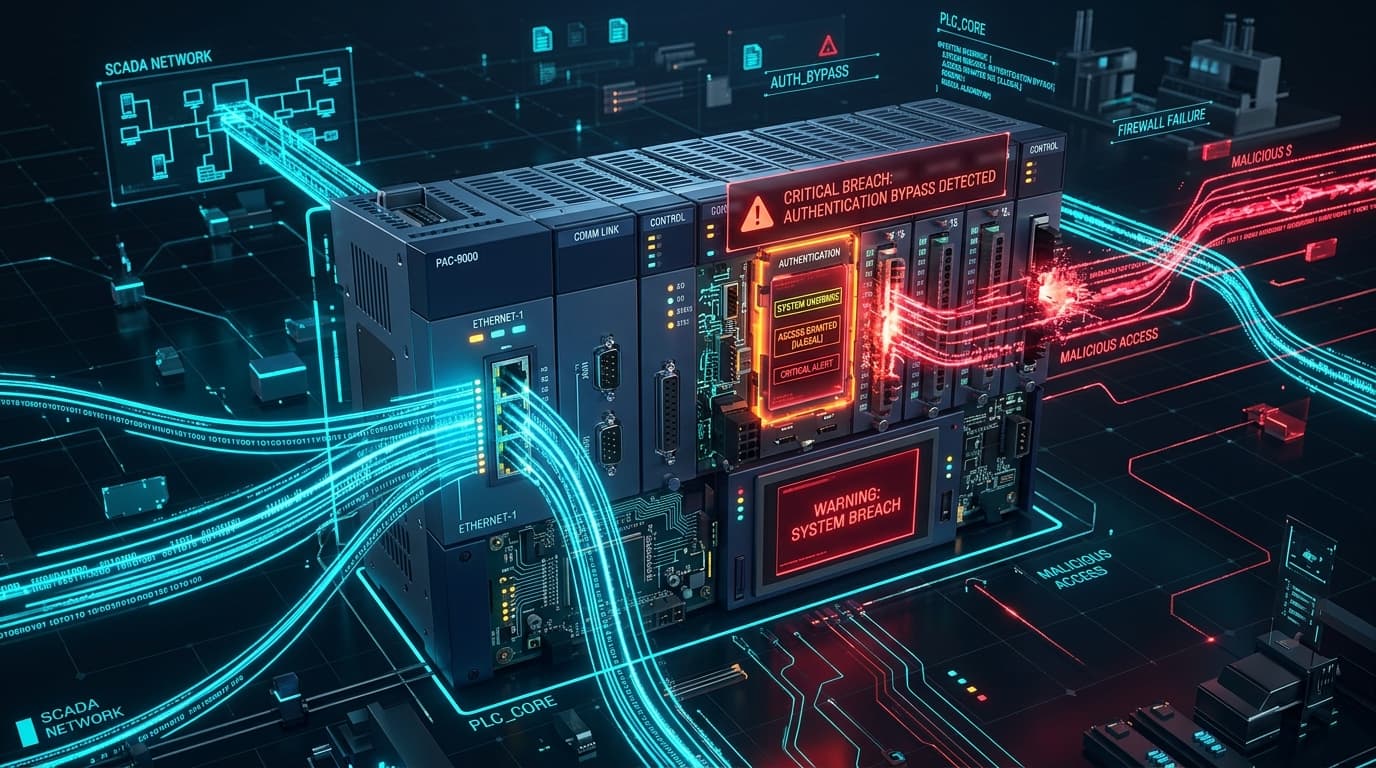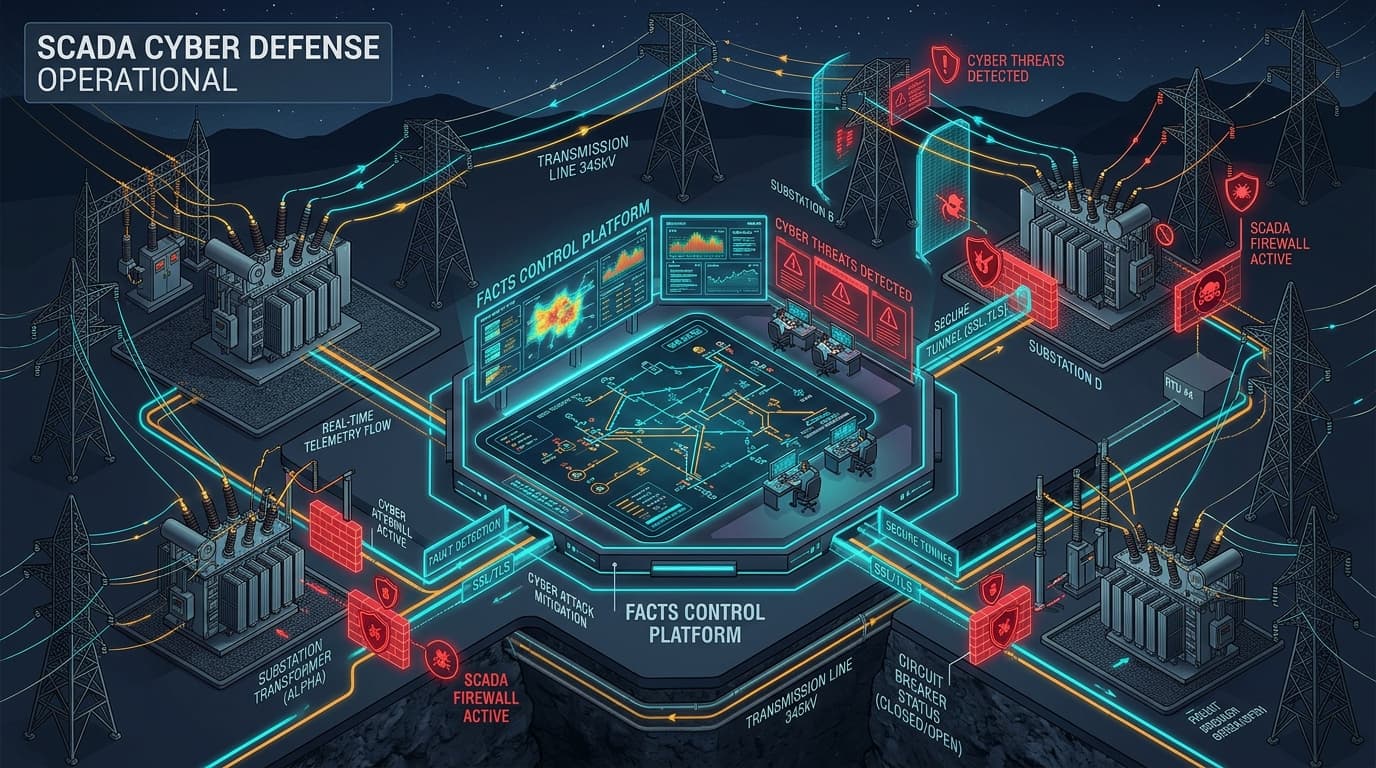
Executive Lead: Critical Flaws in High-Voltage Grid Stabilization Platforms
Hitachi Energy has issued critical cybersecurity advisory 8DBD000229—echoed in international warning ICSA-26-260-03 released by the Cybersecurity and Infrastructure Security Agency (CISA)—disclosing multiple high-impact security vulnerabilities affecting the FACTS Control Platform (FCP). Leading the disclosure is CVE-2024-4872, a flaw carrying a near-maximum Common Vulnerability Scoring System (CVSS v3.1) base score of 9.9 (CVSS:3.1/AV:N/AC:L/PR:N/UI:N/S:C/C:H/I:H/A:H).
Flexible Alternating Current Transmission Systems (FACTS) are mission-critical power electronics platforms deployed across national electrical grids, high-voltage direct current (HVDC) transmission links, offshore wind farm interconnections, and heavy industrial arc furnace installations. The FCP system provides millisecond-level reactive power compensation, active voltage stabilization, and power oscillation damping to prevent cascading grid blackouts. The vulnerabilities reside specifically within the Gateway Service (GWS) component of the platform, enabling unauthenticated remote attackers with IP connectivity to inject arbitrary code into persistent data repositories, traverse restricted file systems, and hijack active operator supervisory sessions without requiring administrative credentials.
Vulnerability Chain & Technical Dissection: FCP Gateway Service (GWS) Breakdown
The FACTS Control Platform utilizes an embedded Gateway Service (GWS) to bridge real-time digital signal processors (DSPs) and programmable logic controllers (PLCs) on the substation bus with higher-level Supervisory Control and Data Acquisition (SCADA) systems and engineering workstations. The security audit identified multiple systemic vulnerabilities across the GWS communication stack:
1. CVE-2024-4872: Remote Code Injection Through Insecure Query Parameter Validation (CVSS 9.9)
Cataloged under CWE-94: Improper Control of Generation of Code ('Code Injection'), the GWS configuration interface exposes an endpoint that processes telemetry query strings and persistent data logging definitions. The input validation routine fails to sanitize special control sequences before concatenating parameters into background administrative scripts and database query routines:
// Decompiled GWS Telemetry Service Ingestion Routine
public void handleTelemetryLogRequest(HttpRequest request, HttpResponse response) {
    String logNamespace = request.getParameter("namespace");
    String filterQuery = request.getParameter("filter_expr");

    // CRITICAL DEFECT: Concatenation without AST parameter binding or strict alphanumeric whitelist
    String executionCommand = "/opt/hitachi/fcp/bin/telemetry_indexer --ns "
        + logNamespace + " --query \"" + filterQuery + "\"";

    // Dispatched directly to underlying OS shell with elevated service privileges
    Process proc = Runtime.getRuntime().exec(new String[]{"/bin/sh", "-c", executionCommand});
}
An unauthenticated network attacker transmitting a crafted HTTP POST request can append shell metacharacters (e.g., ;, &&, or backticks) to break out of the query parameter context and execute arbitrary operating system commands with the privileges of the underlying FCP system account.
2. CVE-2024-3980: Unrestricted Path Traversal in File Retrieval Handlers (CVSS 9.9)
Classified as CWE-22: Improper Limitation of a Pathname to a Restricted Directory ('Path Traversal'), the file retrieval mechanism in the GWS web service allows remote adversaries to pass dot-dot-slash (../../) sequences in HTTP GET requests. This allows an attacker to download arbitrary files from the host operating system, including industrial network topology maps, SSL private keys, PLC firmware image binaries, and stored authentication hashes.
3. CVE-2024-7940: Unauthenticated Local Service Exposure Across All Interfaces (CVSS 8.3)
Under CWE-306: Missing Authentication for Critical Function, internal diagnostics and configuration endpoints intended exclusively for local loopback (127.0.0.1) binding were mistakenly bound to 0.0.0.0, exposing sensitive management interfaces across all physical network adapters.
Impact on Industrial Power Grids & IEC 62443 Compliance
Under the IEC 62443-3-3 standard governing Industrial Automation and Control Systems (IACS), FACTS controllers are classified as critical safety and operational assets requiring Security Level 3 (SL-3) or Security Level 4 (SL-4) protection:
- Reactive Power Grid Sabotage: By executing arbitrary code on the FCP host, an adversary can manipulate thyristor-switched capacitors (TSC) and static synchronous compensators (STATCOM). Injecting invalid control setpoints can trigger catastrophic overvoltage events or trip transmission line protection relays, resulting in widespread regional blackouts.
- Substation Network Pivoting: Compromise of the GWS gateway gives an attacker dual-homed access between Purdue Model Level 3 (Substation LAN) and Level 2 (Process LAN), allowing direct lateral movement to IEC 61850 GOOSE and SV bus networks.
- Firmware and Logic Manipulation: Attackers can overwrite protection curves and automated fault-ride-through (FRT) parameters, blinding operators during transient power surges.
Affected Software Builds & Component Matrix
| Platform | Vulnerable Versions (with GWS) | Fixed Release Status | Impact Without GWS |
|---|---|---|---|
| FACTS Control Platform (FCP) 3.x | 3.4.0, 3.7.0, 3.8.0, 3.10.0, 3.12.0, 3.14.0, 3.15.0 | Mitigation Advisory 8DBD000229 applied | Unaffected if GWS is not installed |
| FACTS Control Platform (FCP) 4.x | 4.0.0, 4.0.1, 4.1.0, 4.1.1 | Mitigation Advisory 8DBD000229 applied | Unaffected if GWS is not installed |
| FCP Gateway Service (GWS) | All standalone releases prior to September 2026 update | Patch update via Hitachi Energy Service Portal | Critical component affected |
Remediation Playbook & Grid Defense Engineering
1. Immediate Substation Perimeter Firewall Lockdown
Because Hitachi Energy has advised that complete firmware replacements require scheduled outage windows, utilities must immediately enforce strict network segregation at the substation firewall boundary. Block all incoming TCP traffic to GWS ports (HTTP 80/443 and proprietary management ports 8080/8443) from non-engineering IP addresses:
# Substation boundary firewall policy (FortiGate / Cisco ISA 3000)
config firewall policy
    edit 101
        set name "BLOCK_EXTERNAL_FCP_GWS"
        set srcintf "wan_substation"
        set dstintf "ot_process_lan"
        set srcaddr "all"
        set dstaddr "FCP_GWS_Appliances"
        set service "HTTP" "HTTPS" "TCP_8080" "TCP_8443"
        set action drop
        set logtraffic all
    next
end
2. Disable Unnecessary GWS Service Instances
For FCP installations where remote engineering access via GWS is not strictly required during continuous operations, stop and disable the GWS daemon on the control server:
# Check GWS service status on FCP Linux host
systemctl status hitachi-fcp-gws.service

# Stop and mask the service to prevent automated startup
systemctl stop hitachi-fcp-gws.service
systemctl mask hitachi-fcp-gws.service
3. Enforce Unidirectional Security Gateways (Data Diodes)
In accordance with IEC 62443-3-2 conduit requirements, transmit FCP telemetry to central SCADA and enterprise historian networks exclusively across hardware-enforced unidirectional security gateways (data diodes), preventing any incoming TCP/IP packets from reaching the FCP controller.
Forensic Indicators & Threat Telemetry
| Log Source | Signature / Pattern | Severity |
|---|---|---|
| GWS Web Server Access Logs | HTTP requests containing ..%2f or shell characters in query strings |
Critical |
Linux Auditd Logs (/var/log/audit/audit.log) |
Child process invocations (sh, bash, nc) originating from GWS process PID |
Critical |
| Substation Switch NetFlow | Anomalous inbound TCP sessions to FCP controllers from non-engineering subnet IPs | High |