Executive Summary: India's Privacy Enforcement Architecture Takes Shape
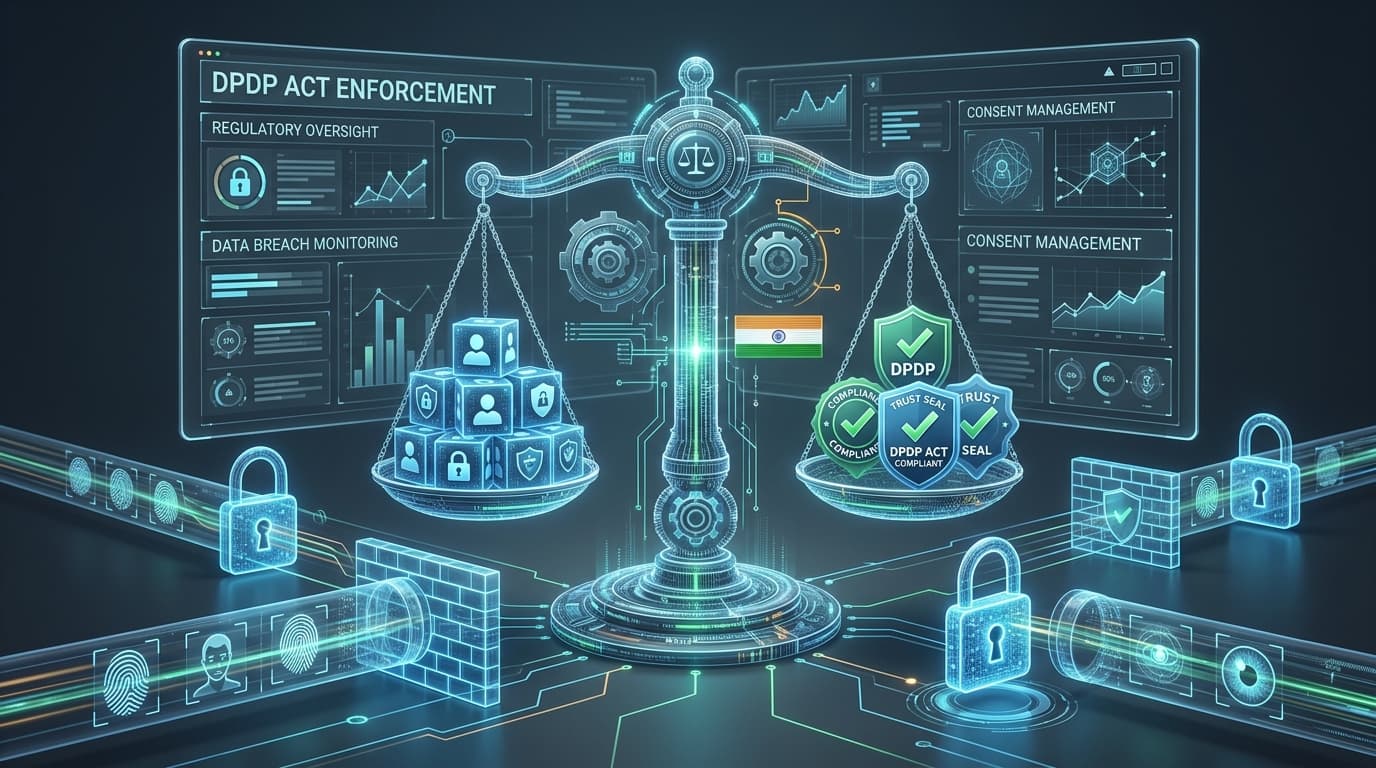
In a milestone development for global data privacy and enterprise cybersecurity governance, the Data Protection Board of India (DPBI)—operating under the statutory authority of the Digital Personal Data Protection (DPDP) Act, 2023 and the finalized DPDP Rules, 2026—has formally operationalized its institutional inquiry mechanisms, civil adjudication procedures, and monetary penalty guidelines.
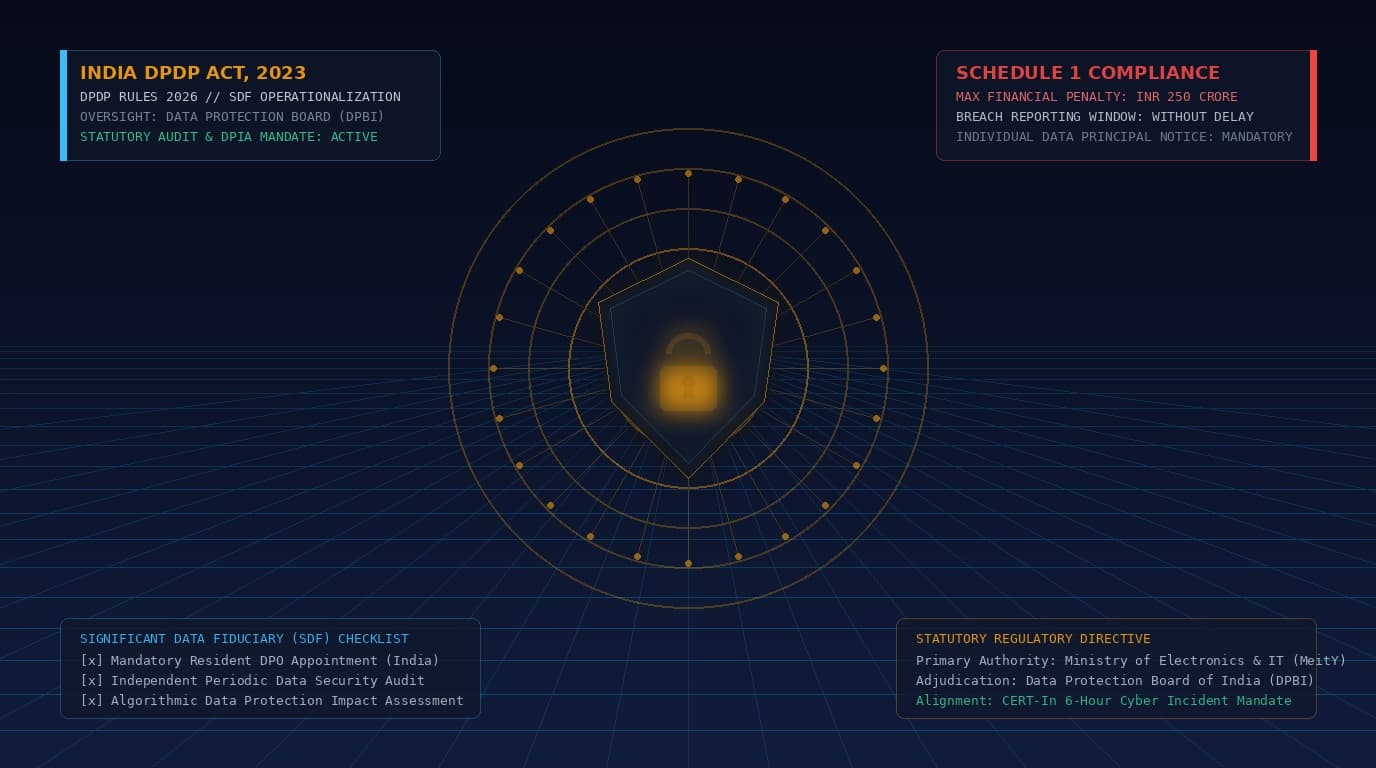
The operationalization of the DPBI marks the definitive transition from legislative debate to active regulatory enforcement. Under Section 33 and the Schedule of the DPDP Act, the Board is empowered to conduct inquiries into personal data breaches, investigate citizen complaints, inspect corporate data handling practices, and levy substantial civil financial penalties—reaching up to ₹250 Crore (approximately $30 million USD) per violation.
With all enterprises processing digital personal data of Indian citizens required to achieve compliance, the Board's directives impose strict technical and operational mandates. Chief Information Security Officers (CISOs), Data Protection Officers (DPOs), and general counsel must align corporate data architectures with the DPBI's digital-by-design enforcement model, establishing rigorous incident notification pipelines and verifiable security safeguards.
Statutory Penalty Matrix: Tiered Financial Liabilities Under the Schedule
Unlike previous regulatory frameworks that relied on criminal sanctions or ill-defined compensation caps, the DPDP Act establishes a deterministic, non-compensatory civil penalty structure. All penalties levied by the Board are directly credited to the Consolidated Fund of India.
The Board determines the quantum of monetary penalties based on statutory assessment criteria outlined in Section 33(2), including the nature, gravity, and duration of the breach; the type and volume of personal data exposed; whether the violation was repetitive; the financial gains realized or losses avoided; and the timeliness and effectiveness of mitigation measures undertaken by the entity.
| Violation Classification | Governing Section | Maximum Penalty Cap |
|---|---|---|
| Failure to Implement Reasonable Security Safeguards (Resulting in a personal data breach) |
Section 8(5) / Schedule 1 | Up to ₹250 Crore (~$30,000,000 USD) |
| Failure to Notify Board or Data Principals of Breach (Breach notification omission or delay) |
Section 8(6) / Schedule 2 | Up to ₹200 Crore (~$24,000,000 USD) |
| Violation of Obligations in Relation to Children (Tracking, behavioral profiling, or targeted ads) |
Section 9 / Schedule 3 | Up to ₹200 Crore (~$24,000,000 USD) |
| Non-Compliance with Significant Data Fiduciary Mandates (DPO appointment, DPIA audits, periodic reviews) |
Section 10 / Schedule 4 | Up to ₹150 Crore (~$18,000,000 USD) |
| General Breach of Any Other Provision of Act/Rules | Residual / Schedule 5 | Up to ₹50 Crore (~$6,000,000 USD) |
Mandatory Breach Notification Protocol: Two-Track Disclosure Regime
Section 8(6) of the DPDP Act mandates that in the event of a personal data breach, the Data Fiduciary must give the Board and each affected Data Principal intimation of such breach in such form and manner as prescribed under the DPDP Rules.
1. Intimation to the Data Protection Board
Under the DPDP Rules 2026, the notification to the DPBI must be submitted via the Board's digital portal without undue delay. The initial incident submission must encompass:
- Nature and Scope: The technical description of the incident (e.g., unauthorized database exfiltration, ransomware encryption, misconfigured cloud storage, credential stuffing).
- Data Categories & Volume: The categories of personal data compromised (e.g., Aadhaar numbers, PAN identifiers, biometric data, financial transaction history, healthcare records) and estimated count of impacted Data Principals.
- Root Cause Assessment: Initial forensic determination regarding the attack vector, compromised credentials, or software vulnerability exploited.
- Remediation Actions: Technical countermeasures deployed to contain the breach, isolate affected servers, revoke compromised session tokens, and rotate cryptographic keys.
2. Direct Notification to Data Principals
Crucially, the DPDP framework departs from jurisdictions that permit quiet regulatory-only disclosures. Fiduciaries must notify affected individuals directly in clear, plain language across verified communication channels (SMS, registered email, or authenticated in-app messaging):
# Mandatory Elements for Data Principal Breach Notifications:
1. Clear description of the cybersecurity incident and date of occurrence.
2. Specific categories of the individual's personal data compromised.
3. Potential operational, financial, or identity risks confronting the Data Principal.
4. Concrete protective measures recommended for the individual (e.g., password reset,
   credit monitoring, two-factor authentication re-enrollment).
5. Dedicated contact details of the Data Protection Officer (DPO) or grievance redressal officer.
# Architectural Flow of DPBI Breach Intake & Adjudication:
[ Personal Data Breach Occurs ] (e.g., S3 Bucket Leak / Ransomware Extortion)
│
├─► Within Prescribed Window: Automated Breach Pipeline Triggered
│
├─► [ Submission to DPBI Digital Portal ]
│ ├─ Forensic Root Cause Analysis
│ ├─ Volume & Categories of Impacted Data Principals
│ └─ Containment & Remediation Artifacts
│
├─► [ Direct Notification to Data Principals ]
│ ├─ Clear, plain-language advisory sent via SMS/Email
│ └─ Remedial security advice & DPO contact channels
│
▼
[ DPBI Adjudication Process (Section 33) ]
├─ Virtual Digital Hearings & Evidentiary Inquiries
├─ Statutory Mitigation Assessment (Section 33(2))
└─ Issuance of Binding Order & Civil Penalties (Up to ₹250 Crore)Synergy with Sectoral Regulations: Harmonizing DPDP and RBI Mandates
For banks, non-banking financial companies (NBFCs), and fintech payment aggregators, compliance with the DPDP Act must be synchronized with existing Reserve Bank of India (RBI) directions. Under the RBI Cyber Security Framework in Banks (CSFB) and the Master Direction on Information Technology Governance, financial institutions are obligated to report cybersecurity incidents to CSIRT-Fin / CERT-In within 6 hours of detection.
Enterprise compliance offices must establish a unified incident response taxonomy to ensure that rapid 6-hour CERT-In incident notifications do not conflict with subsequent formal DPBI personal data breach submissions.
Defensive Playbook: Enterprise Compliance Roadmap
Security and compliance leaders operating within the Indian jurisdiction should execute the following five-stage technical preparedness roadmap:
1. Automated Personal Data Discovery & Mapping
Deploy automated data posture discovery tools to map data flows, identify shadow databases, catalog S3/Blob storage buckets, and classify personal data assets across multi-cloud environments:
# Example policy: Audit AWS S3 buckets for unencrypted personal data in Indian region
aws s3api list-buckets --output text --query 'Buckets[*].Name' | tr '	' '
' | grep -E 'india|in-' | while read bucket; do
    echo "[*] Checking Encryption for Bucket: $bucket"
    aws s3api get-bucket-encryption --bucket "$bucket" 2>&1 | grep -q "ServerSideEncryptionConfiguration" || echo "[!] WARNING: Unencrypted bucket detected: $bucket"
done
2. Formalize Significant Data Fiduciary (SDF) Governance
Entities designated as Significant Data Fiduciaries must appoint an India-based Data Protection Officer (DPO) who reports directly to the Board of Directors, engage independent data auditors to conduct annual Data Protection Impact Assessments (DPIA), and document consent lifecycles.
Actionable Checklist for Enterprise CISOs & DPOs
- Institute 24/7 Incident Escalation: Ensure Security Operations Center (SOC) playbooks include predefined triggers for immediate legal and DPO notification upon confirming exfiltration of personal records.
- Deploy Client-Side Consent Architecture: Replace pre-ticked consent boxes with clear, itemized consent notices available in English and all 22 languages specified in the Eighth Schedule to the Constitution of India.
- Implement Hardware-Backed Encryption: Store personal data at rest using AES-256 with keys managed in dedicated Hardware Security Modules (HSMs) with strict access logging.
- Audit Third-Party Data Processors: Review vendor outsourcing contracts to mandate immediate contractual breach disclosure within 2 hours of processor compromise.