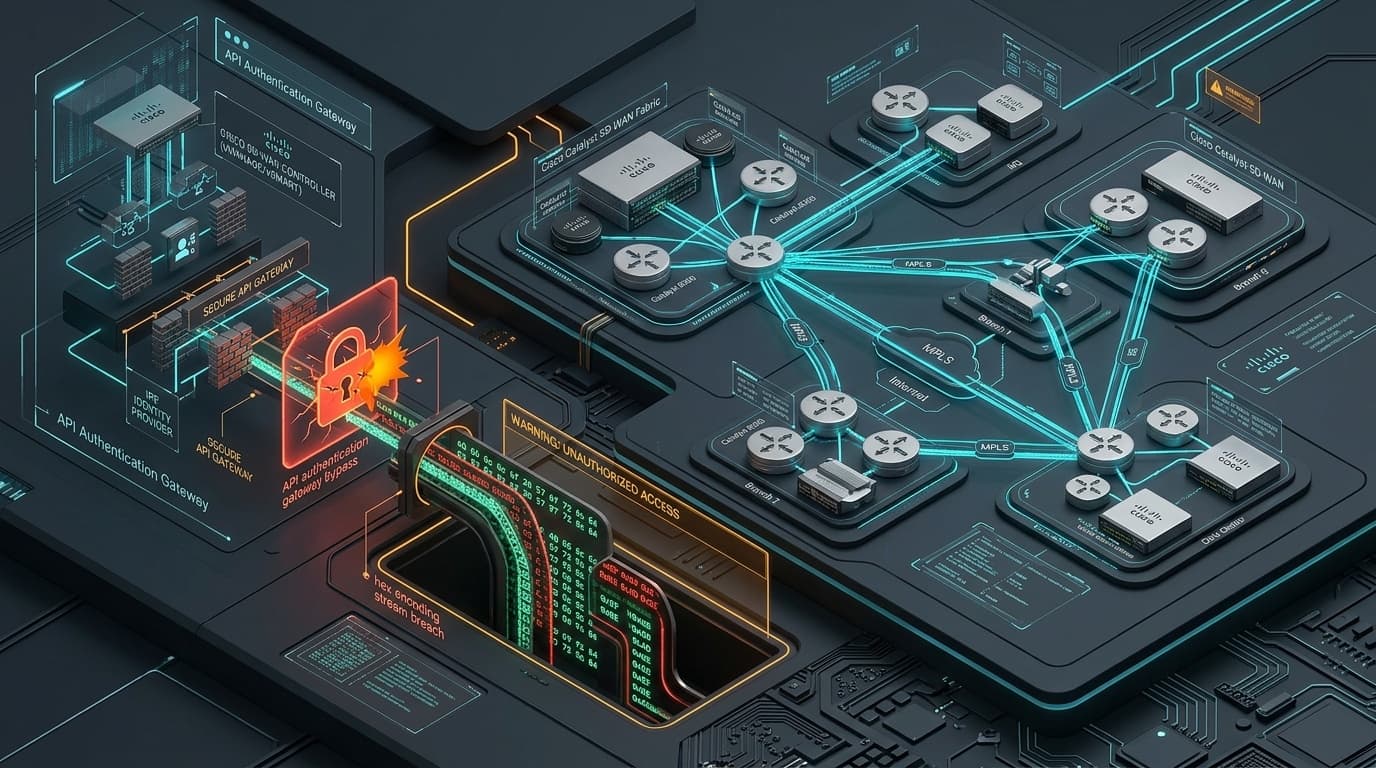
Cisco Systems has issued an emergency security advisory detailing a maximum-severity authentication bypass vulnerability (CVE-2026-76504, CVSS 9.8) impacting Cisco Catalyst SD-WAN Manager (formerly Cisco vManage). The flaw allows unauthenticated remote attackers to bypass the application's central access control gate and interact directly with internal administrative APIs. Telemetry confirms active threat actor exploitation in the wild, targeting enterprise edge routers, financial branch offices, and government communications backbones.
Vulnerability Breakdown: Hex Encoding Parser Discrepancy (CWE-287)
Cisco Catalyst SD-WAN Manager orchestrates edge SD-WAN routers across corporate wide-area networks. Its architecture uses an internal reverse proxy to inspect incoming HTTP requests and enforce Java EE role-based authentication before dispatching requests to core microservices.
Under CVE-2026-76504, the front-end reverse proxy and the backend REST API engine evaluate URL encoding inconsistently. When processing multi-byte hexadecimal character sequences (e.g., %252f or non-canonical hex representations), the front-end filter normalizes the request string only once, treating the URI as an unprivileged public resource.
Upon reaching the secondary API dispatcher, the string undergoes a second unescaping pass:
# Attacker request utilizing double-hex encoded directory separators
GET /dataservice/%252f%252fadmin%252fdevice%252faction%252finstall HTTP/1.1
Host: sdwan-manager.corp.internal
User-Agent: Mozilla/5.0
Accept: application/json
Content-Type: application/json

# Result: Security filter evaluates path as benign; backend routes to privileged install action
Because the authentication interceptor is bypassed, the request executes with root administrative permissions, allowing adversaries to modify BGP route tables, push malicious container overlays to edge vEdge/cEdge routers, and capture cleartext branch traffic.
CVSS v3.1 & v4.0 Technical Scoring Matrix
| Security Metric | CVSS Vector Specification | Value |
|---|---|---|
| Attack Vector | Network (AV:N) | Remote, unauthenticated over TCP 443 / 8443 |
| Attack Complexity | Low (AC:L) | No specialized environment or race conditions required |
| Privileges Required | None (PR:N) | Direct unauthenticated API execution |
| Scope Impact | Unchanged (S:U) / Critical Confidentiality & Integrity | Complete administrative takeover of SD-WAN fabric |
Threat Hunting: Identifying Exploitation via Log Telemetry
Security operations centers (SOCs) should inspect Nginx access logs and Java container logs (/var/log/nms/vmanage-server.log) for non-standard hex characters in authentication requests:
# Splunk query to detect SD-WAN hex-encoding bypass probes
index=cisco_sdwan sourcetype=vmanage_access
| regex uri=".*(%252f|%255c|%2e%2e).*j_security_check.*"
| table _time, src_ip, uri, status, user_agent
Defensive Remediation Checklist
- Apply Cisco Maintenance Release: Immediately upgrade Cisco Catalyst SD-WAN Manager to version 20.12.3, 20.9.6, or 20.15.1.
- Restrict Management Access: Never expose SD-WAN Manager web interfaces directly to the public internet. Restrict port 8443 access exclusively to dedicated management VLANs and VPNs protected by hardware MFA.
- Revoke & Reissue Device Certificates: If unexpected administrative API access is identified in access telemetry, regenerate the SD-WAN root enterprise certificate and revoke compromised edge device tokens.