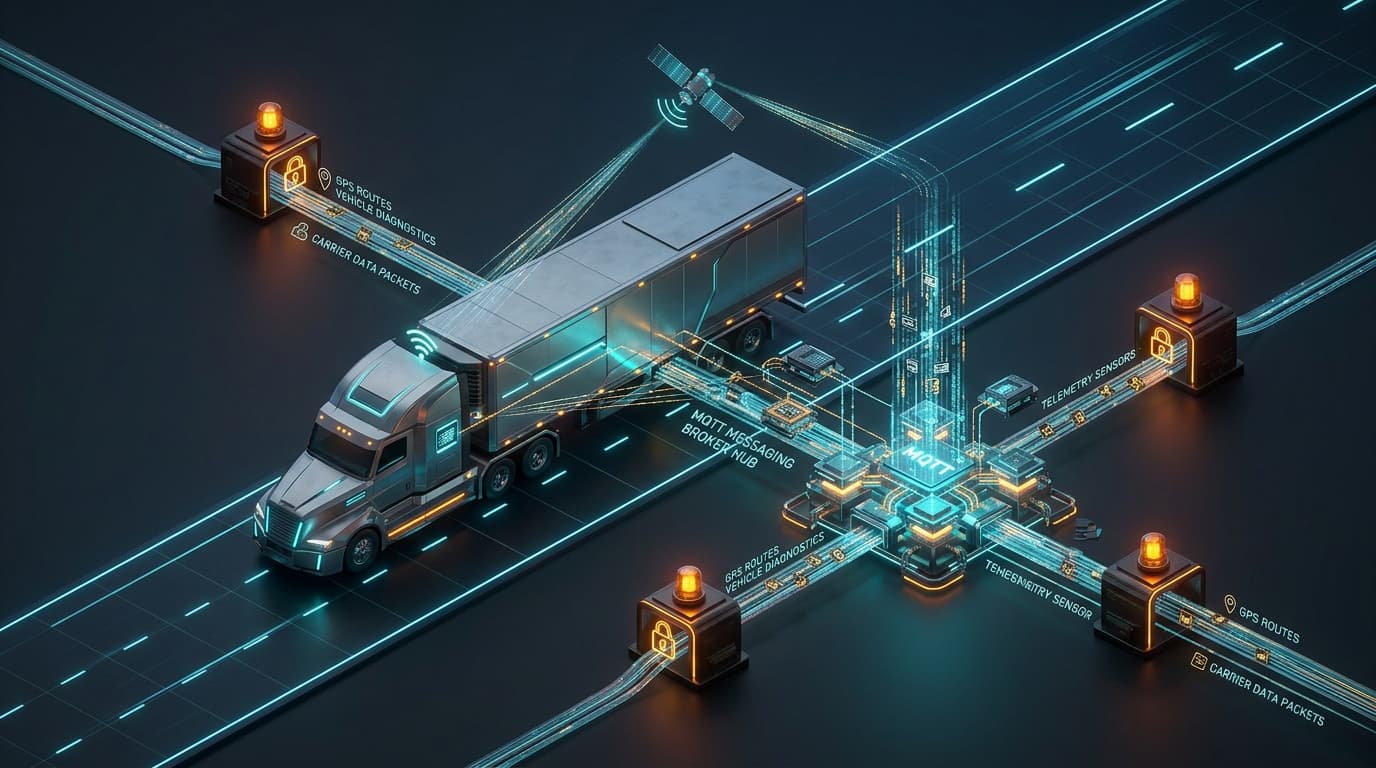
Executive Lead: Commercial Freight Fleet Telematics Exposed to Eavesdropping
The Cybersecurity and Infrastructure Security Agency (CISA) has released an urgent Industrial Control Systems (ICS) cybersecurity advisory, cataloged as ICSA-26-260-01, detailing critical security vulnerabilities affecting Bransys Electronic Logging Devices (ELD) and their companion mobile fleet management software. The disclosure is led by CVE-2026-86520 (CVSS v3.1: 7.5), an authentication failure arising from the embedding of static, hardcoded credentials for central Message Queuing Telemetry Transport (MQTT) message brokers.
Accompanying the primary credential defect are CVE-2026-86689 (Cleartext Transmission of Sensitive Information, CWE-319) and CVE-2026-77960 (Inadequate Encryption Strength, CWE-326). Together, these vulnerabilities allow unauthenticated remote adversaries anywhere in the world to connect directly to centralized cloud MQTT brokers and intercept continuous telemetry broadcasts from commercial tractor-trailers, delivery fleets, and intermodal transport carriers.
Electronic Logging Devices are legally mandated by the U.S. Federal Motor Carrier Safety Administration (FMCSA) and European transport safety authorities to record commercial drivers' Hours of Service (HOS), engine operational hours, and driving duty status. Because these devices interface directly with the vehicle's internal Controller Area Network (CAN) bus (via J1939 or OBD-II ports) and stream data through cellular and mobile bridges, a security breakdown threatens supply chain visibility, driver safety, and corporate operational security.
Architecture Breakdown: The Role of ELD Devices in Modern Supply Chains
Modern fleet telematics systems rely on a hybrid operational architecture bridging automotive operational technology (OT) with enterprise cloud analytics:
- Vehicle CAN Interface (J1939 / J1708): The physical ELD hardware plugs into the diagnostic port of the commercial heavy-duty vehicle, continuously capturing engine revolutions (RPM), odometer mileage, vehicle speed, fuel consumption, and brake telemetry.
- Mobile Gateway (Bluetooth / Wi-Fi): The ELD hardware transmits raw telematics data locally to a tablet or smartphone running the Bransys ELD mobile application inside the truck cab.
- Cloud Telematics Ingestion (MQTT over TLS): The mobile application processes the raw stream and publishes structured JSON telemetry packets to centralized carrier MQTT brokers, where fleet dispatchers monitor vehicle locations and compliance dashboards in real time.
+-----------------------------------------------------------------------------------------+
|                       BRANSYS FLEET TELEMATICS ARCHITECTURE                             |
+-----------------------------------------------------------------------------------------+
| Heavy Commercial Vehicle        Truck Cab Mobile App          Central Telematics Cloud   |
| [Engine ECM / J1939 CAN] ---> [Bransys ELD Mobile] -------> [MQTT Message Broker]       |
|    Vehicle Speed, RPM,           Bluetooth / Wi-Fi              topics: fleet/+/telemetry|
|    Braking & Diagnostics                                                |               |
|                                                                         v               |
|                                                               [Adversary Infiltration]  |
|                                                               Hardcoded Credentials     |
|                                                               Subscribes to All Topics! |
+-----------------------------------------------------------------------------------------+
Vulnerability Mechanics: Static MQTT Secrets & Unencrypted Broadcasts
The core defect, CVE-2026-86520, is categorized under CWE-798 (Use of Hard-coded Credentials). Reverse engineering of the Bransys ELD mobile application packages revealed that client authentication tokens, MQTT usernames, and static passwords were hardcoded in plain text within decompiled application source code and resource files:
// Decompiled snippet illustrating static credentials in telematics client:
public class MqttBrokerConfig {
    public static final String BROKER_URL = "ssl://telematics.carrier-hub.com:8883";
    public static final String DEFAULT_CLIENT_ID = "bransys_client_shared";
    public static final String AUTH_USER = "fleet_telematics_global";
    public static final String AUTH_PASS = "Br@nsys_MQTTHub_2026!"; // HARDCODED SECRET
    public static final String TOPIC_WILDCARD = "carriers/+/vehicles/+/telemetry";
}
Because the broker configuration permitted any authenticated client using this shared credential to subscribe to wildcard topics (such as carriers/+/vehicles/+/telemetry or fleets/+/status), an attacker extracting this credential from a single mobile APK or iOS IPA package can issue an MQTT SUBSCRIBE command and harvest real-time messages from thousands of independent trucks across diverse shipping carriers.
Furthermore, under CVE-2026-86689, secondary diagnostic endpoints failed to enforce TLS encryption, broadcasting vehicle diagnostic trouble codes (DTC) and driver duty logs over unencrypted HTTP channels. CVE-2026-77960 documented the use of weak cryptographic keys for local data caching, enabling local attackers with physical access to an operator tablet to extract historical GPS route logs.
Exploitation Scenario: Cargo Piracy, Fleet Sabotage & Corporate Espionage
The operational implications of compromised commercial fleet telematics extend far beyond standard software data leaks:
- Targeted Cargo Theft and Supply Chain Hijacking: Organized crime syndicates targeting high-value freight (pharmaceuticals, electronics, luxury goods, munitions) can track specific shipping routes in real time. Knowing exact GPS positions, scheduled rest-stop locations, and driver mandatory off-duty rest cycles enables pinpoint physical hijacking.
- Competitive Intelligence & Industrial Espionage: Competitors or nation-state adversaries can analyze carrier traffic density, freight movement velocities, delivery destinations, and distribution hub throughput, deriving sensitive economic intelligence on industrial supply chains.
- Driver Privacy and Safety Violations: Continuous location tracking compromises driver safety and personal privacy, exposing operator identification numbers, licensing information, and historical travel records.
Technical Vulnerability & Version Matrix
| Identifier | Vulnerability Type | CWE ID | Affected Releases | Remediated Version |
|---|---|---|---|---|
| CVE-2026-86520 | Hardcoded MQTT Credentials | CWE-798 | Android < 11.00.00 / iOS < 1.1.54 | Android 11.00.00 / iOS 1.1.54+ |
| CVE-2026-86689 | Cleartext Sensitive Transmission | CWE-319 | Android < 11.00.00 / iOS < 1.1.54 | Enforced TLS 1.3 / HTTPS |
| CVE-2026-77960 | Inadequate Encryption Strength | CWE-326 | Android < 11.00.00 / iOS < 1.1.54 | AES-256-GCM Keystore Storage |
| CISA Advisory | ICSA-26-260-01 | ICS-CERT | Global Commercial Fleet Deployments | Official CISA ICS Notice Published |
Fleet Defense & Telematics Hardening Playbook
Fleet managers, logistics operators, and IoT cybersecurity engineers must implement the following multi-tiered mitigation strategy aligned with the IEC 62443 industrial cybersecurity standard:
1. Immediate Client Application Updates
Enforce mandatory updates across all enterprise mobile device management (MDM) profiles managing truck-in-cab tablets and smartphones:
- Update Bransys ELD for Android to version 11.00.00 or later through Google Play or enterprise MDM sideloading.
- Update Bransys ELD for iOS to version 1.1.54 or later via the Apple App Store.
- Verify that older application versions are blacklisted from connecting to enterprise carrier networks.
2. Reconfigure MQTT Broker Access Control Lists (ACLs)
Decommission shared, hardcoded credentials on the MQTT broker immediately. Transition to per-device, dynamic credentials with granular topic authorization rules:
# Mosquitto / EMQX Broker ACL Policy Example:
# Prohibit wildcard topic subscriptions across untrusted mobile clients
topic readwrite carriers/%u/telemetry

# Deny global wildcard listening
pattern deny carriers/+/vehicles/+/telemetry
pattern deny #

# Enforce client certificate validation (Mutual TLS)
listener 8883
require_certificate true
use_identity_as_username true
cafile /etc/telematics/certs/ca.crt
certfile /etc/telematics/certs/broker.crt
keyfile /etc/telematics/certs/broker.key
3. Enforce Mutual TLS (mTLS) and Hardware Keystore Backing
Under IEC 62443-3-3 (System Security Requirements), industrial telematics streams must be bound to cryptographic identity tokens rooted in hardware:
- Generate unique client private keys inside the Android Hardware-backed Keystore or iOS Secure Enclave.
- Ensure private keys are non-exportable and authenticate via ephemeral X.509 client certificates signed by an internal intermediate Certificate Authority (CA).
- De-provision client certificates immediately upon driver reassignment or vehicle retirement.
4. Network Segmentation & Purdue Model Boundary Controls
Commercial fleet operations center dispatch networks should treat incoming vehicle telematics connections as external, untrusted traffic:
- Terminate MQTT telemetry connections in an isolated DMZ (Purdue Level 3.5).
- Sanitize and validate all incoming payload schemas before routing telematics records to internal enterprise resource planning (ERP) or warehouse management systems (WMS).
- Implement anomaly detection rules to flag unusual topic subscription requests or sudden spikes in telemetry polling from single IP addresses.